
How Do You Build a Business That Can Run Without You?
How I went from coaching clients to building The Coaching Institute, and what replacing myself actually involved.
I became a coach because I wanted to help myself. At the time, I was considering hiring a coach, and somewhere in that decision I became curious about learning the work myself. I wanted access to the materials behind the scenes. If something could help me change, I wanted to understand why it worked, how it worked and what else might become possible.
I had spent much of my life being pretty miserable. I didn’t really know how to be happy, and I wanted to explore what it would take to become my favourite self. How do we lead an extraordinary life? What helps someone move beyond the ways they’ve learned to survive and begin living in a way they actually enjoy? Those questions fascinated me. They still do.
That was the beginning of a business that eventually became far bigger than anything I had imagined. There was no grand plan for a coaching school when I started in 2003. There was me, learning about human behaviour, trying to change my own life and figuring out how to find clients.
How did I grow my coaching business?
In the beginning, I spent a lot of time trying to get clients. I was doing the networking, having the conversations and looking for opportunities, but my attention was on whether someone would become a client. That made every interaction carry a little more weight than it needed to.
Gradually, I stumbled into a different way of approaching it. When I gave the best of what I had in a conversation, a workshop or a networking event, people responded. I could help someone think differently, understand something they’d been struggling with or see a possibility they hadn’t considered. The conversation itself could be useful, whether or not anything happened afterwards.
That became my approach to business. Give people something worthwhile. Find out about them. If there was a genuine match between what they wanted and what I could offer, we could work together.
In my first year, I did around $25,000. In my second, around a quarter of a million dollars. By my third year, I was doing over a million (the business went on to do as much as $14,000,000 a year very shortly after that). I had established The Coaching Institute by 2004, and other coaches began asking how I was doing it.
Sometimes, when I tried to explain, we seemed to be having different conversations. They wanted to know how to get the client. I was talking about how to be useful to the person in front of you, and how to recognise whether working together made sense.
Along the way, I developed coaching systems I could use repeatedly with clients. I was learning what worked, how to deliver it and how to do it again. That gave me something I could teach, and the school began to grow.
Why does a growing business become dependent on its founder?
At first, I did everything. Every event, every webinar, every mentoring session for every student. I knew the work, cared about the student experience and could deliver it, so I kept delivering it.
That is a very understandable place to begin. You’re the person with the skill. You’ve created the opportunity. People are coming because they trust you, and you want to honour that trust. But as demand grows, the arrangement begins to show its limits. Every new opportunity requires more of your time, and the business keeps returning to you for the things it needs to function.
In my From Practice to Enterprise program, I explore this shift: developing the business means learning to build the systems and leadership through which other people can contribute, rather than remaining responsible for doing everything yourself.
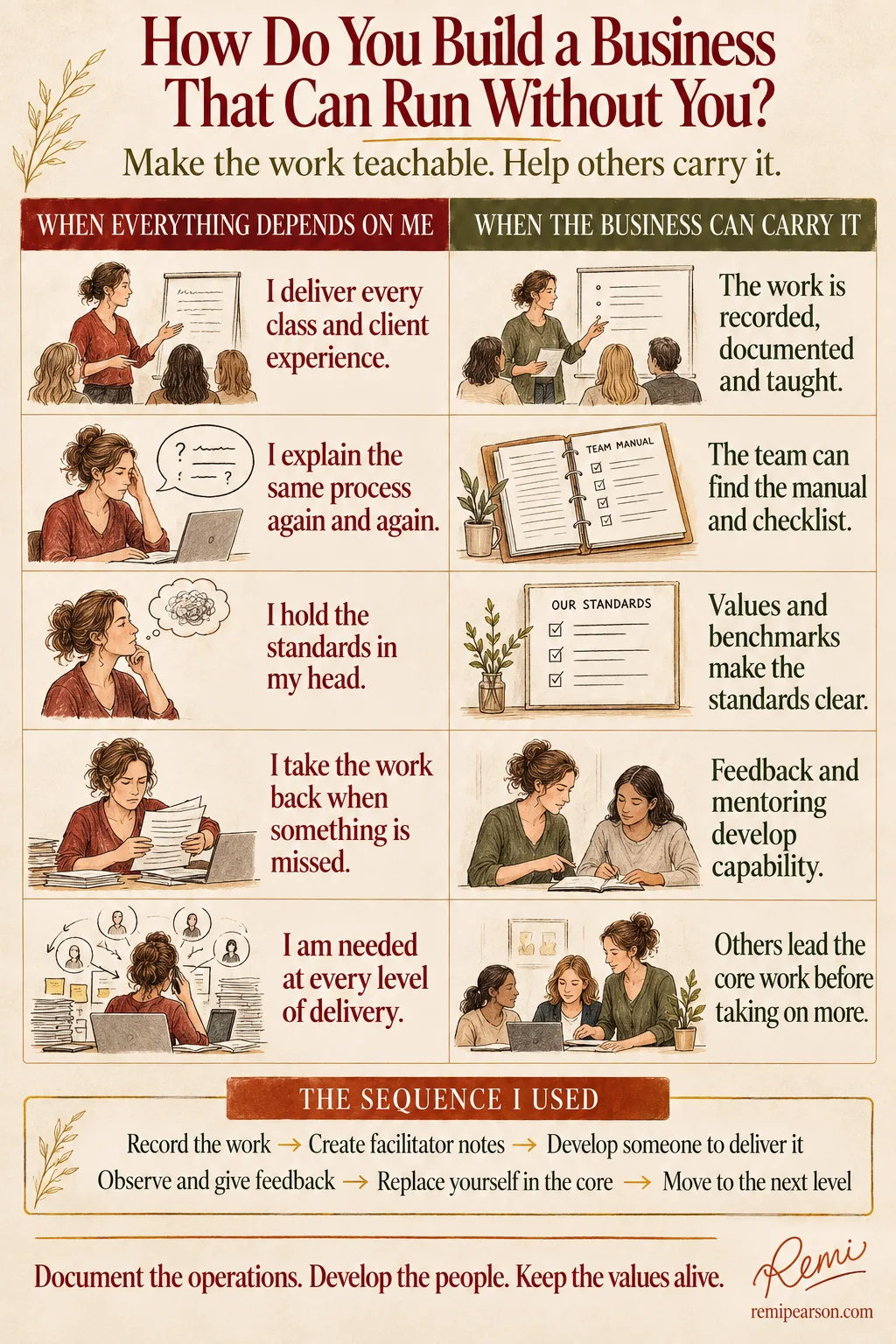
For me, that meant asking a question about work I already knew how to do. How could someone else learn to deliver it well?
How do you replace yourself without losing quality?
I began documenting my work. I would record a webinar, have it transcribed and turn the transcription into facilitator notes. This was before the automated tools we now take for granted, so there was quite a bit of work involved in getting from a recording to something another person could actually use.
Then someone else would run the class using those notes. I would listen to their delivery and give feedback. We could examine what they understood, what they had missed, where the notes needed improving and what needed more practice.
A recording captured what I said. Developing a facilitator required helping them understand what they were doing and why. That distinction mattered. I wanted someone who could work with the material and the students, rather than simply read my words aloud.
We repeated the process. The notes became more useful, the facilitator developed, and the work gradually became something that could be delivered well without me being the person delivering it.
What should you delegate first?
I started with the core programs, the smallest programs, and worked through every aspect of their delivery. A webinar was one part. Mentoring, assessments and the other elements of the student experience also needed attention.
Once I had replaced myself throughout the core program, I moved to the next level. Then the next. Eventually, that process extended through to our premium programs at $25,000.
There was a sequence to it. We developed capability around the established work before moving further into the more advanced work. Each stage gave us a stronger foundation for what followed.
Replacing yourself can sound like a single decision, as though one day you hire someone and hand over your role. My experience was much more granular. It happened through particular classes, particular responsibilities and particular systems, with feedback and development along the way.
How do you turn what you know into business systems?
While that was happening in the student experience, I was also building the systems behind the scenes. As sales progressed and the business moved forward, I reverse engineered what had happened and backfilled the work that supported it.
My rule was simple: if something happened more than once, it needed an operations manual.
We documented the process, the checklist, the recurring activities and the things someone needed to know to carry out the work. The team could go into our shared drive, click a hyperlink and find the relevant material. They could access the operations manual, the to-do list or the daily responsibilities without needing me to reconstruct it for them.
That made knowledge accessible beyond the person who happened to hold it. It also gave us something we could examine and improve. When a process depended on memory, much of it remained invisible until someone forgot a step or wasn’t available.
This connects with Tom McKaskill’s work on preparing businesses for exit. In Ultimate Exits, he identifies undocumented knowledge and dependence on a small number of individuals as limitations, and examines how knowledge, people and resources need to support the transfer and expansion of a business’s capabilities (McKaskill, 2010).
Even when selling is years away, it is useful to ask whether the knowledge that makes the business work can travel beyond you.
How do you build a team you can trust?
Documentation was only part of what I built. Very early on, I also developed a team performance system, including a 90-day cultural review. We had a strong vision, mission and values, and those needed to be present in the ordinary working day.
Feedback came through the filter of living the values and the vision. We had something explicit to refer to, rather than relying on whatever a leader happened to prefer that afternoon. We trained people in the vision and values, discussed them and used them to examine how we worked together.
Someone joining the team went through a 90-day onboarding process and a mentorship program. By the end of that period, we could assess whether they were a cultural match as well as whether they could do the work.
That distinction became important as the business grew. A capable person still needed to contribute to the kind of organisation we were building. Their effect on other people, their willingness to learn and how they approached responsibility mattered alongside their technical ability.
My manual, included in the program here, brings these elements together because systems, culture and leadership continually affect one another. A documented process needs people who can use it, improve it and take responsibility for its purpose (Pearson, 2011).
What does it take to build beyond the founder?
Looking back, I can see how much of the work involved making things available to others that had previously lived inside me. The coaching became teachable. The delivery became documented. The standards became explicit. People had a way to learn, receive feedback and develop.
I still had work to do as the founder. What changed was the work the business needed from me.
I hadn’t started with ambitions to build The Coaching Institute. I began with a personal question about how to live differently, and followed it into conversations, coaching and eventually a school. As it grew, I kept learning how to make the work repeatable and how to help other people carry it.
If your business currently depends on you for almost everything, start with one piece of work you do regularly. Record it. Explain your thinking. Help someone learn it, observe what happens and improve what supports them. That gives you somewhere practical to begin.
Explore the work
From Practice to Enterprise is the starting point for exploring the move beyond a business organised around your own delivery.
Trust That Holds draws on the TRUSTME model for the trust dimension of that work.
For the broader collection, Build Beyond the Founder brings together From Practice to Enterprise, Core Improve Innovate and Trust That Holds.
References
- McKaskill, T. (2010) Ultimate Exits: The Secret Behind Selling Entrepreneurial Ventures at Staggering Prices. Melbourne: Breakthrough Publications. Accessible full text.
- Pearson, R. (2011) Month 10: From Technician to Entrepreneur. Training manual. Small Business Academy, The Coaching Institute.
 Talk to Remi