

Emotion Integration Technique
How moving further away can become the path back to compassion.
Explore EIT


Meaning & alignment · A coaching inquiry
Understanding what is driving your life before deciding where to take it.
Someone tells me they want to build a successful business. They have a clear income goal and can describe what achieving it would mean for their family. They have been thinking about it for years. But when we explore what is happening in their life, they are barely allowing themselves to be seen. They avoid conversations in which someone might reject them, keep postponing opportunities to share their work, and spend considerable time preparing for a future they never quite begin.
The ambition may be sincere. So is the need to remain protected. Until we understand the relationship between those two things, another goal-setting exercise may simply give them a more detailed description of something they feel unable to pursue.
I developed the Values Alignment Technique because I kept encountering this gap in coaching. People were being encouraged to decide what they wanted before they had explored what was already directing their choices. Sometimes their goals reflected something deeply meaningful. Sometimes they reflected expectations they had absorbed from other people, or an attempt to finally feel worthy. A goal could itself be protective, giving someone enough hope about the future to avoid examining how they were living in the present.
For me, goal setting belongs towards the end of a substantial inquiry.
I want to understand what the person is experiencing, what their familiar patterns provide for them, and what happens emotionally when they consider living differently. That takes curiosity and sometimes a willingness to question an account of ourselves that we have become quite attached to.
Within this technique, I use values to describe what is operating in someone’s life: the priorities being expressed and reinforced through their choices, their responses and the emotional experiences they repeatedly organise themselves around. That includes priorities they may never consciously have chosen.
This is a particular use of the word, and it matters that we understand it before going further. If I ask someone what they value, they might tell me adventure, intimacy or self-respect. Those words tell us something about how they see themselves, or how they would like to live. I then want to explore where those values have a presence in their actual experience.
These questions open a conversation about the relationship between what we name and what we live.
Someone may discover that certainty has considerably more influence over their decisions than adventure does. Another person may sincerely desire intimacy while arranging their relationships around keeping difficult feelings private. There is nothing useful about shaming either person for that discovery. We have begun to see what the inquiry needs to include.
A desired experience is something we want to move towards. A lived value has evidence in how we relate to ourselves and participate in our lives.
The distinction can be confronting because most of us would prefer to describe ourselves through our intentions.
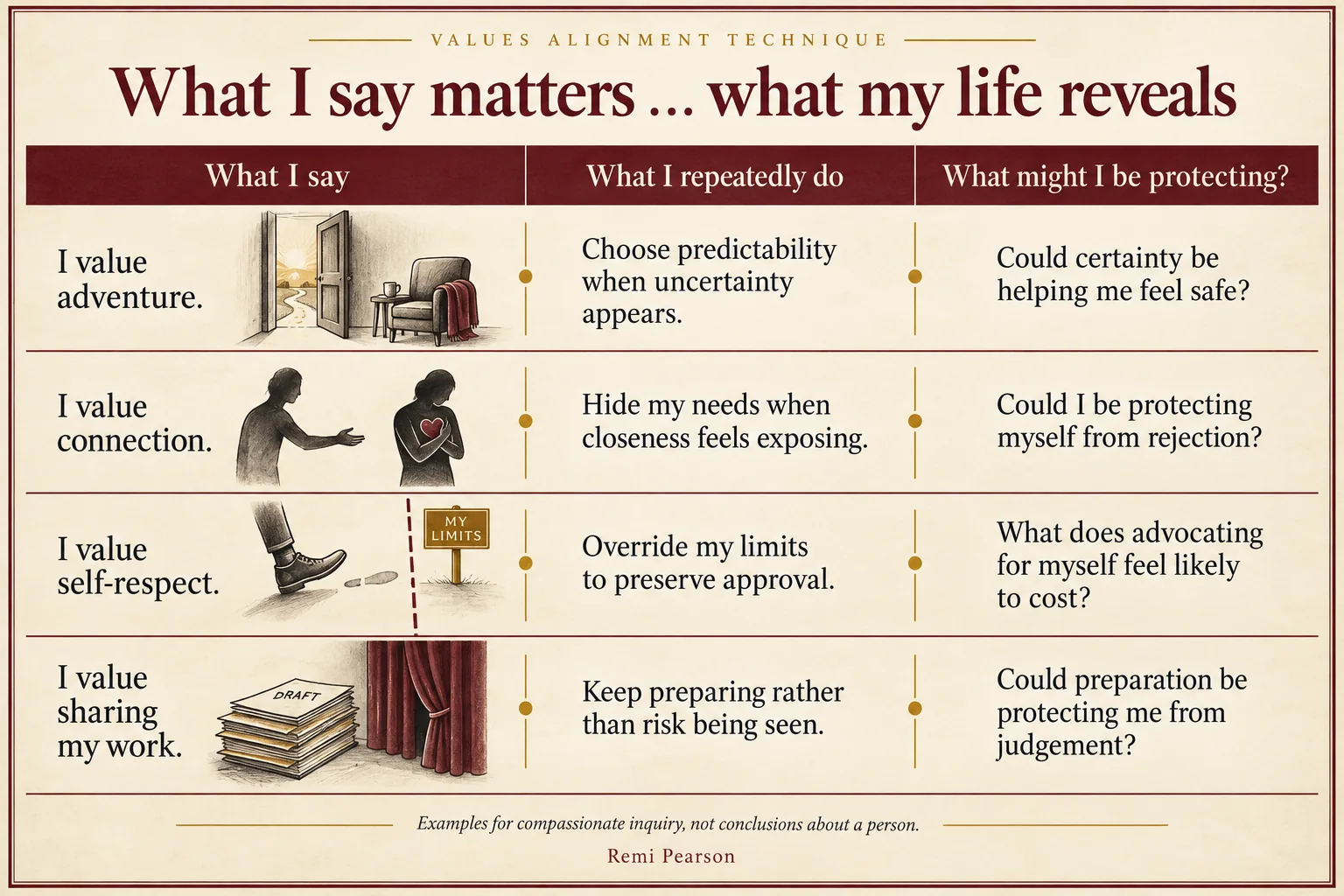
Examples to explore, not conclusions to impose.
We cannot look at someone’s circumstances and assume we know what they value. Someone experiencing illness may be profoundly committed to their health. Someone living in a house they dislike may be there because of a separation or a flood, while doing everything available to establish a different home.
There can be a considerable lag between a change in how we relate to ourselves and a change in our circumstances. A person may begin expressing self-respect while their partner continues to dismiss them. We would need to understand their response to that dismissal, the options available to them and the support they need. The partner’s behaviour alone cannot tell us what the person values.
This is why the technique involves a conversation rather than a quick interpretation. We explore what has happened alongside what the person is doing with what has happened. We consider capacity and willingness separately, because someone may want change intensely while having very little capacity available at that moment.
We also become curious about resourcefulness.
Those questions require care. Another person’s success does not establish what should be possible for this person under different conditions. Equally, accepting every account of impossibility without exploring it can leave someone trapped inside a belief they have never had the opportunity to examine.
A goal can give us something emotionally long before we achieve it. Imagining a successful business might offer relief from feeling stuck. Imagining a loving relationship might make present loneliness more bearable. There is nothing inherently wrong with that; the capacity to imagine a different future can help sustain us.
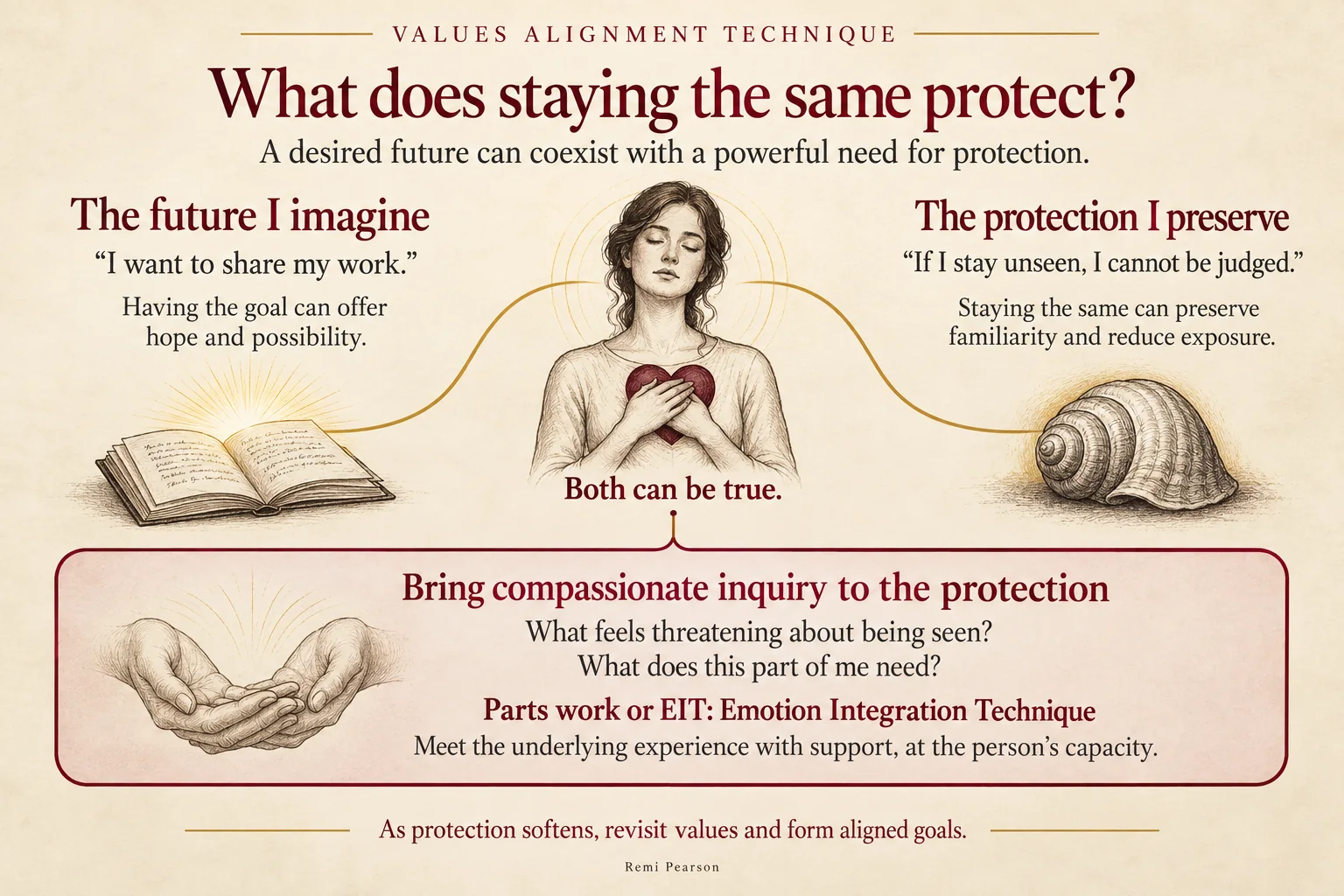
But sometimes the imagined future becomes an escape valve. Someone repeatedly announces that they want to earn a million dollars, yet does very little to bring their work into contact with potential customers. Having the goal allows them to continue experiencing themselves as someone who is going somewhere, while their everyday choices preserve the familiarity of where they are.
In that situation, I am interested in two questions:
Perhaps visibility brings the possibility of criticism. Perhaps succeeding would unsettle an important relationship. Perhaps trying wholeheartedly would expose them to a disappointment they have spent years avoiding. We cannot know until we inquire, and the person may not know either.
This is where secondary gain becomes relevant. Staying the same may provide something the person relies on, even when they are unhappy with the consequences. Recognising that benefit helps us understand why an apparently desirable change has remained so difficult.
There may also be discomfort in the discrepancy between their stated ambition and their behaviour. People find ways to explain that discrepancy, sometimes convincingly enough that they stop noticing it. The conversation needs to make it possible to look again without turning the discovery into another reason to attack themselves.
I use the VIA character strengths survey early in the process as a starting point for conversation. It can help someone recognise qualities they have overlooked, taken for granted or never considered particularly meaningful. Their response to the results is often as useful as the results themselves.
We might explore where they recognise a strength in their life, where they struggle to express it, or why a particular description feels unfamiliar. The survey gives us material to work with and a way of bringing aspects of their experience into conscious awareness.
Strengths and values have different roles in this inquiry. Recognising a capacity for curiosity, for example, does not automatically tell us what takes priority when curiosity brings the person close to something uncomfortable. We still need to explore how they live, and what influences them when there is something at stake.
The process can take around four hours because these distinctions need room. We are separating what the person believes they should value from what they desire, and exploring both alongside what is already operating.
Some answers become clearer only after the person has had time to hear themselves.
Consider a hypothetical person who repeatedly sets aside their needs to preserve a relationship. They say they want to feel important to their partner, yet whenever expressing a need creates tension, they withdraw the request and attend to the other person’s comfort.
Within the language of this technique, self-abandonment is being given priority over self-advocacy. That can be painful to recognise. It does not mean they enjoy being dismissed or have consciously decided that their needs are irrelevant. We need to understand what advocating for themselves seems likely to cost.
Perhaps disagreement threatens their sense of connection. Perhaps they learned early that having needs made them difficult to love. Keeping the relationship undisturbed may feel necessary enough that they repeatedly sacrifice their own experience to preserve it.
As their relationship with themselves changes, we would expect to see self-advocacy begin to have a presence. They may acknowledge discomfort they previously explained away, seek support, or become clearer about what they are willing to participate in. The external outcome might take time.
There is a further distinction worth exploring here. An enormous amount of effort can go into trying to persuade another person to let us matter. From the inside, that effort can feel like standing up for ourselves. Yet we may still be making our worth dependent on receiving their agreement.
Am I responding to the knowledge that I matter, or am I still trying to convince this person to grant me that position?
The answer may emerge slowly. It can bring grief as well as clarity, particularly when someone begins to recognise that the relationship they have been trying to secure cannot offer what they need.
Recognising a protective pattern tells me where the work needs to deepen. If someone discovers that staying invisible protects them from criticism, I want to understand the part of them for whom criticism feels so threatening, and what that part needs.
This is where I bring in inner-work approaches, including parts work or EIT, Emotion Integration Technique, according to what emerges for the person. We explore the protection and develop a relationship with the experience it has been keeping at a distance. That may involve feelings the person has never had enough support to meet.
An intellectual explanation can be useful, but understanding why we do something does not necessarily change what happens inside us when the familiar threat appears. Someone can explain their fear of rejection beautifully and still experience an overwhelming need to retreat when they feel exposed.
I am interested in the felt shift: the person developing enough capacity and self-compassion to be with something they previously had to organise their life around avoiding. That work proceeds at their pace. We cannot assume that recognising a protection means they are ready to relinquish it.
As the inner work unfolds, we revisit what matters and what is now possible.
A familiar priority may loosen its hold. Something the person could previously only wish for may begin to feel available as a way of relating to themselves.
Through the VIA character strengths survey and conversation.
What is already directing choices, responses and the emotional experiences the person organises around.
Secondary gain, and the gap between intention and experience.
Through parts work or Emotion Integration Technique, at the person’s pace, developing a relationship with what the protection has kept at a distance.
With the understanding included.
Towards the end of this inquiry, we can return to the question of what the person wants. We now have a fuller understanding of what has been influencing their choices and what their earlier goals may have been doing for them.
Some goals remain meaningful. Others change considerably. Someone may still want to build a successful business, while recognising that the income figure they borrowed from the coaching community has little to do with the life they want. Another person may discover that their desire for a relationship has been organised around finally proving they are lovable, and begin to consider what mutual care would actually require.
The goal emerges with this understanding included. There is room to consider whether it expresses something they are coming to live, or whether it asks an external achievement to resolve a relationship with themselves that still needs attention.
We continue to pay attention to lived evidence. How is the person responding when their needs arise? What happens when the old protection is activated? Their experience gives us information about where the inner work has taken hold and where more care is needed.
The question I want someone to leave with is one they can keep returning to:
What is directing my life, and can I meet that honestly enough to have more choice?
A meaningful goal becomes easier to form when we have allowed ourselves to explore the answer.
Once a year, I run training for practitioners in the Values Alignment Technique. We explore how to distinguish lived values from desired experiences, recognise protection and secondary gain, and bring inner work into the inquiry before moving towards aligned goals.
How moving further away can become the path back to compassion.
Explore EITNeeds, boundaries and emotions, with worthy, lovable and enough at the centre.
Read the triadWhat the problem we keep trying to solve may be protecting us from.
Read on Talk to Remi