The Critical Alignment Model
Why people come last because people come first.
Explore CAM
Leadership & evolution · Seven levels of thinking
How our values develop and why our best thinking can disappear under pressure.
You can learn more about the thinking of a leader when something goes wrong than you can from almost anything they say about themselves. Under ordinary conditions, most of us can present as thoughtful, collaborative and relatively sophisticated. Add threat, uncertainty, financial pressure or a challenge to identity, and a different organising logic can appear. The leader who speaks about empowerment begins controlling every decision. The team that values candour retreats into agreement. The person who believes they are purpose-led becomes preoccupied with winning.
This does not make them fraudulent. It reveals the level of thinking they can genuinely sustain.
I developed the T.R.U.S.T.M.E. model as a context-independent way of understanding these shifts. Its seven levels are Trust, Relatability, Uniqueness, Systems, Tenacity, Meaning and Evolution. The model is informed by Clare Graves’ developmental research and Spiral Dynamics, developed by Don Beck and Christopher Cowan, and it also draws on Ken Wilber’s integral understanding that development must transcend and include what came before. I have adapted those foundations into a practical model for leadership, organisations, teams, families, cultures and individual development.
T.R.U.S.T.M.E. is not a personality test. It does not sort people into seven permanent kinds. It asks what level of thinking is organising a person or system now, what that level makes visible, what it cannot yet solve, and what appears when pressure removes the performance.
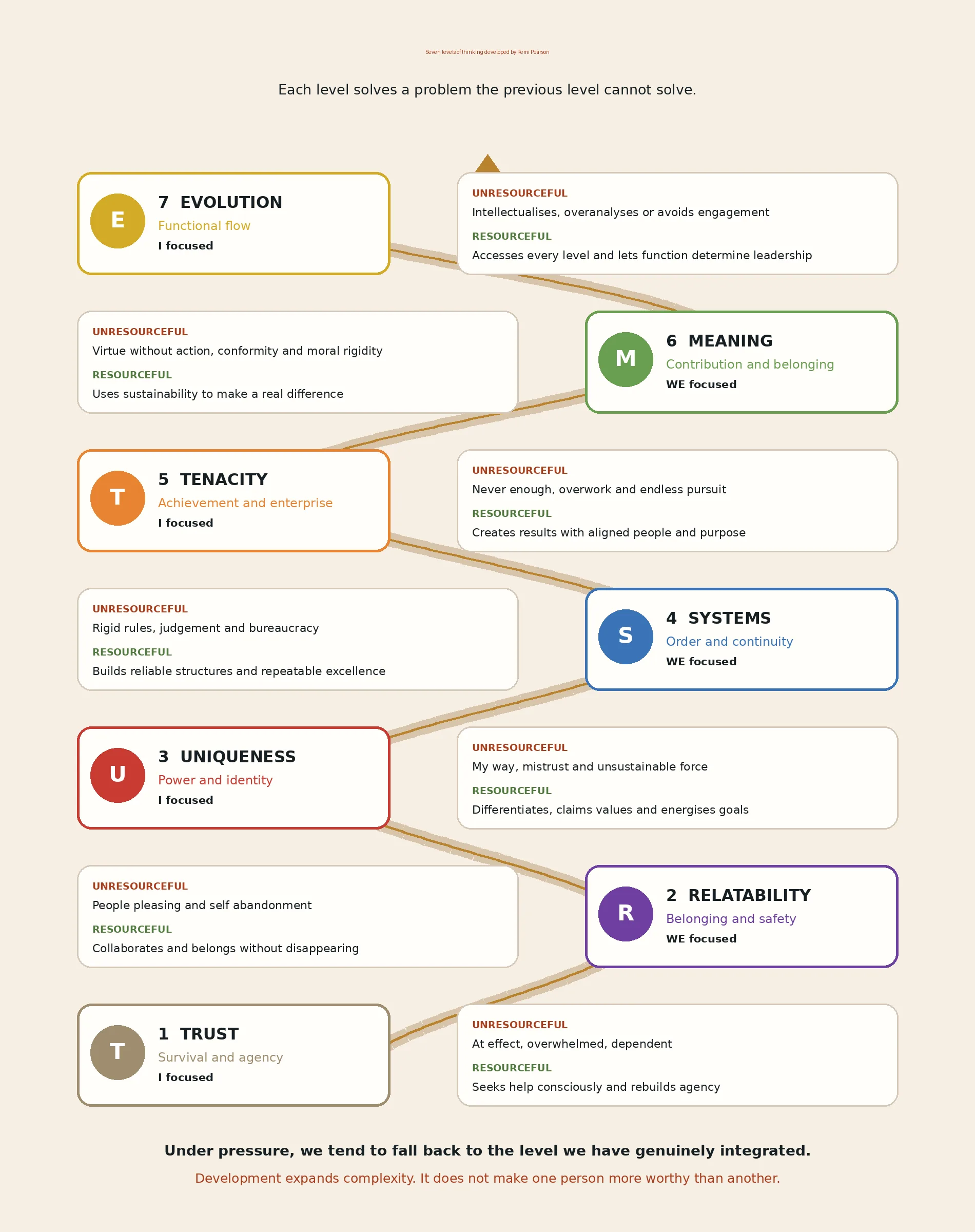
The seven levels of the T.R.U.S.T.M.E. model developed by Remi Pearson
Graves was interested in why human beings respond so differently to life. Spiral Dynamics describes value systems, sometimes called value memes, that arise through the relationship between life conditions and our capacity to cope with those conditions. A meme in this sense is not a slogan on the internet. It is a pattern of shared meaning that moves through families, organisations and cultures, shaping what people reward, fear, permit and regard as obviously true.
We internalise the environments in which we live. A family may organise itself around loyalty and belonging. A start-up may reward rebellion and speed. A profession may prize rules, evidence and procedural correctness. A social movement may define goodness through agreement with the group. People absorb these messages, often long before they realise they have done so. This is why someone can feel competent in one culture and strangely wrong in another. Their values may be colliding with the organising values of the system.
The model can therefore be applied at any scale. We can examine the thinking of one person, the tension between two parts of that person, a marriage, a leadership team, a company culture or an entire community. The content changes. The developmental questions remain surprisingly consistent.
The seven levels move between individual expression and collective stability. Trust, Uniqueness, Tenacity and Evolution are primarily I-focused. Relatability, Systems and Meaning are primarily we-focused. Each movement solves something the previous orientation could not solve, while eventually creating a new problem of its own.
The group gives safety, and eventually the individual needs to differentiate. Individual power creates movement, and eventually the movement needs structure. Systems create reliability, and eventually the person wants achievement beyond compliance. Achievement produces results, and eventually those results can feel empty. Meaning brings contribution and belonging back into view, and eventually even the meaningful group can become rigid. Evolution makes the whole repertoire available according to what the situation actually requires.
This is not a ladder of human worth. More complex thinking is still more complex, and pretending otherwise is not useful. A person at Evolution can hold more perspectives and deliberately access earlier capacities. That does not make them more deserving of dignity. A person whose home has just been destroyed may need the resourceful survival intelligence of Trust, not an abstract conversation about systems and meaning.
Development expands complexity. It does not make one person more worthy than another.
One of my additions to the developmental model is the deliberate distinction between the resourceful and unresourceful expression of each level. The level itself is not the problem. The question is whether we are using its capacities consciously, in response to reality, or being controlled by its unresolved fears and limitations.
Dependence can be helplessness, or it can be the intelligent decision to rely on others while we learn. Belonging can require self-abandonment, or it can give us collaboration without the loss of self. Power can become domination, or it can be the energy required to leave a system that no longer permits truth. Systems can become bureaucracy, or they can preserve learning so that people do not have to reinvent excellence every day.
The same distinction continues through the later levels. Tenacity can become exhausting proof that enough is never enough, or it can generate sustainable results. Meaning can become righteous agreement without action, or it can turn reliable resources toward contribution. Evolution can become intellectual distance and analysis paralysis, or functional flow, where the person can use the capacity that fits and allow the most suitable person to lead.
The level itself is not the problem.
Trust is the first individual level. Its question is whether I can survive and whether I have enough agency to affect what happens next. In its unresourceful form, the person experiences themselves as being at effect. The world feels confusing, other people hold the answers, and dependency becomes passive. An external locus of control dominates because life appears to happen to them.
Resourceful Trust may still involve severe difficulty. Someone may have lost their home, entered an unfamiliar field or found themselves at the bottom of an enormous learning curve. The difference is that they seek support consciously. They know they need answers and resources, and they participate in obtaining them. The problem to solve is not dependence itself. It is the recovery of enough safety and agency to begin engaging with other people and the world.
Relatability is the first collective level. Safety is found in belonging to the family, tribe, team or culture. Its unresourceful expression is fitting in at the price of the self. People please, accommodate, wait to be told what is acceptable and suppress personal advocacy. They may agree in the room and resist afterwards because direct disagreement feels too dangerous.
Resourceful Relatability gives us genuine collaboration. We can rely on one another, honour shared history and experience the deep relief of belonging where we actually want to belong. The developmental problem emerges when belonging requires disappearance. To progress, the person must risk differentiation and discover what is true for them, even when their truth is not rewarded by the group.
Uniqueness is the power level. It breaks the spell of conformity and says: this is what I stand for, this is what I prefer, and it is acceptable that it matters to me. It can be selfish, aggressive and deeply mistrustful. At its unresourceful edge, it becomes my way or the highway, with people treated as obstacles or instruments. Results may arrive quickly, but they are rarely sustainable because the leader cannot build anything that survives their force of personality.
And yet Uniqueness is necessary. A person trapped in accommodation cannot collaborate their way into authenticity. Breaking from a family system, an inherited identity or a culture that punishes difference takes energy. Resourceful Uniqueness provides healthy ego, anger, differentiation and commitment. It energises goals. Its next problem appears when freedom without repeatability becomes chaos.
Systems is the return to the collective through order, rules and continuity. It asks how learning can be preserved, how behaviour can become reliable and how a result can be repeated without one heroic person holding the entire operation together. At its best, Systems creates benchmarks, standards, documentation and fair expectations. We can model excellence that already exists instead of solving the same problem over and over.
Its unresourceful expression mistakes the system for the purpose. Correctness becomes more important than usefulness. Anything outside the box is judged, data is treated as the only form of knowing, and bureaucracy begins protecting itself. The developmental task is to retain what creates reliability while recovering initiative, experimentation and the capacity to pursue an outcome rather than merely obey a process.
Tenacity is entrepreneurial. It draws on the power of Uniqueness and the reliability of Systems, then turns them toward achievement. It is pragmatic, productive and willing to bring along people who are heading in the same direction. Resourceful Tenacity creates movement at scale. There is leadership with a purpose, opportunity is recognised, measures matter and things actually happen.
Its shadow is the permanent sense that the next achievement, training, strategy or level of income will finally be enough. The person can become a perpetual student while also over-functioning, forever preparing for the result that might allow them to rest. Tenacity solves the practical problem of getting somewhere. It cannot answer whether the destination has meaning.
Meaning returns to the collective with a wider circle of concern. The person or organisation wants their work to contribute, not merely succeed. Resourceful Meaning becomes possible when the capacities beneath it have been integrated. There is enough agency to act, enough differentiation to withstand disagreement, enough structure to produce reliably and enough enterprise to sustain the work. Financial sustainability matters because a contribution that cannot survive remains an intention.
This is where I gently challenge people who say they are here to make a difference while avoiding the difficult levels required to build anything. Meaning can become an identity that feels virtuous without producing meaningful action. Its unresourceful expression demands that everyone agree about how goodness should look, then judges anyone who will not fit the policy of the group. The person who has not integrated Uniqueness may call self-abandonment compassion. The person who has not integrated Systems may call unreliability freedom. The work is to make meaning real.
Evolution begins a different kind of development. Graves described the movement beyond the first six levels as a substantial change in meaning. In the T.R.U.S.T.M.E. model, Evolution is where the previous capacities become consciously available. The person can use Trust when they genuinely need support, Relatability when belonging matters, Uniqueness when a boundary must be drawn, Systems when reliability is needed, Tenacity when a result must be produced and Meaning when contribution should lead.
This is functional flow. Leadership is not a status to protect. The best person for the situation can lead, and someone operating resourcefully at Evolution does not need that person to be them. They can move between internal reflection, observable behaviour, group culture and organisational systems without insisting that one perspective explains everything.
Evolution also has an unresourceful expression. Complexity can become a hiding place. The person may intellectualise, overanalyse, trust the idea of evolution so completely that they stop intervening, or use their knowledge of the levels to excuse behaviour they should address.
Access to a map is not evidence that we have travelled the territory.
Ken Wilber’s phrase ‘transcend and include’ captures something essential. Development is not the rejection of earlier capacities. If a later level cannot access healthy power, order, enterprise or belonging, it is not integrated. It is merely avoiding parts of the spiral while claiming to be above them.
We also do not express one level everywhere. Someone may show Tenacity at work, Relatability in their family and unresourceful Trust when facing illness or financial shock. Life conditions can pull earlier patterns forward. Under pressure, people commonly fall back, sometimes by two levels or more, until they reach the thinking they have truly embodied rather than the thinking they can describe.
This is why pressure is so revealing in leadership. Ask someone about feedback when everything is calm and most will claim to welcome it. Challenge a decision they identify with and you may meet the level actually governing them. The point is not to catch people out. It is to know what capacity is available, what has not yet been integrated and what the situation requires next.
Under pressure, we fall back to the level we have genuinely integrated.
I once worked with a business generating more than one million dollars a year in bad debt. The leaders were focused on acquiring new customers, dominating their market and keeping the energy moving forward. They resisted the Systems work of measurement, accountability and repeatable correction because it felt slow and restrictive. The problem was not a lack of drive. It was drive that had not integrated the next capacity, and eventually the business failed.
The model also explains team clashes that appear personal. Relatability experiences the certainty of Uniqueness as threatening. Uniqueness experiences Systems as suffocating. Systems experiences Tenacity as reckless. Tenacity experiences Meaning as slow or commercially naive. Meaning experiences Tenacity as selfish. Each may be responding coherently from within its own value system while remaining unable to see what the other level is protecting or providing.
A useful cultural review therefore asks:
The same questions work in a family. One parent may privilege loyalty, another independence. A child may be trying to differentiate inside a system that interprets difference as betrayal. Suddenly the conflict has a structure, and structure gives us somewhere more intelligent to begin.
We cannot solve the central problem of one level using only the thinking that created it.
We may be able to imitate later language, particularly when the culture rewards it. We cannot sustainably skip the developmental work. The unresolved level waits for pressure, then returns with surprising authority.
The most useful question is therefore not ‘Which level am I?’ It is:
Which level is organising my response here, is it resourceful, and what capacity must become available next?
The unresolved level waits for pressure.
If your leadership team wants to identify the thinking shaping its culture, its blind spots and its next stage of development, bring me in to work with your leadership team.
Invite Remi to work with your leadership teamTo take this work further through Rebel Yell, join the waitlist here.
Join the Rebel Yell waitlistTo learn the complete model in your own time, purchase the online program on the T.R.U.S.T.M.E. model.
Purchase the T.R.U.S.T.M.E. online programThe T.R.U.S.T.M.E. model was developed by Remi Pearson and is informed by Clare W. Graves’ theory of levels of human existence, Don Beck and Christopher Cowan’s Spiral Dynamics, and Ken Wilber’s integral theory.
Further reading includes Graves (1970), Beck and Cowan (1996), Wilber (2000, 2004), Cacioppe and Edwards (2005), Butters (2015).
Why people come last because people come first.
Explore CAMUnderstanding what is driving your life before deciding where to take it.
Explore VATWhat the problem we keep trying to solve may be protecting us from.
Read on Talk to Remi