

How Do You Build Self-Esteem That Lasts?

The Self-Esteem Triad

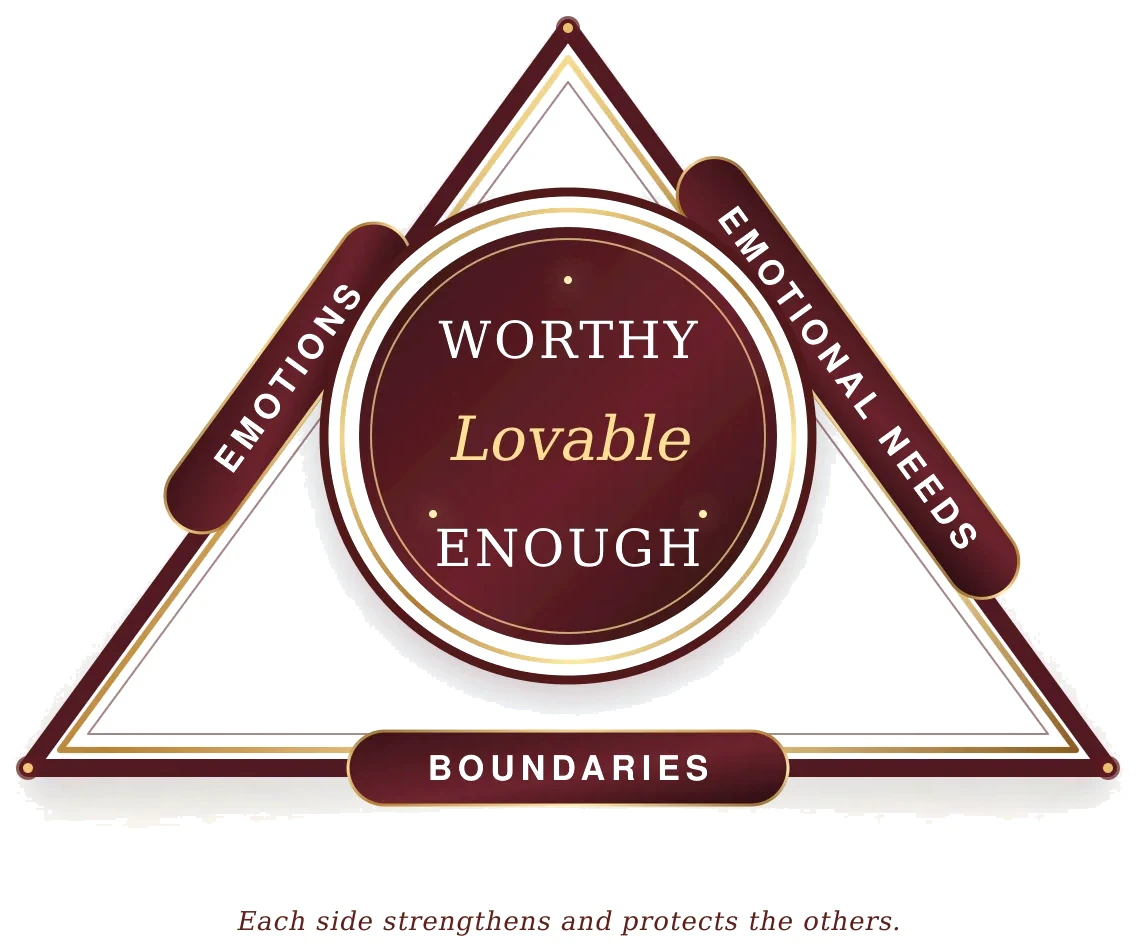
Self-esteem is built through the relationship we have with ourselves. We strengthen it when we can recognise our needs and respond to them, remain ourselves while connected to other people, and stay present with our emotions without letting them decide everything we do. I call these three capacities the Self-Esteem Triad: needs, boundaries and emotions. At their centre is the lived experience of being worthy, lovable and enough.

Self-esteem is something we live.

It is a grounded sense of:

I am.I know who I am.I know how to take care of myself.All of me is welcome here.

The Self-Esteem Triad: a triangle whose three sides are Emotional Needs, Boundaries and Emotions, with Worthy, Lovable, Enough at the centre. Each side strengthens and protects the others.

We often talk about self-esteem as though it were a belief we could install through repetition. Think more positively. Stop doubting yourself. Tell yourself you are worthy. Act confident until you feel confident.

Sometimes those things help. They can change how we perform, how we speak or what we are willing to attempt. Yet none of them necessarily changes the relationship we have with ourselves.

Confidence can rise and fall according to the situation. You might be exceptionally confident in your work and deeply uncertain in an intimate relationship. You might speak comfortably to a room full of people, then abandon yourself the moment somebody you love becomes disappointed in you.

Self-esteem sits underneath those fluctuations. It is quieter and more fundamental. It is the embodied experience of knowing yourself, remaining in relationship with yourself and being able to care for the person you actually are.

I call this I-amness.

It is the grounded feeling that I exist as a person in my own right. I can recognise what I need. I can remain present with what I feel. I know where I end and another person begins. I can belong to myself while being deeply connected to you.

That is the foundation of the Self-Esteem Triad.

What is the Self-Esteem Triad?

The Self-Esteem Triad is a mental model I created to understand the foundations of our relationship with ourselves. Its three interdependent capacities are needs, boundaries and emotions. At the centre is the felt experience of being worthy, lovable and enough. Each capacity strengthens and protects the others. If one is missing, we often try to compensate in ways that make sense at the time but cost us something later.

I created the model because I kept seeing people trying to create change through willpower.

They knew what they were supposed to do. They had read the books, listened to the podcasts and understood their patterns intellectually. They made resolutions, created plans and tried to discipline themselves into becoming healthier, happier or more successful.

Then the same patterns returned.

They shut down when emotion entered the room. They agreed to things they did not want. They stayed silent until resentment took over. They pursued achievement, purpose or personal growth while remaining disconnected from their most basic needs. They tried to become more confident without creating the internal conditions that would allow them to feel secure in themselves.

Their difficulty was rarely a lack of information or desire. They were trying to build change on foundations that had never been properly developed.

Willpower can force a behaviour for a while. It cannot give you a relationship with your sadness. It cannot teach you what safety feels like. It cannot show you where another person’s responsibility ends and yours begins. It cannot make all of you feel welcome inside your own life. For that, we need to understand how needs, boundaries and emotions actually operate together.

Needs

Can I recognise and respond to what I need?

Every human being has needs. Having them does not make us weak, demanding or too needy. It makes us human.

Our needs influence how we attach, protect ourselves, make decisions, form relationships and interpret what happens around us. When we do not know what our needs are, we cannot take meaningful responsibility for meeting them. We might expect other people to work them out for us, suppress them until they become impossible to ignore or try to meet a deeper need through something that can never satisfy it.

A person who needs reassurance may criticise their partner instead of asking for closeness. Someone who needs safety may try to control everything around them. Someone longing to matter may overfunction, achieve or make themselves indispensable. Someone who needs rest may continue performing until their body forces them to stop.

The need has not disappeared. It has simply found an indirect route.

Knowing our needs allows us to ask better questions:

  • What am I actually needing here?
  • Is this the immediate need, or is something deeper underneath it?
  • Which part of this need can I meet for myself?
  • Where do I need support, care or cooperation from another person?
  • Can I communicate that directly, without blame, manipulation or self-abandonment?

Every time we recognise a genuine need and respond to it responsibly, we strengthen self-trust. We demonstrate to ourselves that our inner experience matters and that we will not automatically abandon ourselves when caring for ourselves becomes inconvenient.

That is an act of self-esteem.

Boundaries

Can I remain myself while being connected to you?

Boundaries are often reduced to saying no. That is part of them, but it is nowhere near the whole story.

A boundary is a lived understanding of where I begin and end, and where you begin and end. It allows me to know which feelings, choices, responsibilities and consequences belong to me, and which belong to you.

This is differentiation.

Differentiation allows two people to be close without becoming psychologically fused. I can care about your feelings without making them my identity. I can listen to your perspective without automatically surrendering my own. I can disappoint you and remain a loving person. I can love you without disappearing into what you need me to be.

When this capacity is underdeveloped, connection can become enmeshment. We may experience another person’s disappointment as evidence that we have done something wrong. We may accommodate their preferences before we have even noticed our own. We may confuse empathy with responsibility, agreement with safety, or self-sacrifice with love.

Over time, this produces self-abandonment. We lose access to self-advocacy because we are no longer clear about the self we are advocating for.

Healthy boundaries are not instruments for controlling other people. They tell us what we will participate in, how we will care for ourselves and what we will do when something is no longer healthy for us. They also reveal which relationships have room for our differentiated self.

When I can remain connected to you without leaving myself, my sense of who I am becomes more stable.

That is also self-esteem.

Emotions

Can all of me be welcome?

Our emotions are part of how we know ourselves.

They give us information about what matters, what hurts, what feels threatened, what we long for and what may need our attention. They are not always literal instructions, and they do not need to control our behaviour. They do need a relationship with us.

If I have no relationship with my sadness, I will try to shut it down, outrun it or explain it away. I may also struggle to remain present when sadness appears in somebody else. Their emotion activates everything I have learned to avoid in myself.

The same applies to anger, fear, grief, shame, joy, tenderness and vulnerability. Whatever we exile internally becomes difficult to meet compassionately in another person.

Some people become flooded by emotion. Others disconnect, intellectualise, minimise or withdraw. A dismissive-avoidant protective pattern, for example, may involve shutting down when emotional closeness intensifies. This does not necessarily mean the person feels nothing. Often, the system has learned that emotional experience is unsafe, overwhelming or unlikely to be met well.

A healthier relationship with emotion allows us to notice what we feel, experience it in the body, name it and stay present without immediately turning it into a verdict about ourselves or somebody else.

We learn to speak for our emotions without speaking entirely from them.

  • “My anger is telling me that something feels unfair.”
  • “My sadness needs acknowledgement.”
  • “My fear is asking for more information and safety.”
  • “My resentment may be showing me where I have repeatedly abandoned a boundary.”

Emotional maturity does not require permanent calm. It means we can remain in relationship with ourselves when calm is absent.

When every emotion is allowed to belong, we no longer have to divide ourselves into acceptable and unacceptable parts.

That, too, is self-esteem.

How do needs, boundaries and emotions work together?

Needs, boundaries and emotions continually inform one another.

An emotion may alert us to an unmet need. A boundary may protect our ability to respond to that need. Recognising the need may help us understand why the emotion has become so intense. Our emotional response may then show us whether the boundary feels safe, rigid, unclear or repeatedly violated.

When one part of the triad is underdeveloped, we tend to compensate through protective strategies.

We may recognise our feelings but have no language for what we need, leaving us flooded, confused or dependent on immediate relief. We may know what we need but struggle to communicate or protect it, leading to hints, resentment, overgiving or repeated self-abandonment. We may become highly skilled at setting boundaries while remaining emotionally unavailable, turning boundaries into walls rather than structures that support healthy connection.

Some people have developed considerable strength in one or two areas. In my experience, however, most of us have meaningful work to do across all three.

This is not evidence that we are broken. These gaps usually reflect what we were taught, what was modelled for us and what we had to do to remain safe or connected. People pleasing, perfectionism, withdrawal, control, hyper-independence, emotional shutdown and overfunctioning often began as intelligent attempts to protect us or get an important need met.

They deserve understanding. They also need updating.

Why are ‘worthy, lovable and enough’ at the centre?

Worthiness is not a prize awarded once we have healed enough, achieved enough or behaved well enough. It becomes an experience we build through the way we relate to ourselves. Within the Self-Esteem Triad, being worthy, lovable and enough looks like this:

  • I know myself.
  • I recognise what I need and take responsibility for responding to it.
  • I can ask for help without making another person entirely responsible for me.
  • I can welcome my emotional experience with honesty and compassion.
  • I can stay connected without erasing myself.
  • I can protect what matters to me without needing to control you.
  • I can make mistakes, experience discomfort and remain in relationship with myself.

These are not affirmations intended to drown out doubt. They describe the inner coherence that begins to emerge when needs, boundaries and emotions are held together.

The centre of the model is the felt result of repeatedly showing ourselves:

I know you. I can hear you. I will care for you. I will not keep leaving you to preserve a relationship, avoid a feeling or earn a place in the world.

What are the fifteen emotional needs?

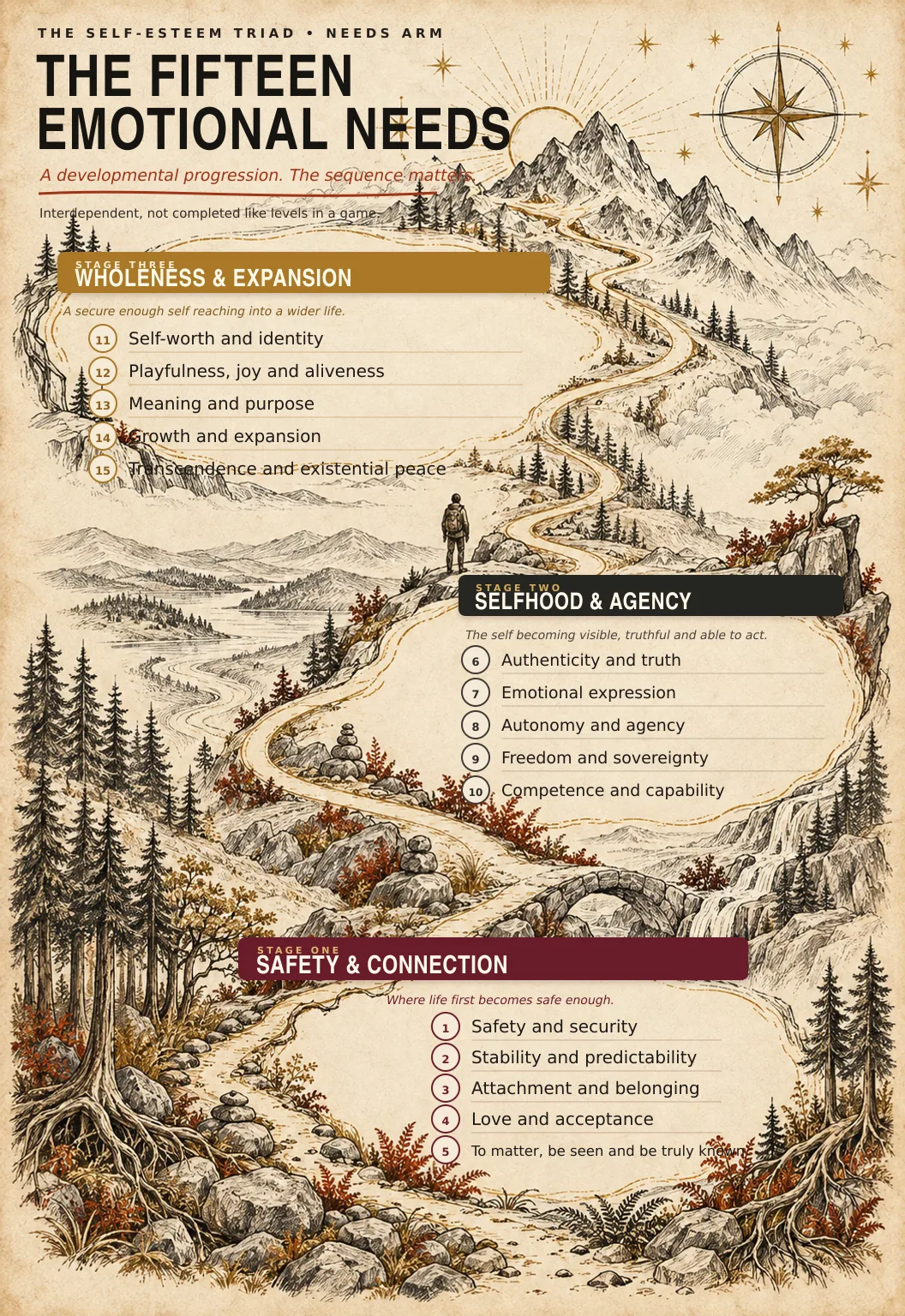
Within the needs arm of the Self-Esteem Triad is my developmental hierarchy of fifteen core human needs. They move from our most foundational requirements for safety and connection towards selfhood, meaning, growth and existential peace.

The Fifteen Emotional Needs, drawn as a path up a mountain. Stage one, Safety and Connection: safety and security; stability and predictability; attachment and belonging; love and acceptance; to matter, be seen and be truly known. Stage two, Selfhood and Agency: authenticity and truth; emotional expression; autonomy and agency; freedom and sovereignty; competence and capability. Stage three, Wholeness and Expansion: self-worth and identity; playfulness, joy and aliveness; meaning and purpose; growth and expansion; transcendence and existential peace.

Stage one

Safety and connection

Where life first becomes safe enough.

  1. Safety and security
  2. Stability and predictability
  3. Attachment and belonging
  4. Love and acceptance
  5. To matter, be seen and be truly known

Stage two

Selfhood and agency

The self becoming visible, truthful and able to act.

  1. Authenticity and truth
  2. Emotional expression
  3. Autonomy and agency
  4. Freedom and sovereignty
  5. Competence and capability

Stage three

Wholeness and expansion

A secure enough self reaching into a wider life.

  1. Self-worth and identity
  2. Playfulness, joy and aliveness
  3. Meaning and purpose
  4. Growth and expansion
  5. Transcendence and existential peace

They are interdependent, and we do not complete them like levels in a game. The sequence matters, though.

We can spend years pursuing purpose, growth, transcendence or the idea of finally being happy while having very little relationship with safety, belonging or acceptance. What looks like expansion may actually be escape. We keep reaching for something “out there” because turning towards the original hurt feels unbearable.

The language may sound elevated. The nervous system may still be trying to survive.

There is nothing wrong with wanting a meaningful life. The question is whether our pursuit of meaning grows from a secure enough foundation, or whether we are using it to avoid taking care of business closer to home.

How can I begin building self-esteem with the Triad?

The starting point is not a score, a diagnosis or another reason to judge yourself. It is gentle, honest observation.

Begin by learning what each arm means and noticing how it currently operates in your life. These questions are places to start, not a test you have to pass.

Explore your needs

  • What do I need in order to feel safe, connected and able to be myself?
  • Which needs can I recognise easily?
  • Which needs do I judge, minimise or expect myself to have outgrown?
  • Do I know how to meet some of these needs for myself?
  • Can I ask safe people to participate in meeting them?
  • Am I chasing a higher-level need while neglecting something more foundational?

Explore your boundaries

  • Can I tell where my responsibility ends and another person’s begins?
  • What happens inside me when somebody is disappointed with me?
  • Do I alter, silence or abandon myself to preserve connection?
  • Can I say yes freely, or is my yes driven by fear, guilt or obligation?
  • Can I remain emotionally connected to another person while holding a different view?

Explore your emotions

  • Which emotions feel welcome in me?
  • Which ones do I suppress, intellectualise, dismiss or judge?
  • What happens when somebody else expresses those emotions?
  • Can I notice a feeling without immediately acting on it?
  • Can I become curious about what the emotion is protecting, communicating or asking me to acknowledge?

There is no perfect sequence. You might begin with the arm that feels safest, or with the one creating the most difficulty. Work in one area will often reveal what is happening in the others.

The pace matters.

Awareness needs to be introduced at a rate the person can genuinely integrate. Insight delivered without regard for emotional and cognitive capacity can overwhelm the very system we are trying to help. Sustainable change involves calibration, allowing each realisation to become usable before demanding the next one.

The purpose is not to expose every gap at once. It is to develop enough awareness, safety and capacity that a healthier relationship with the self can take root.

A pathway out of self-abandonment

The Self-Esteem Triad gives us a practical way to understand something that can otherwise feel abstract.

Self-esteem is built in the moments when we notice what we need and respond rather than dismissing it. It grows when we let sadness belong, when we listen to anger without allowing it to run the entire show, and when we refuse to trade our identity for temporary approval.

It grows when we recognise that another person’s feelings are real without automatically making them our fault. When we allow ourselves to be known. When we ask directly. When we receive care. When we remain present through discomfort. When we stop demanding that confidence carry the weight of an undeveloped relationship with ourselves.

Over time, these moments become an internal foundation.

We become less dependent on performance to prove our worth. We become more capable of intimacy because connection no longer requires disappearance. We become more emotionally available because we are no longer at war with our own internal experience.

We become differentiated, authentic and able to say, with increasing steadiness:

This is who I am.This is what I feel.This is what I need.This is where I stand.I can be close to you and still belong to myself.

That is the work of the Self-Esteem Triad.

Related ideas

Begin exploring your Self-Esteem Triad

A guided introduction to understanding your needs, boundaries and emotions, recognising the protective patterns that developed around them, and beginning to build a more grounded relationship with yourself.

Back to Ideas & Models