Values Alignment Technique
Understanding what is driving your life before deciding where to take it.
Explore VAT

Meaning & alignment · A thinking architecture
Why people come last because people come first.
Most performance problems are diagnosed at the point where they become visible. Someone misses a deadline. A team member fails to follow through. A meeting goes nowhere. A strategy that looked perfectly sensible on paper produces patchy results, and eventually the conversation arrives at the person: Why didn’t they do it? What is wrong with their attitude? Do they need more feedback, more accountability, perhaps a performance review?
It is an understandable place to look because the person is standing right there. Their behaviour is observable. Their name is attached to the task. Yet by the time a problem becomes visible through a person, it may have travelled through an entire system that was never designed carefully enough to support the outcome being demanded of them.
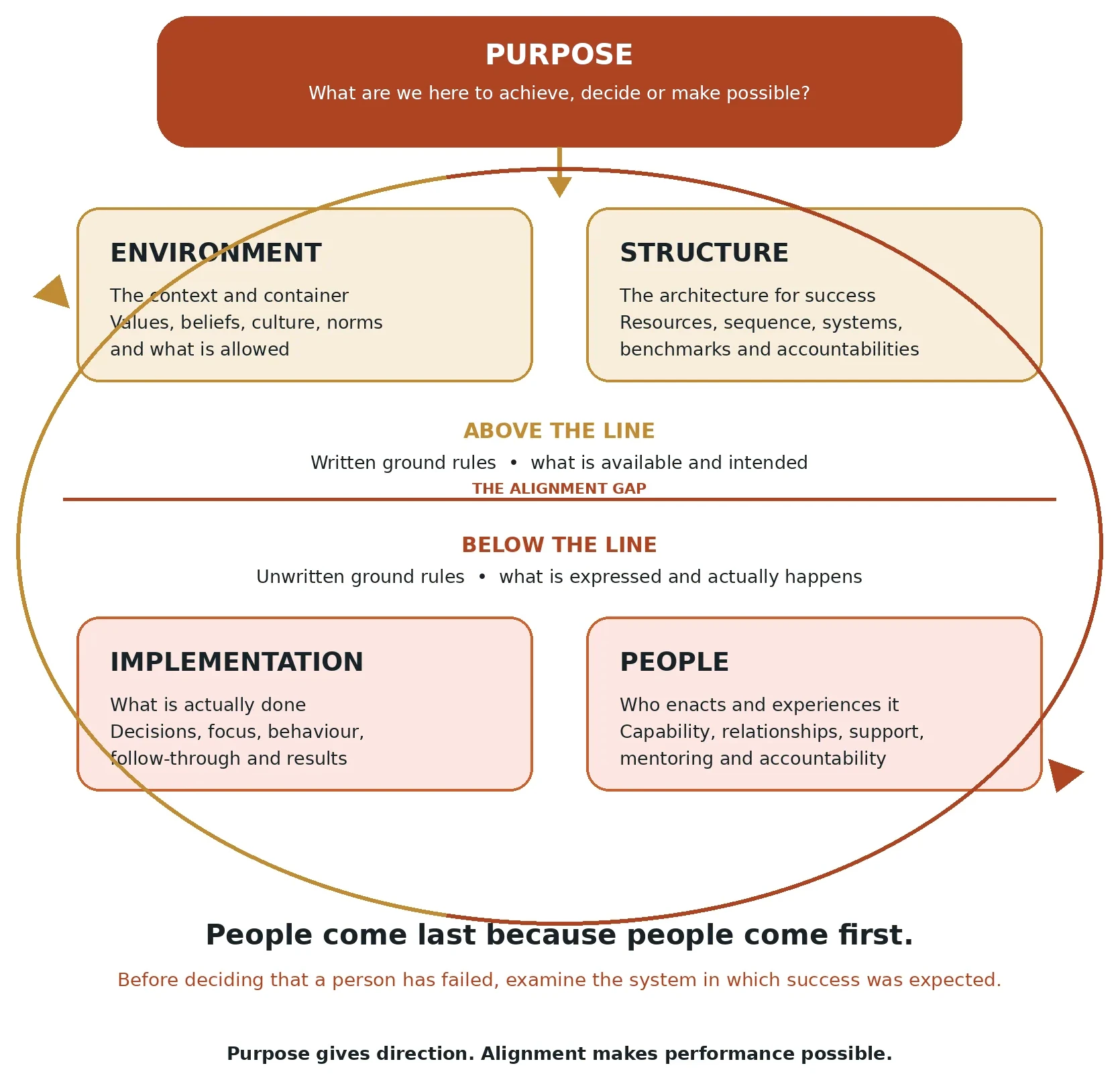
I developed the Critical Alignment Model, or CAM, because I wanted a way to think before reacting. I wanted to be able to examine a decision, a coaching conversation, a leadership problem or an entire organisation without being captured by whichever part of it happened to be loudest. I then organised the research program around the model and its profiling architecture so that the work could be examined rather than resting only on my experience or authority. CAM asks us to consider five dimensions in sequence: Purpose, Environment, Structure, Implementation and People. Each dimension changes how we understand the next one. Leave one out and we begin making decisions with missing information.
Purpose is the fifth and highest dimension of CAM. It sits above the model because without it, we can become extremely efficient at achieving an outcome that was never worth pursuing. Before discussing who will do something or how it will be done, I want to know what we are here to achieve. What is the purpose of this meeting, this project, this performance review, this coaching session or this organisation? What will be different if we succeed, and is that difference actually worthy?
This sounds obvious until you observe how rarely it is settled. People enter meetings carrying different purposes without realising it. A leader believes a performance conversation is about improvement while the person receiving it experiences it as evidence that a decision has already been made about them. A marketing team believes the purpose is to generate leads while the founder is trying to protect the reputation of the brand. Everyone can work hard and still pull the system apart.
Purpose is therefore more than a goal. A goal may tell us what we hope to produce. Purpose tells us why the outcome matters, what it must remain aligned with and what we are unwilling to sacrifice in order to achieve it. Once that is clear, the other four dimensions have something coherent to organise around.
Purpose gives direction. Alignment makes performance possible.
Environment is the context or container in which the outcome is being pursued. At an organisational level it includes culture, values, shared assumptions, market conditions, standards, written ground rules and what the organisation has decided is acceptable. Within a family, it may include the family’s norms, loyalties, unspoken permissions, beliefs about conflict and what happens when someone tells the truth. Within an individual, Environment includes beliefs, attitudes, identity, values, expectations and what that person holds to be possible.
The inner and outer environments can also be in conflict. A family may claim openness as a value while one parent carries an internal rule that disagreement is disrespect. A company may publish values about initiative while a leader privately believes that control equals competence. The written environment says one thing and the lived experience teaches another. That conflict matters because people learn the actual rules of a system very quickly, however beautifully the official ones are written.
When I work with a leader, I am curious about the environment from which they operate.
These questions reveal the conditions in which every later decision will be made.
Structure is everything that should make the desired outcome possible and repeatable. It includes available resources, roles, decision rights, categories of responsibility, policies, operational manuals, checklists, sequences, measures and benchmarks of excellence. It includes what happens first, what cannot happen until that first step is complete, how competence is established, and how anyone knows whether the work is good enough to move forward.
Take lead generation. A team cannot sensibly be told to generate more leads as though that instruction contains a strategy. There must be a product, then an offer, then a pathway through which the offer becomes visible. A landing page has its own benchmarks: the language, images, promise, evidence, call to action and the experience after someone responds. Each part depends on something earlier. If the sequence is incomplete, a bottleneck is not evidence that the person at the end of it is inadequate. The structure made the bottleneck likely.
Structure also includes resources and resourcefulness. Has the person been given the information, authority, time, tools and examples required to succeed? Have the benchmarks remained trapped in the leader’s head, only becoming visible when someone violates them? Many leaders believe they have delegated when what they have really done is transferred an expectation they have never made explicit.
Purpose, Environment and Structure tell us what has been intended and what is available. Environment and Structure contain the written ground rules. They describe what the organisation, family, team or individual says should happen.
Implementation and People reveal what is expressed. They contain the unwritten ground rules, the repeated behaviours through which we discover what the system truly permits, prioritises and produces. The distance between the two is the alignment gap. If the values say that honesty is welcome but people are punished for bringing difficult information into the room, the unwritten rule wins. If a policy requires careful review but every deadline makes review impossible, speed is the real policy.
This is why CAM is recursive rather than merely a checklist. What occurs below the line gives us information about what was missing, confused or contradicted above it. We then move back through the model, revise our understanding and try again. It is a thinking architecture, not a process to complete once and place in a folder.
The unwritten rule wins.
What are we here to achieve, decide or make possible?
The context and container
The architecture for success
Written ground rules · what is available and intended
What is actually done
Who enacts and experiences it
Unwritten ground rules · what is expressed and actually happens
Implementation is the work people actually do. It is how decisions are made, what receives attention, what is avoided, how consistently agreed processes are followed, and whether action produces the intended result. It is where Purpose, Environment and Structure become visible in behaviour.
Most organisations rush here. They begin doing because doing feels productive, then attempt to repair the resulting confusion with more meetings, more urgency and more feedback. Conventional coaching often makes the same error. It asks what the client wants, what they will do next and when they will do it, without examining whether the goal belongs to them, what assumptions shaped it, what system surrounds it or what the outcome will cost. That may produce activity. I do not regard it as deep coaching.
Behaviour matters, of course. The mistake is treating it as though it appeared independently. CAM asks whether implementation is aligned with the stated purpose, supported by the structure and possible within the environment. If it is not, exhorting people to try harder is poor leadership wearing the costume of accountability.
People are the final dimension because leaders have an obligation to establish the conditions in which people can reasonably succeed before deciding that the problem resides within them.
The phrase I have used for years is that people come last because people come first. It is not sentimental. It is a demanding leadership standard. Until Environment, Structure and Implementation are in place, what appears to be a people problem is usually a leadership or systems problem.
Imagine a meeting in which someone says that a colleague failed to complete their part of a project. The surface reading is simple: the person did not do it. Move one dimension back and we may find that their work depended on an approval that never arrived. Move into Structure and we discover there was no clear owner for that approval, no escalation point and no benchmark for when the work had to leave one part of the operation to reach the next. What looked like an individual failure was the predictable end of an upstream bottleneck.
I have used CAM in organisations for many years, and the pattern is remarkably consistent. Leaders arrive believing they have a people problem. Once we examine the earlier dimensions, we find unclear purpose, a culture that contradicts its stated values, missing architecture, confused decision rights, inadequate resources or implementation that has drifted away from the original design. Sometimes, after all of that has been repaired, there is genuinely a people problem. CAM does not remove accountability. It makes accountability honest.
Before deciding that a person has failed, examine the system in which success was expected.
CAM is content-independent and context-independent. The subject changes while the architecture remains useful. It can be applied to a strategic decision, a family conflict, a speaking event, a coaching session, a product launch, a personal goal or the design of an organisation. We still ask what the purpose is, what environment contains it, what structure supports it, what is being implemented and who is involved or affected.
I built The Coaching Institute using this model, and it became the foundation of my bestselling book, Disruptive Leadership. CAM has since been adopted within large organisations internationally because it gives leaders a way to move beyond the most convenient explanation and examine the whole system. It has shaped how I coach leaders, facilitate difficult conversations, diagnose organisational problems and conduct strategic thinking at senior level. It also challenges one of the most persistent habits in leadership: blaming the point at which a problem becomes visible instead of tracing the conditions that produced it.
The Critical Alignment Model is research-informed. I organised the research around it deliberately, drawing together bodies of work concerned with systems thinking, adult development, double-loop learning, motivation, organisational design and reflective inquiry. I also organised the development of the associated Meta Dynamics™ Profiling Tool to examine preferences across the Environment, Structure, Implementation and People dimensions. The 2017 technical handbook reports a normative sample of 535 professional participants and documents internal consistency testing, construct comparisons and factor analysis. That factor analysis broadly recovered the four proposed CAM domains, with an additional factor containing extraneous items or outliers.
The psychometric work supports the development of the profiling tool and the coherence of its domains. I am not interested in inflating that into a claim that every proposition or application of CAM has somehow been proven.
Its credibility comes from something more substantial: a clear theoretical foundation, an organised program of research around the profiling architecture, and decades of applied use across leadership, facilitation, coaching, business design and strategic decision-making.
The full Meta Dynamics™ profile offers a detailed view of thinking preferences across the model. The CAM mini profile provides a more accessible entry point, helping someone notice where they naturally place attention and which dimensions they may neglect. Neither should be used to place a person in a fixed box. The useful question is what their preference causes them to notice, what it causes them to miss and what becomes possible when their thinking widens.
Not a personality label. A development map.
The next time a performance problem appears, resist beginning with the person.
This does not make leadership slower. It stops organisations spending months trying to correct the wrong part of the system.
People come last because people come first.
For senior leaders who want to use CAM to think through a substantial strategic question, join the waitlist for Rebel Yell, my senior-level strategic thinking offer.
Join the Rebel Yell waitlistTo see where your attention naturally goes across the model, complete the CAM mini profile online.
Take the CAM mini profileFor the fuller leadership application of the model, read my bestselling book Disruptive Leadership.
Purchase Disruptive LeadershipUnderstanding what is driving your life before deciding where to take it.
Explore VATWhat operating logic is this person, team or organisation using?
See the levelsWhat the problem we keep trying to solve may be protecting us from.
Read on Talk to Remi