

The Self-Esteem Triad
Needs, boundaries and emotions, with worthy, lovable and enough at the centre.
Read the triad


Why Do We Keep Trying to Solve the Same Problem?
Someone sits across from me and explains, often with considerable accuracy, what is wrong with their partner. They are inconsistent. They avoid difficult conversations. They make promises and fail to keep them. If they would finally take responsibility, the person telling me this could stop feeling so anxious and get on with enjoying the relationship.
Sometimes every word of that account is true. The partner really does need to behave differently. But as we talk, another question begins to emerge … what happens to this person if their partner never changes? Where does that leave their capacity to care for themselves, recognise what they need, or decide what they are willing to live with?
I began developing the distinction between safe problems and risky truths through working with clients individually and doing intervention work with audiences. I kept noticing how often people located the problem somewhere outside their own influence. It was their past. It was someone else’s behaviour. It was a situation that should never have happened, or circumstances that refused to cooperate. Their explanations were frequently understandable, and sometimes impossible to dispute. Yet the explanation could also leave them with very little room to move.
You cannot change what happened in your childhood. You cannot make another person become accountable, emotionally available or willing to love you well. There are circumstances you can influence and circumstances you cannot. If your relationship with yourself has to wait until all of that is resolved, you may find yourself waiting a very long time.
The question that interested me was where some agency remained, even when the difficulty was real. Over time, I came to understand that the risky problem was more accurately a risky truth: something about our own experience that we had not yet felt able to meet.
A safe problem can be deeply painful. It can consume years of someone’s life and have serious consequences. The word “safe” describes the protection that focusing on it provides. While our attention stays on the familiar problem, we may be spared from feeling or acknowledging something more emotionally exposing.
We may be consumed by someone else’s lack of love while barely recognising how often we abandon ourselves to keep their attention. We may be trying to eliminate a behaviour without having any relationship with the loneliness that makes the behaviour so compelling. We may keep returning to an account of why our life cannot change because considering what we could do next brings us into contact with fear we do not yet know how to hold.
None of this needs to be conscious. Someone can sincerely want a problem to end while also relying on the protection it offers. That is part of what makes these patterns so confusing. We can be exhausted by something and still feel threatened by the possibility of living without it.
A safe problem can also be something we can directly change. Procrastination, for example, is a behaviour we can interrupt. But if we focus exclusively on getting ourselves to act, we may never discover what acting would expose us to. Perhaps completing the work means letting it be seen. Perhaps being seen brings the possibility of judgement, and judgement touches a much older uncertainty about whether we are enough.
The behaviour matters. Understanding its protective function changes how we approach it.
Above the surface
Just beneath
Deeper still
What can I meet with compassion? Where do I have agency?
In my work, I am rarely satisfied with helping someone manage a protective behaviour without also exploring what it is protecting. I want to understand what happens inside them when the familiar way of coping is unavailable.
Consider someone whose addictive behaviour is bound up with loneliness or disconnection. “I have to stop doing this” may become the entire problem as they understand it. They monitor themselves, make promises, try harder and feel ashamed when they return to the behaviour. Meanwhile, the question of how to experience genuine connection remains largely untouched.
Through this model, I would want to explore what connection asks of them. Can they allow someone to know them? Can they acknowledge that they need care? What happens when they feel lonely without immediately reaching for relief? Do they have any experience of being accompanied through that feeling?
That is an inquiry into the role the behaviour may be playing for this person. It is not a claim that every addiction has the same explanation, or that understanding an emotional pattern replaces other support. It is a reason to look carefully at what we are asking someone to give up, and what capacity they have to meet the experience underneath it.
A child who feels overwhelmed needs help with that experience. Someone who can remain present, respond with care and help them discover that a feeling can be endured without losing connection. When that support has been missing, a person may reach adulthood with very little confidence in their ability to experience loneliness, sadness or fear without being overtaken by it.
From that position, protection makes sense. Numbing may make sense. Controlling what other people do may make sense. The pattern may be costly now, but we need to become curious about why it has felt necessary.
My focus is on helping someone develop a different, felt relationship with what hurts. Being able to explain a feeling is useful, but I also want to know whether they can experience it with some compassion for themselves. Can they notice the loneliness and remain present? Can they feel hurt without deciding the hurt makes them weak or unlovable? Can they receive support without feeling ashamed of needing it?
As that capacity develops, the behaviour may become less necessary. There is more available to the person than the familiar struggle to overpower themselves.
A risky truth often brings us close to something we have spent years avoiding. We may have to acknowledge how much we want to be loved, how lonely we have become, or how frightened we are that someone could know us properly and still leave.
We may also have to recognise what we already know about a situation. That a relationship is hurting us. That we keep agreeing to things we resent. That the life we are maintaining requires us to suppress needs we can no longer pretend not to have.
There can be consequences to knowing these things. Once I accept that my need for care is legitimate, it becomes harder to keep explaining away its absence. Once I recognise that I matter, some of the arrangements I have tolerated may become difficult to continue.
This is why I do not treat the process as a clever exercise in getting someone to admit the “real problem”. An interpretation can be intellectually plausible and still arrive too quickly to be useful. The person needs enough emotional and intellectual bandwidth to consider what is emerging.
Nothing is gained by making someone feel exposed and then calling that a breakthrough.
The relationship between an anxiously attached person and a dismissively avoidant partner can help illustrate this distinction. These are descriptions of attachment patterns, not fixed identities, and the details differ between relationships. But a familiar dynamic is one person pursuing connection while the other withdraws from it.
The person pursuing may spend enormous energy trying to get their partner to show up consistently, handle conflict and take responsibility. Those requests may be entirely reasonable. The avoidant partner still has responsibility for their behaviour.
The inquiry is what the pursuing person can do on their own side of the street.
What happens inside them when their partner pulls away? What keeps them trying to earn a response from someone who repeatedly refuses it? What do they feel when they consider that this relationship may not be able to offer what they need?
Those questions can bring us into contact with an attachment wound. They can also bring us into contact with grief. It may feel more familiar to keep trying to fix the partner than to acknowledge the possibility that the relationship is unacceptable as it stands.
As the person develops more self-compassion and a clearer relationship with their emotional needs, the dynamic may lose some of its hold. They may become less willing to pursue, persuade or accommodate at their own expense. They may recognise, with considerable sadness, that they cannot keep participating in this relationship.
Their partner has not necessarily changed. Their own relationship with themselves has.
Taking care of your side of the street can therefore lead to a boundary, a different conversation or a decision to leave. It does not mean becoming sufficiently calm to tolerate whatever someone else does. Nor does it mean accepting responsibility for another person’s mistreatment. Their side of the street remains theirs.
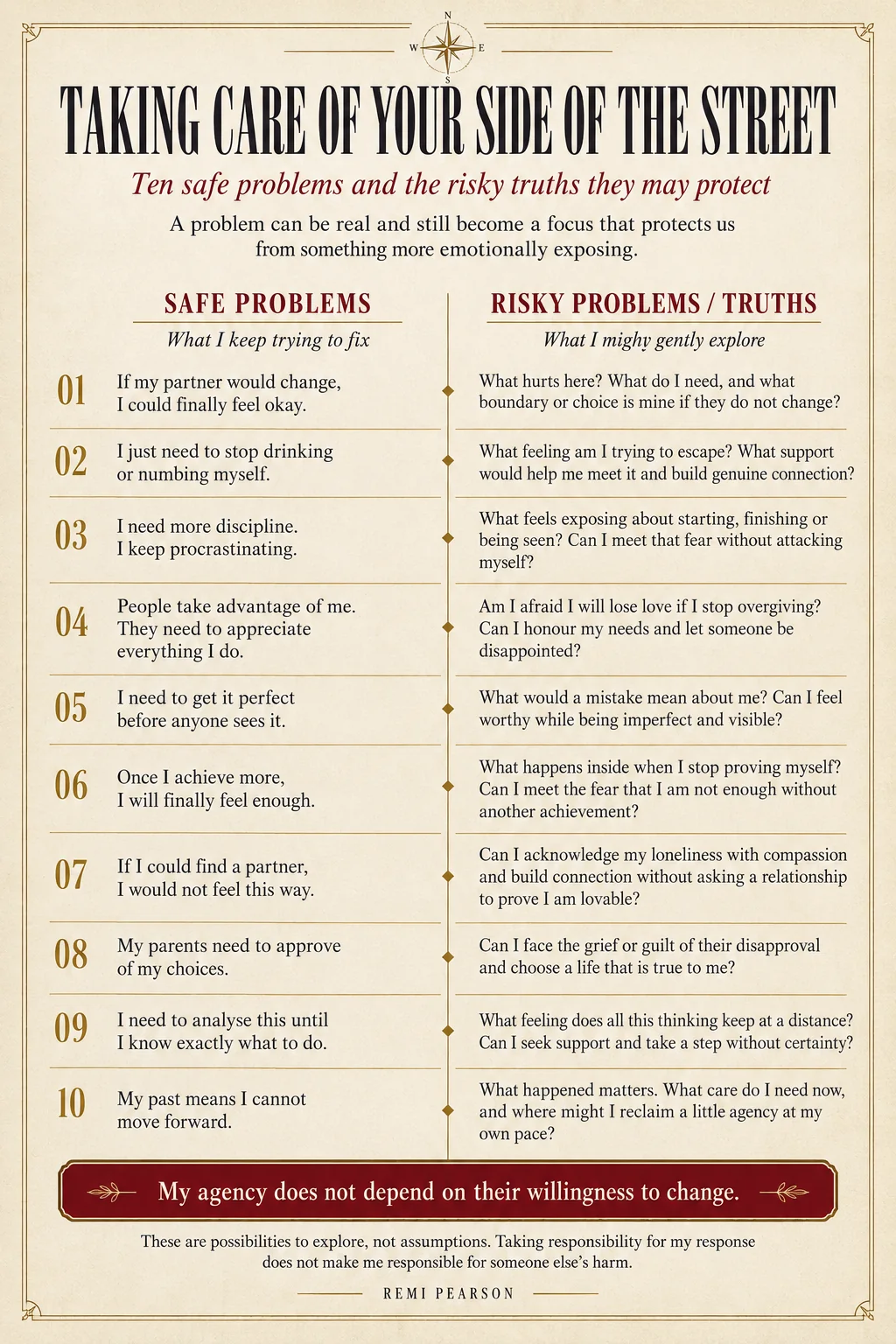
My agency does not depend on their willingness to change.
This distinction needs particular care when we are talking about illness, childhood abuse or other experiences a person did not choose.
Someone living with cancer has a real illness. Someone who was abused as a child experienced real harm. The invitation to explore agency must never become an implication that they created what happened, or that changing their attitude will make the external difficulty disappear.
What I am interested in is whether there is any room to care for ourselves within what is happening. Can we claim something for ourselves while life is difficult? Can we receive love, recognise a need, ask for help or experience a moment of joy without requiring the entire situation to be resolved first?
Even that can be a big ask. If someone hears it as “Now I am supposed to feel joy while I am going through this”, we have added another burden. That is not the intent.
The invitation needs to remain small enough and compassionate enough to be useful. Perhaps today there is no access to joy. Perhaps what is available is the possibility of feeling frightened without criticising ourselves for being frightened. Perhaps we can let someone sit beside us, or say honestly that we are having a hard day.
Agency includes how we respond to our own limits. There is no requirement to turn pain into a positive experience before we deserve care.
Safe Problems, Risky Truths helps us recognise where we may be directing our attention and what we may be protecting. It gives us a place to begin. The work that follows depends on the person and what emerges.
I might invite someone to consider:
These questions are invitations. They do not come with an answer someone is supposed to produce. If a person cannot yet identify what they are protecting, we can respect that. If the inquiry brings them close to overwhelm, we need to notice and respond to their capacity.
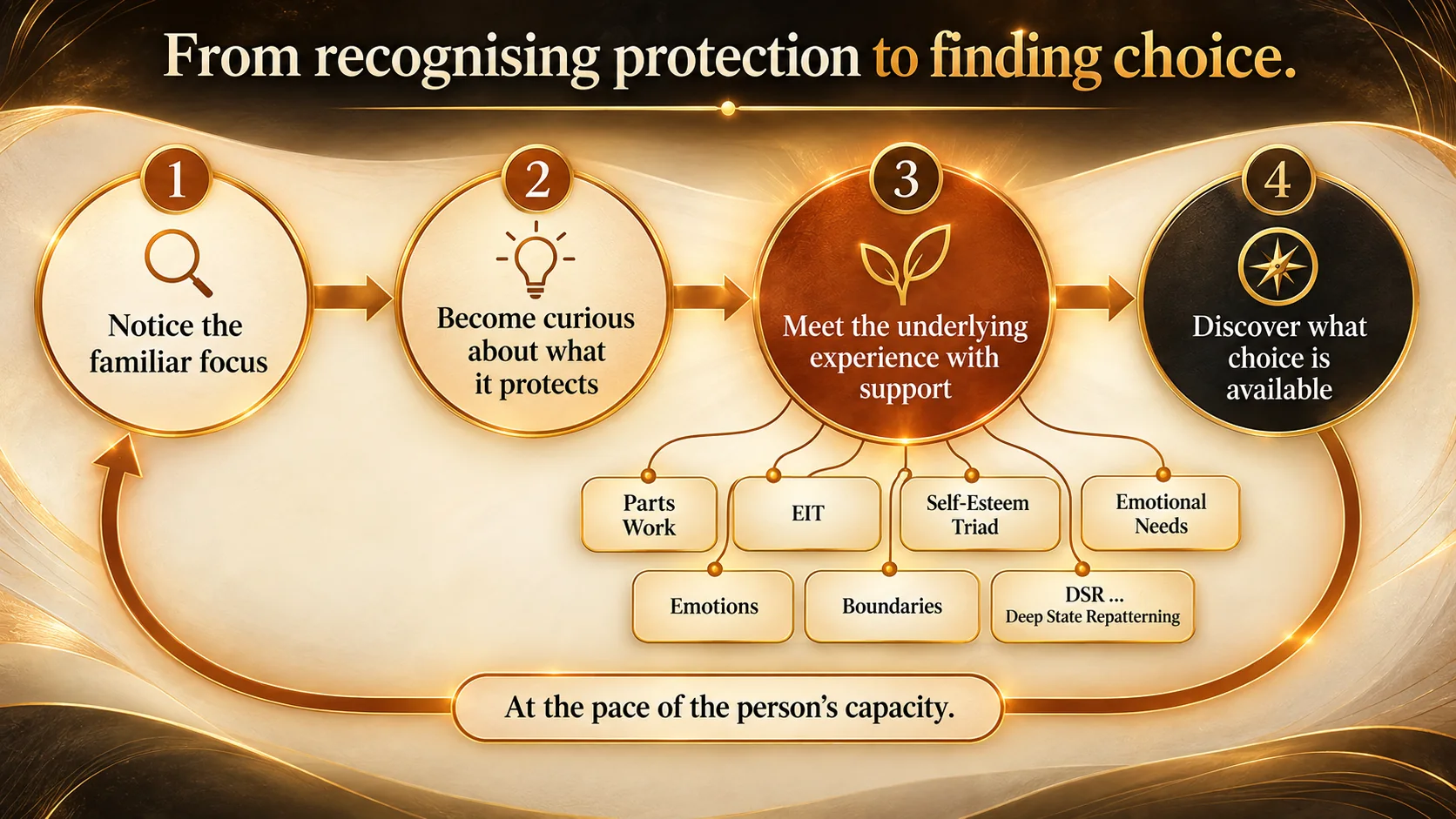
I use different approaches within this work, including IFS-informed parts work, Emotional Integration Technique and the Self-Esteem Triad. Each offers a way of developing the relationship with what has come into view. We might become curious about the part that feels it must keep everyone happy. We might gently explore the emotion beneath an urge to control. We might discover an emotional need the person has scarcely permitted themselves to recognise, or a boundary they have never felt entitled to hold.
The pace matters throughout.
A person can have a powerful intellectual understanding of their pattern and still need time, support and repeated experience before something shifts emotionally. We cannot assume that because they can describe it, they are ready to be without it.
For me, the pathway to self-acceptance includes building a relationship with the emotions we would rather not have. It is difficult to accept ourselves while continually rejecting what we feel.
That does not mean we enjoy every emotion, act on every impulse or remain indefinitely in distress. It means we begin to recognise that sadness can be here without making us inadequate. Loneliness can be acknowledged without making us unlovable. Hurt can receive our attention without becoming evidence that something is wrong with us.
This is what I mean by being okay with not feeling okay. There is room for our actual experience, and we can respond to it with care.
The Self-Esteem Triad belongs here because emotions, needs and boundaries are involved throughout. Our emotions may help us recognise what requires attention. Our needs give us a clearer sense of what matters. Our boundaries help us act in ways that take that knowledge seriously. The recognition that we are worthy, lovable and enough becomes something we practise in the way we treat ourselves, including when life is difficult.
A question I return to is, “What would love do right now?”
Sometimes love would ask us to rest. Sometimes it would help us have a conversation we have been avoiding, or stop making excuses for behaviour that hurts us. Sometimes it would simply stay with the part of us that feels frightened and has spent a long time believing it had to manage alone.
The external problem may still require attention tomorrow. We may still need to act, seek help or make a difficult decision. But there can be a change in how we accompany ourselves through it.
We no longer have to make our right to compassion conditional on the problem being gone.
Needs, boundaries and emotions, with worthy, lovable and enough at the centre.
Read the triadThe developmental hierarchy inside the Needs arm.
See the needsWhat to do in the live moment of activation.
Explore EIT Talk to Remi