

Deep State Repatterning
Why an old experience can stop being over, and how the mind can place it in the past.
Explore DSR


Why Can’t I Feel My Emotions Even When I Understand Myself?
Some clients can understand themselves brilliantly and still be almost entirely unavailable to themselves emotionally. They can explain their attachment pattern, identify the likely childhood origin of it, recognise the protector, describe what it does in relationships and perhaps even tell you why it developed. Ask them where they feel any of this in their body and the whole process can suddenly stop.
They look for the correct answer. They search for an emotion they can name with confidence. They try to work out where a feeling ought to be located, then become frustrated because they cannot find it. The more the practitioner asks them to tune in, the more conceptual they become. What was intended as an invitation begins to feel like a test they are failing.
I developed Emotion Integration Technique, or EIT, because I kept meeting people for whom parts work did not go far enough. This was particularly common among highly dissociative, intellectually defended clients and dismissive-avoidant men who seemed to live from the neck up.
They did not need more pressure to feel. They needed a way of beginning that respected the intelligence of the protection already in place.
Internal Family Systems gave us a powerful way of recognising that our apparently difficult behaviours are often organised by protective parts. A part withdraws, intellectualises, becomes angry, stays busy, forgets, controls, pleases or goes numb because at some point that strategy helped the system manage something it could not safely hold. This changed the conversation from “What is wrong with you?” to “What is this trying to do for you?”
Yet the healing movement in parts work usually depends on some access to curiosity or compassion. Many clients can understand that instruction intellectually. They can see that a part is protective and still feel irritated by it, ashamed of it or desperate to make it disappear. If compassion is unavailable, repeatedly asking for compassion becomes another demand. The client is left with the original protection and a fresh piece of evidence that they are somehow doing healing badly.
I encountered this very clearly with one client when I used the familiar parts-work invitation: could the dissociative part step aside? Another part appeared. I asked whether that part would step aside, and another appeared behind it. The process continued, part after part, while the dissociation remained. Eventually the obvious became unavoidable. Dissociation was not interrupting the work. Dissociation was the central protective strategy. Trying to move it out of the way made no sense.
So I stopped trying to defeat it and began working with it.
EIT begins with whatever is actually true for the person. The starting point might be frustration, numbness, tightness, annoyance, blankness, forgetting or simply, “I don’t know.” The client does not have to name the emotion correctly. In fact, insisting on a label can strengthen the very intellectualisation we are trying to soften.
A sensation is enough. The absence of sensation is enough. Not knowing is enough.
I might ask, “Can you feel compassion for the part of you that feels frustrated?” The answer may be no. Good. That is honest, and honesty gives us somewhere real to begin. “Can you feel compassion for the part of you that cannot feel compassion for the frustration?” Again, the answer may be no. Then we go another layer out. “Can you feel compassion for the part that cannot feel compassion for the part that cannot feel compassion?”
It sounds almost absurd when written down, but experientially something important is happening. Instead of asking the client to overcome dissociation, we are allowing the system to create as much distance as it needs. Every step outward makes the original experience less threatening. We keep moving until we reach a part the client can meet with genuine compassion.
Most people need about three layers. The furthest I have gone is five. There is no prize for reaching compassion quickly. The movement outward is not avoidance of the intervention. It is the intervention respecting the person’s existing route to safety.
“Can you feel compassion for the part of you that feels frustrated?”
No.
“Can you feel compassion for the part of you that cannot feel compassion for the frustration?”
No.
“Can you feel compassion for the part that cannot feel compassion for the part that cannot feel compassion?”
Yes.
Once compassion becomes available, we reverse direction. I ask the client to bring that compassion one step inward to the part that could not access it before. When the distance has been sufficient and the compassion is genuine, they can. Then we bring it through the next layer, and the next, until the client can feel compassion for the original frustration, numbness, dissociation or bodily sensation.
This is often a completely new experience. Highly dissociative clients are accustomed to judging their dissociation. They have been told, explicitly or implicitly, that they are cut off, too defended, emotionally unavailable, broken or difficult to reach. They may have spent years trying to fix this part of themselves. EIT allows them to encounter the dissociation as something worthy of compassion.
What has always been treated as the problem is finally understood as protection.
That softens the entire frame. There is often rigidity in dismissive-avoidant and highly intellectual defences, a constant sorting of experience into right and wrong, sensible and irrational, acceptable and unacceptable. This narrow lens is not evidence that the person lacks feeling. It is often evidence that feeling became unsafe enough to require a highly controlled relationship with life. Compassion introduces another possibility. The system no longer has to choose between control and overwhelm.
Move further out, one layer at a time, until a part appears that can be met with genuine compassion.
Carry that compassion back through every layer until it reaches the original presentation.
Ask what is underneath, and begin again from there.
Once the client can remain compassionately connected to the original presentation, we ask what is underneath it. If the starting point was frustration, sadness may appear. If sadness cannot yet be met with compassion, we move outward again until compassion becomes available, then carry it back inward. Under sadness there may be loneliness. Under loneliness, grief. The same movement repeats: outward, inward, then down.
The sequence is not imposed as a formula, and the client does not need to produce psychologically impressive answers. The process may begin with an emotion, a thought, a physical tightness, a blank space or an amnesic part that protects through forgetting. The practitioner follows what the system offers and continues to make compassion safer than judgement.
In my work, grief and shame consistently appear near the roots. Anger is not a primary emotion to me. It is a secondary emotion, often a more powerful way of expelling or defending against hurt and fear. Grief is woven through the human experience: grief for the childhood we did not have, what we lost, what we needed and never received, what we hoped a relationship might become, or the existential grief of being alive and knowing that everything changes.
Shame sits deeper still, particularly in people who are highly dissociative, defensive or dismissive-avoidant. This is not merely shame about something they did. It is shame organised around who they believe they are not: not lovable enough, not worthy enough, not strong enough, not capable of belonging as they are. I have not found an exception to this in the clients for whom EIT is most useful.
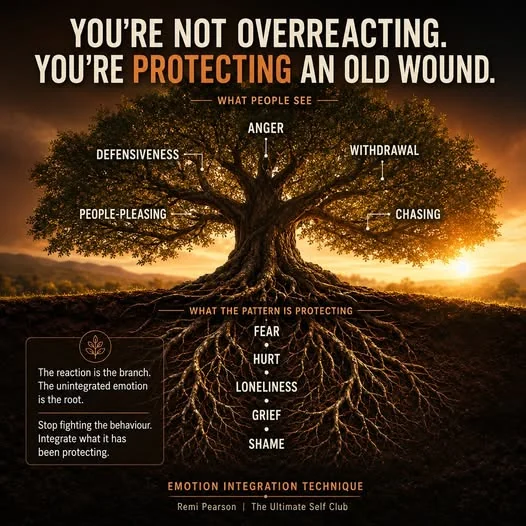
The goal is not to cut off the branches. The goal is to become capable of being with what is underneath them.
Is compassion the mechanism of EIT, or is capacity? Both. Compassion is the experience that becomes available. Capacity is what expands because the person can remain with an experience they previously had to avoid, suppress or push outside themselves.
Emotional capacity, as I understand it, means I can be with my uncomfortable feeling. I do not have to enjoy sadness or grief. I do not have to romanticise loneliness. I can stay in relationship with myself while the feeling is present. If I can feel compassion for my sadness, loneliness or grief, I am feeling compassion for myself. My emotional bandwidth has expanded.
That expansion changes relationships as well. When I cannot tolerate grief in myself, I am likely to struggle with grief in another person. I may minimise it, solve it too quickly, deflect into humour, become defensive, retreat, intellectualise or simply not know what to do. Once I can be compassionately present with my own emotion, another person’s emotion is less threatening. I have a way of being with it without having to erase it.
This is why EIT is bigger than reducing reactivity. It increases the range of human experience a person can remain present to. With more capacity comes more choice. The automatic protector does not need to disappear or be defeated.
It no longer has to carry the entire burden alone.
I believe wholeness is our natural state. We do not manufacture it through enough personal development. We notice it as we bring back into the fold what we previously had to exclude. Integration means welcoming the emotions that were pushed away, shut down or suppressed and meeting them with compassion rather than judgement.
Every emotion belongs. Every emotion developed within a context and serves a purpose. Protection makes sense because it organised around experiences the person could not safely tolerate at the time. The work is not to cut away the branches of the tree. The work is to become capable of being with what is underneath them.
A client has integrated an emotion when they can remain with it without becoming overwhelmed, rejecting it, disappearing into analysis or requiring a protector to take over immediately. The emotion can move through the person without becoming an identity or an emergency. What was previously exiled becomes part of the whole again.
This is also the movement towards self-acceptance. Compassion for dissociation becomes compassion for the self who needed to dissociate. Compassion for grief becomes compassion for the self who lost something. Compassion for shame reaches the self who concluded there was something fundamentally missing or wrong.
Bit by bit, the person comes home to more of themselves.
Not every client needs EIT. Many people can locate an emotion, access compassion and work directly with their parts. EIT was developed for the clients who cannot get to that first step without becoming more stressed, self-conscious or intellectualised. It is especially useful where dissociation, avoidance and conceptual thinking have become dominant protective strategies.
The technique is simple to describe, but it requires practitioner skill. The practitioner must recognise protection, work with light Ericksonian trance, pace the movement without force, listen for when compassion is genuine, and know when to move outward, return inward or drop beneath the presenting layer. This is not an exercise I recommend as casual self-inquiry. The softness of the process depends on the quality of the facilitation.
EIT is not endorsed by Internal Family Systems, nor is it part of the official IFS model. I developed it as the next step in my own work for clients whose dissociation prevented them from accessing the compassion parts work requires. It belongs in the wider public conversation because practitioners meet these clients every day. We need an approach that does not mistake their protection for resistance or make them responsible for the limits of the intervention being offered.
There is a particular beauty in watching someone feel compassion for a strategy they have spent years despising. The shoulders soften. The need to get the answer right begins to loosen. The client discovers that they do not need to force their way into the body or perform emotional fluency for the practitioner. They can begin exactly where they are.
The way in is sometimes found by moving further out. Once safety is real, compassion can make the return journey. What was held at a distance can come closer. What was underneath can emerge without being dragged into view. The person does not lose the protector. They gain a relationship with it, and with the grief, hurt, loneliness, fear and shame it has been carrying.
That is the purpose of Emotion Integration Technique. We are not trying to make somebody more emotional. We are helping them become more capable of being with the emotions that already belong to them.
The result is a wider internal world, a softer relationship with the self and more freedom in the moment when an old protection would once have made the decision.
If you are a practitioner, therapist or coach who would love to access this model, explore the blended practitioner training I will offer once each year, combining Internal Family Systems for practitioners with Emotion Integration Technique.
Why an old experience can stop being over, and how the mind can place it in the past.
Explore DSRNeeds, boundaries and emotions, with worthy, lovable and enough at the centre.
Read the triadWhat the problem we keep trying to solve may be protecting us from.
Read on Talk to Remi