
Parts work / IFS
Helps a younger part reveal what it protected, what it feared and what it needed.



Why Does the Past Still Affect You When You Know It’s Over?
Most people know when an experience is over in calendar time. They can tell you the year it happened, where they lived, who was there and how many decades have passed since. Yet the emotional system does not organise experience only by date. Something can be finished factually and remain unfinished internally.
The person may understand what happened, have talked about it many times, and still find that an ordinary moment in the present produces fear, shame, anger, hurt or powerlessness that belongs partly to another time.
That gap has occupied me for much of my working life. It is one thing to help somebody explain a pattern. It is another to help the pattern lose its authority. Insight matters, sometimes enormously, but conscious understanding does not automatically reach the level at which the original emotional meaning was formed. A person can know they were not responsible for what happened to them and still carry the felt conviction that somehow they were. They can know a present relationship is safe and still react as if abandonment or engulfment is imminent. They can know they are capable and continue to organise their decisions around an old moment of humiliation, rejection or failure.
I created Deep State Repatterning™ to work with this gap between what a person knows and what they continue to experience. The model begins with an observation:
Our problems are located in time.
We do not merely remember an event as information. We represent it internally through images, sensations, sounds, spatial locations and symbolic arrangements. We have a felt sense of where the past is, where the future is, and how close or distant particular experiences seem.
Deep State Repatterning™, or DSR™, uses those representations deliberately. It extends beyond the body of work of NLP by bringing symbolic time, light Ericksonian trance, carefully managed association and dissociation, parts work, emotional release, meaning change, self-forgiveness and future pacing into one coherent process.
The aim is to help a past event become part of a person’s history without continuing to act as an instruction for their present life.
When a significant emotional event occurs, especially in childhood, the mind is not recording a neutral documentary. It is trying to make sense of experience with whatever capacities are available at the time. A child thinks personally and emotionally. If a trusted adult is unavailable, rejecting, frightening or violating, the child rarely concludes that the adult lacks capacity. The conclusion is more likely to be about the self:
These conclusions may never become sentences, yet they can become the organising meaning beneath later decisions.
One event then gathers others around it. I describe this as a chain of pearls. Experiences with a similar emotional signature become linked, even when the circumstances are different. An early rejection may connect with exclusion at school, a betrayal in adulthood and a partner arriving home late. The present event may be relatively small, but it activates the emotional weight of the entire chain.
The person experiences today through an accumulation of yesterdays.
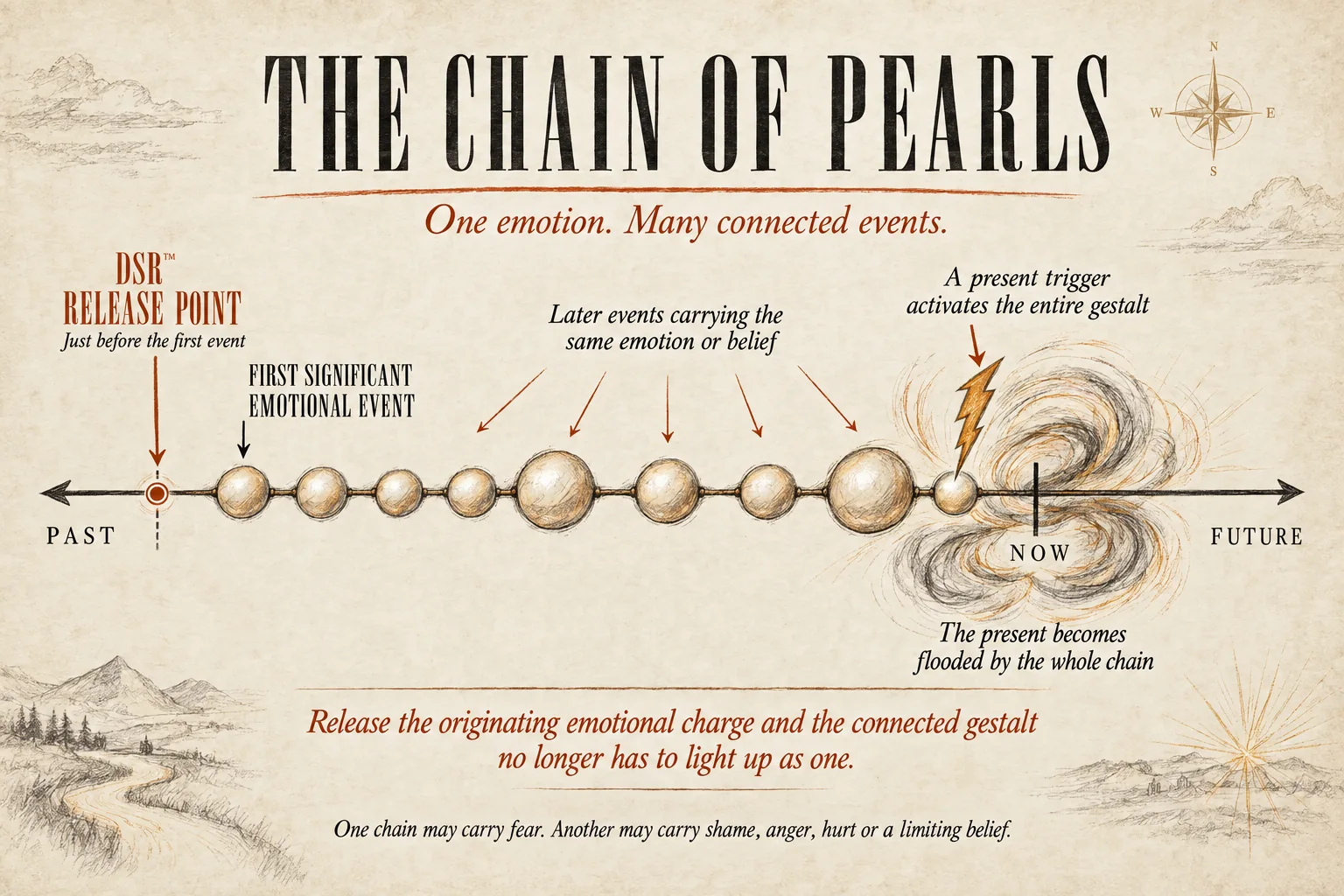
When the originating emotional meaning changes, the later chain has to reorganise.
This is why the first Significant Emotional Event, or SEE, matters in Deep State Repatterning™. The work does not settle for the most recent example simply because it is easiest to describe. We follow the pattern back to the earliest event the person’s mind identifies as relevant. The process is symbolic and imaginative by design. The mind works with symbols, spatial relationships, colour, movement and metaphor. Whether the timeline appears visually, is sensed in the body, or is known in some other way is less important than the person’s ability to work with their own internal representation.
People sometimes fear that a deep process means surrendering control. Deep State Repatterning™ is collaborative from beginning to end. I work with the client, never at them. They remain responsive, they make the discoveries, and the symbols and meanings come from their own mind. I routinely record the intervention and give the recording to the client. Listening afterwards often makes something beautifully clear:
The practitioner did not insert a revelation. The client found it.
The process depends on moving intelligently between association and dissociation.
Allows a person to experience something from within it, looking through their own eyes and noticing the emotion, meaning and bodily response.
Creates distance. The person may imagine floating above the timeline, seeing the event from far enough away to remain safe and resourced.
Too much association can flood the system. Permanent dissociation leaves the experience untouched. The movement between the two creates enough safety for the old pattern to become available without requiring the person to be swallowed by it again.
That distinction matters, particularly when the original experience involved abuse, abandonment or profound shame. The purpose is not to make somebody relive what happened. We are not looking for emotional theatre or intensity as proof that something important is occurring. We are creating the conditions in which the person can approach an experience, gain distance when needed, discover what was previously unavailable, and return with a different relationship to it.
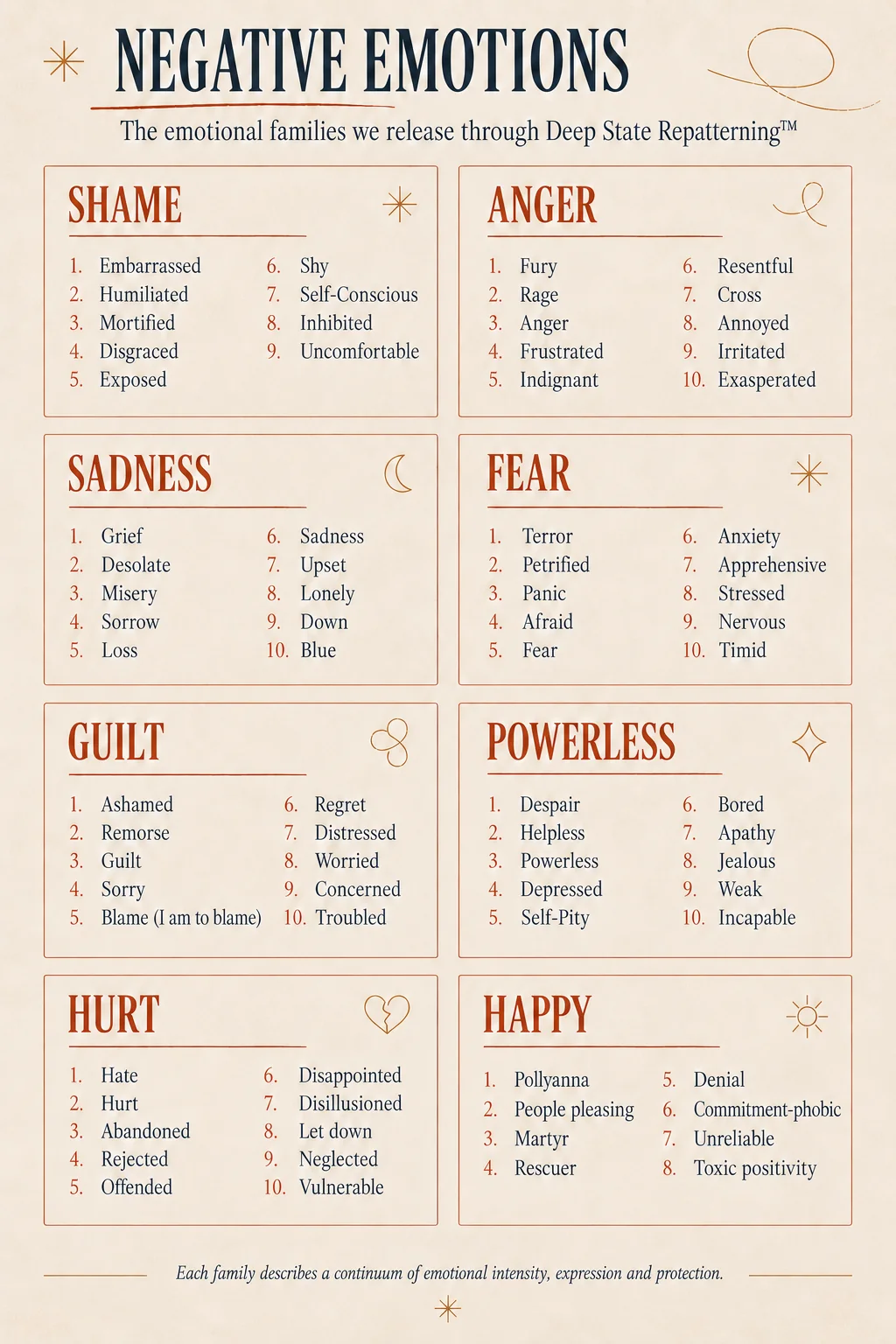
At the centre of DSR™ is work with a negative emotion or limiting belief attached to a past event. This does not mean deleting memory. It does not mean deciding that harm was acceptable, pretending the past was positive, or becoming incapable of feeling fear, anger or sadness. Emotions belong to us. They carry information and help us respond to life. The difficulty is the historical charge that arrives before the present moment has been accurately assessed.
When the process works, the meaning attached to the event may lose its force, become flat, become unavailable or simply become unnecessary. The memory may remain, but it no longer makes the same demand. The person can look towards it without the old physiological and emotional pull. The event stops being an active instruction about who they are, what relationships mean, or what the future permits.
This gives the person a fresh start with the emotion.
Fear can return to being fear about something genuinely threatening now. Anger can become a boundary signal rather than the accumulated force of every earlier violation. Sadness can belong to an actual loss without opening the whole archive. The emotional capacity remains. The historical chain no longer has to run the present.
The shift also changes time in the other direction. If the past no longer carries the same meaning, the person’s current experience of themselves can change. When the present self changes, the future looks different too. Options that were previously invisible can become imaginable. A person who no longer experiences themselves as fundamentally unsafe, unworthy or powerless does not have to force confidence as a performance. Different choices begin to make sense from the inside.
I believe meaningful change often begins below the level of conscious reasoning. Willpower is useful for action, but it is a poor instrument for ordering an old hurt to stop hurting. We cannot reason ourselves out of every protective response because many of those responses were formed before we had sophisticated reasoning. They live in emotional learning, bodily anticipation, imagery and meaning.
For that reason, DSR™ uses light Milton Ericksonian hypnosis and precise language to engage the person’s imaginative and symbolic capacities. Hypnosis here is not a loss of agency. It is a focused state in which ordinary analytical interference softens enough for deeper associations to become available. The client is not made unconscious. They are invited into a different quality of attention.
The language matters. The timing matters. The practitioner must recognise when to invite greater distance, when to allow association, when a protective part needs to be heard, and when the person has reached an insight that sounds positive but has not yet arrived at its highest intent.
DSR™ uses a deliberate process of moving upward through a hierarchy of meaning. A learning may begin as I can protect myself, then become I can trust myself, I belong to myself, I am whole, or I am love. The words cannot be imposed. The practitioner listens for the point at which the person reaches a felt sense of self-recognition or belonging that is true for them.
Self-forgiveness is essential within the model, and it is often misunderstood. It does not mean the person caused what happened. In work involving childhood sexual abuse, the opposite recognition is frequently required: I could not possibly have prevented an adult from doing what they chose to do. A child may carry responsibility because personalising the event created an illusion of control. If it was my fault, perhaps I can become good enough, quiet enough, useful enough or invisible enough to stop it happening again. The strategy is tragic, but it is not foolish. It was the mind trying to survive an impossible experience.
Forgiving the self means releasing the charge of imagined responsibility, the shame of having been vulnerable, and sometimes the judgement of the protective strategies developed afterwards. It allows compassion to enter the memory without rewriting the facts.
Forgiveness of another person may emerge, but it is never a demand to minimise harm, reconcile, remove boundaries or abandon accountability.
Deep State Repatterning™ is a distinct intervention, but it does not sit in isolation from the rest of my work. When a person returns symbolically to an early event, a younger part may need attention.
Helps a younger part reveal what it protected, what it feared and what it needed.
Approaches the avoided emotional experience in manageable increments.
Clarifies why closeness, separation, dependence or autonomy carries a particular threat.
Reveals what happened to self-trust, self-worth and personal authority.
These are not techniques thrown together for effect. Each offers a different way of understanding what is occurring at the same moment. DSR™ provides the architecture of symbolic time, depth, safety and repatterning. The other models help determine what work needs to happen once the relevant experience is available. A skilled practitioner does not drag a person through a script. They understand the purpose of every element well enough to respond to the person in front of them.
This was central to my work with people who had experienced childhood sexual abuse. The intervention was never simply about making a memory feel less vivid. The deeper work was often the recovery of self-trust. Parts that had carried fear, shame, vigilance or self-blame needed to be met rather than overridden. The person needed to discover, at the level where the injury had been organised, that their perceptions belonged to them, their boundaries were real, their vulnerability was never consent, and their adult self could now protect what the child could not.
A compelling inner experience is not enough. The shift must be tested. After the originating event has been worked with, the client returns through the timeline and notices what happens to subsequent moments linked to it. We then bring to mind situations that previously triggered the emotion or belief.
The process then moves forward. Future pacing allows the person to encounter imagined situations that once activated the pattern and discover how they respond now. This matters because change is not complete merely because the past feels different during a session. The person needs an emerging experience of choice in the future. Their nervous system, imagination and sense of identity begin rehearsing life without the old instruction. What happens beyond the session matters as well.
Any method capable of reaching deeply into emotional experience must be handled with care. Depth by itself is not evidence of quality. Intensity is not healing. The practitioner’s task is to preserve agency, pace the work to the person’s capacity, recognise protection rather than battle it, and understand that the client’s mind is already attempting to help them.
Deep State Repatterning™ was developed through decades of coaching, teaching and intervention work at The Coaching Institute, which I founded. It reflects a conviction that has shaped my entire body of work: people are not defective collections of symptoms. Their patterns make sense in relation to what they experienced, what they concluded, and how they learned to protect themselves. The work becomes possible when we respect that intelligence while helping the person recognise that the conditions which created the pattern are no longer happening now.
A person does not need to forget their past to become free of its automatic authority. The experience can remain part of their history without continuing to dictate identity, intimacy, possibility or choice.
When the old emotional meaning is no longer needed, the past can finally become what the calendar has said it was all along: over.
Needs, boundaries and emotions, with worthy, lovable and enough at the centre.
Read the triadWhat the problem we keep trying to solve may be protecting us from.
Read onWhat to do in the live moment of activation.
Explore EIT Talk to Remi