

Why Do I Lose Myself in Relationships?
The moment you leave yourself, and how compassionate inner work helps you return.
Someone says something that hurts you, and before you have had time to acknowledge the hurt, you are explaining why they probably didn’t mean it. You are tired, but they need something, so you agree. You want to raise a concern, then notice their mood and decide that now is probably not the time. Somehow, it rarely becomes the time.
These moments can seem too ordinary to deserve attention. We call them being considerate, keeping the peace or choosing our battles. Sometimes that is exactly what they are. But when we repeatedly move away from our own feelings and needs to preserve a relationship, something happens inside us. We remain available to the other person while becoming increasingly unavailable to ourselves.
I think this is where self-abandonment deserves our attention. We often notice it afterwards, when we feel resentful, exhausted or strangely absent from our own life. The more useful place to become curious is the moment our experience stopped counting.
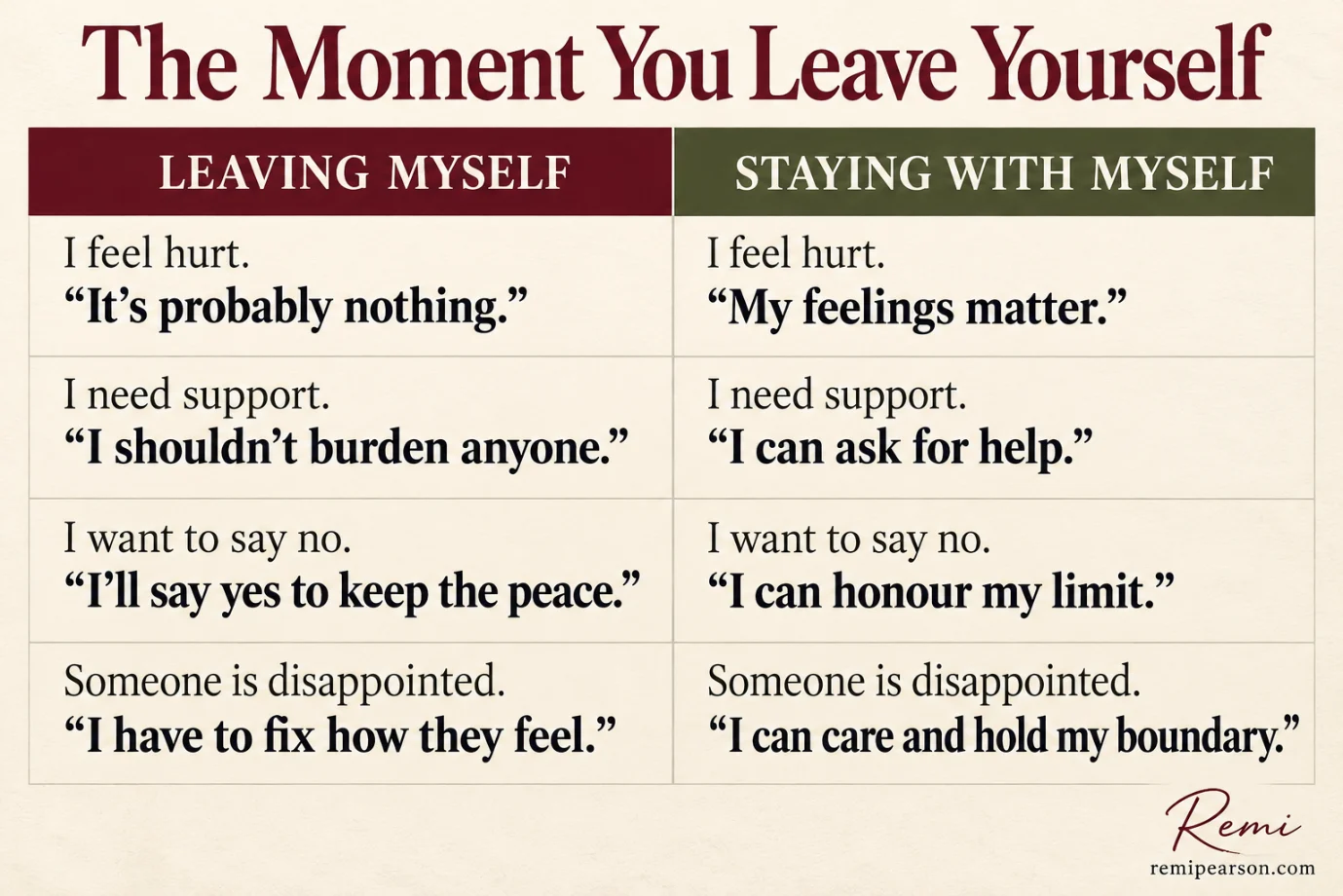
What does self-abandonment look like?
Self-abandonment can happen while we appear remarkably functional. We organise everything, respond thoughtfully and make life easier for the people around us. Meanwhile, our own discomfort is being edited out of the conversation.
Perhaps we tell ourselves we are too sensitive. Perhaps we decide that needing reassurance would be embarrassing, or that asking for support would add to someone else’s burden. We might even recognise what we need and immediately explain why we should manage without it. Knowing ourselves does not prevent us from dismissing ourselves.
Compromise leaves room for both people to matter. When self-abandonment becomes familiar, our own experience can start to feel like an inconvenience we must resolve before we are allowed to participate.
Why do I put other people’s feelings before my own?
For some of us, paying close attention to other people became an early route to connection or safety. We learned when to be quiet, when to help and which feelings were unlikely to be welcomed. Being easy to love may have seemed to require becoming very undemanding.
Internal Family Systems offers a compassionate way to explore these patterns. Within the IFS model, parts that please, control, withdraw or take excessive responsibility can be understood as protectors. Their strategies may be costly, but their intention is to prevent something the person experiences as threatening. The model emphasises respecting those protectors and developing a relationship with them before approaching the vulnerability they guard (IFS Institute, n.d.).
This changes the quality of our attention. We can become curious about what the accommodating part fears would happen if we spoke honestly. Would someone leave? Become angry? Decide we were selfish? A part of us may still experience those possibilities as far more dangerous than the gradual loss of ourselves.
How can compassionate self-inquiry help?
Compassionate self-inquiry begins with a willingness to notice what is actually happening. We might recognise tightness, hurt, numbness or an immediate urge to reassure the other person. We do not have to produce a sophisticated explanation before our experience deserves attention.
Useful questions include, What happened inside me just then? What am I trying to prevent? What do I need that I have already begun dismissing? We can also notice how we feel towards the part that stepped in. Are we curious about it, or furious that it has done this again?
That distinction matters. Inquiry can become another form of self-surveillance if we use it to catch ourselves being wrong. The possibility of change opens when we can listen without immediately requiring the answer to justify our feelings or make them disappear.
What if I cannot feel compassion for myself?
Being told to offer ourselves compassion can feel surprisingly difficult. Someone may understand the idea and still feel irritated by their vulnerability, ashamed of their needs or frightened of what might emerge if they stopped controlling everything.
Gilbert and Procter’s (2006) work on compassionate mind training specifically addressed people with high shame and self-criticism who found self-warmth difficult or frightening. Their small, uncontrolled pilot reported improvements in self-criticism, shame and self-soothing. It also recognised that compassion may need to become an accessible experience, rather than another instruction someone is expected to follow.
I developed Emotion Integration Technique for people whose protection makes that access difficult. The starting point may be frustration, blankness, dissociation or simply not knowing. In EIT, we work outward through the layers of protection until genuine compassion becomes available, then bring that compassion inward towards the original experience. We approach what is underneath at a pace the person can manage (Pearson, 2026).
This is facilitated work. Its purpose is to respect the protection while helping someone develop a different relationship with the feelings they have needed to keep at a distance.
How do I stay connected to myself when someone is disappointed?
My Self-Esteem Triad connects our relationship with emotions, emotional needs and boundaries, with worthy, lovable, enough at the centre. It gives us a practical way to consider what returning to ourselves might involve.
We acknowledge the emotion we have pushed aside. We allow the need we have discounted to matter. Then we consider what boundary or response would honour that experience. Perhaps we need time before answering, want to express hurt or need to revisit a commitment we made too quickly.
The difficult part may be allowing the other person to have feelings about our response. We can care about their disappointment while continuing to assess what is right for us. Guilt may appear, and we can listen to it without automatically assuming it proves we have done something wrong.
Self-compassion is something we can develop through practice. Neff and Germer’s (2013) randomised trial found that participants in a Mindful Self-Compassion programme reported greater increases in self-compassion and wellbeing than a waitlist group. This supports practising a more supportive inner relationship, including during the ordinary moments when our old responses appear.
What does returning to myself look like?
Returning may begin after we have already agreed, minimised the hurt or taken responsibility for something that belongs to someone else. We can notice what happened and reconsider our response. We can acknowledge the part that tried to protect the relationship while making room for the experience it pushed aside.
The relationship itself also deserves an honest assessment. Some people can make room for our needs; others repeatedly punish their expression. Inner work should help us recognise those conditions and decide how to respond, including when distance or leaving becomes necessary.
We may still feel uncertain. The other person may still be disappointed. But we begin to have a place in the conversation, and the relationship no longer gets our participation at the automatic expense of our own experience.
References
- Gilbert, P. and Procter, S. (2006) ‘Compassionate mind training for people with high shame and self-criticism: Overview and pilot study of a group therapy approach’, Clinical Psychology & Psychotherapy, 13(6), pp. 353–379. doi: 10.1002/cpp.507. Available as free full text.
- IFS Institute (n.d.) ‘The Internal Family Systems model outline’. Available at: IFS Institute (Accessed: 30 September 2026).
- Neff, K.D. and Germer, C.K. (2013) ‘A pilot study and randomized controlled trial of the Mindful Self-Compassion program’, Journal of Clinical Psychology, 69(1), pp. 28–44. doi: 10.1002/jclp.21923. Available as free full text.
- Pearson, R. (2026) ‘Emotion Integration Technique’. Remi Pearson. Available at: Remi Pearson
 Talk to Remi