

Why Do I Keep Repeating the Same Patterns?
Tell me the truth … what am I missing?
You find yourself having the same conversation with a different person. Or taking responsibility for something you promised yourself you would stop carrying. Perhaps you set a goal, genuinely care about it, and then watch another month disappear into everybody else’s priorities. The circumstances change enough to feel new, but somewhere along the way you recognise the ending.
It can be frustrating, particularly when you’ve already done considerable work on yourself. You can explain the pattern, identify where it began and talk thoughtfully about why it happens. Yet when the moment arrives, you still say yes, take over, go quiet or postpone the decision. Eventually, “Why do I keep doing this?” becomes a more searching question … “What am I not seeing?”
Why do the same problems keep happening?
There are several places to look, and we tend to return to whichever explanation is most familiar. If we’re accustomed to examining our childhood, we look there. If we’re action-oriented, we make another plan. If we’re used to carrying responsibility, we decide we need to try harder. Each approach may reveal something useful, while leaving other parts of the situation almost untouched.
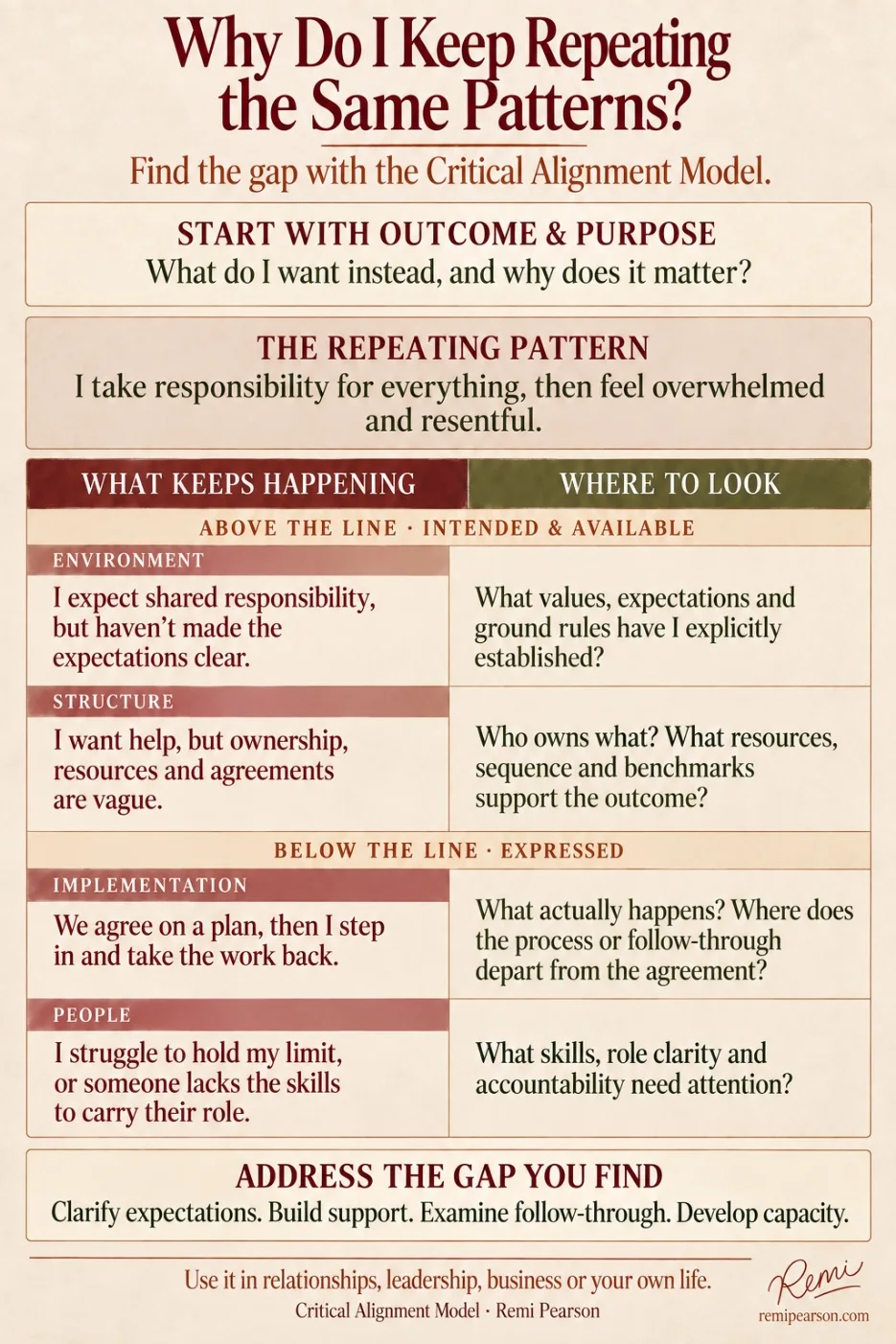
This is where I use the Critical Alignment Model, or CAM. We begin with the outcome and purpose, then examine four dimensions: Environment, Structure, Implementation and People. The model gives us a way to investigate the distance between what we intend and what is actually happening, and identify what needs attention (Pearson, 2026a).
Let’s take a familiar pattern: I keep taking responsibility for everything, then feeling overwhelmed and resentful. It might appear in a relationship, where you organise everything and initiate every difficult conversation. At work, you become the person everyone relies on to solve the problem. In your personal life, the things you want to pursue keep being pushed aside because someone else needs you.
There may be genuine demands and people who aren’t carrying their share. Those belong in the analysis. So does the possibility that some of your own arrangements and responses keep making this outcome more likely.
How do I identify what is keeping me stuck?
First, name the outcome you actually want. “I want to stop feeling overwhelmed” tells us what you want relief from, but leaves the alternative fairly vague. Perhaps you want a relationship with shared responsibility, a team that can make decisions without you, or time you can reliably devote to your own goals. What would that look like in an ordinary week?
Then we examine the four dimensions.
Environment concerns the values, expectations and ground rules you have explicitly established. If shared responsibility matters, have you named what that means? Have you communicated your limits, or are you hoping someone will notice how much you’re carrying? An expectation that exists only in your head gives other people very little to work with.
Structure examines what you have organised to support the outcome: resources, responsibilities, sequence and benchmarks. Who owns what? What time is available? How will you know whether things are improving? You can sincerely value your own development while leaving no room for it in your calendar.
Implementation brings us to what happens in practice. You agreed to delegate, then took the work back. You planned to protect an evening, then made yourself available. You intended to speak honestly, then said, “It’s fine.” Here we examine the process, follow-through and repeated departures from what was intended.
People concerns the skills, roles and accountability needed, including your own capacity. Can you make a clear request, hold a boundary or give feedback? Can the other person fulfil the responsibility they’ve accepted? We need to distinguish between something that hasn’t been clarified, something that hasn’t been learned and something someone repeatedly chooses not to do.
Above the line, Environment and Structure establish what is intended and available. Below the line, Implementation and People show how it is expressed. Examining both helps us locate the gap more precisely (Pearson, 2026a).
Why do I keep doing something I want to change?
Sometimes the practical gap is straightforward. Sometimes you discover that you’ve organised your life carefully, yet abandon the arrangement when someone is disappointed or uncomfortable.
That deserves attention. Being needed might give you a sense of belonging. Taking over might spare you the uncertainty of trusting someone else. Remaining endlessly available might protect you from the fear that a boundary will change the relationship. These are possibilities to explore, rather than conclusions to impose.
In my Safe versus Risky Problems work, we examine whether the problem we keep discussing allows us to postpone a more difficult truth. “Nobody helps me” may be accurate. There may also be an uncomfortable question about what happens when help is offered, or what you’re willing to do when a clear request is repeatedly ignored (Pearson, 2026b).
As I put it: “More information does not close a gap you are still organised around protecting” (Pearson, 2026a).
How can I be honest with myself without blaming myself?
An honest analysis requires enough compassion to keep looking. Otherwise, noticing your contribution becomes another opportunity to call yourself weak, foolish or somehow defective, and the examination quickly loses its usefulness.
Research supports taking a kinder approach to our mistakes. Across four experiments, Breines and Chen found that self-compassion could increase motivation to improve, including motivation to make amends and effort following a test failure (Breines and Chen, 2012). We can acknowledge something difficult about our behaviour while remaining interested in how it developed and what would help us respond differently.
Values Alignment adds another question: what do my choices currently make room for? If you say your own life matters, but repeatedly surrender every available hour, there is a discrepancy worth examining. Your constraints matter, and change may take time. Even so, the discrepancy gives you somewhere concrete to begin (Pearson, 2026c).
How do I stop repeating the same patterns?
Choose a change that addresses the gap you actually found. An unclear agreement needs clarification. A missing skill needs development. A boundary you repeatedly abandon may require inner work around the feelings that arise when you honour it.
Then observe what happens. A meta-analysis of 138 experimental studies found that interventions encouraging people to monitor their progress improved goal attainment on average, with larger effects when progress was recorded or reported (Harkin et al., 2016). Keep a simple record of the agreement, what happened and what you learned, so you have evidence to work with next time.
If you want help examining your own situation, Find the Gap in Your Own Life, AUD $29, is the place to begin. It uses Critical Alignment to help you identify what is preventing movement. Bring a real situation: the conversation you keep postponing, the responsibility you keep taking back, the goal that never gets room.
For a broader exploration, Find the Truth of the Situation brings together four programs for AUD $79: Find the Gap in Your Own Life; When Your Values and Your Life Stop Matching; Safe or Risky Problems?; and Let Truth Lead.
Start with the pattern you’re tired of explaining. What does a careful look at it reveal that your familiar explanation has been leaving out?
References
- Breines, J.G. and Chen, S. (2012) ‘Self-compassion increases self-improvement motivation’, Personality and Social Psychology Bulletin, 38(9), pp. 1133–1143. doi: 10.1177/0146167212445599. Accessible full text.
- Harkin, B., Webb, T.L., Chang, B.P.I., Prestwich, A., Conner, M., Kellar, I., Benn, Y. and Sheeran, P. (2016) ‘Does monitoring goal progress promote goal attainment? A meta-analysis of the experimental evidence’, Psychological Bulletin, 142(2), pp. 198–229. doi: 10.1037/bul0000025. Repository record and full-text access.
- Pearson, R. (2026a) ‘Critical Alignment Model’, Remi Pearson. Available at: Remi Pearson
- Pearson, R. (2026b) ‘Safe versus Risky Problems’, Remi Pearson. Available at: Remi Pearson
- Pearson, R. (2026c) ‘Values Alignment Technique’, Remi Pearson. Available at: Remi Pearson
 Talk to Remi