

Why Do I Keep Repeating the Same Patterns Even When I Understand Myself?
Why insight isn’t enough, and what inner work makes possible.
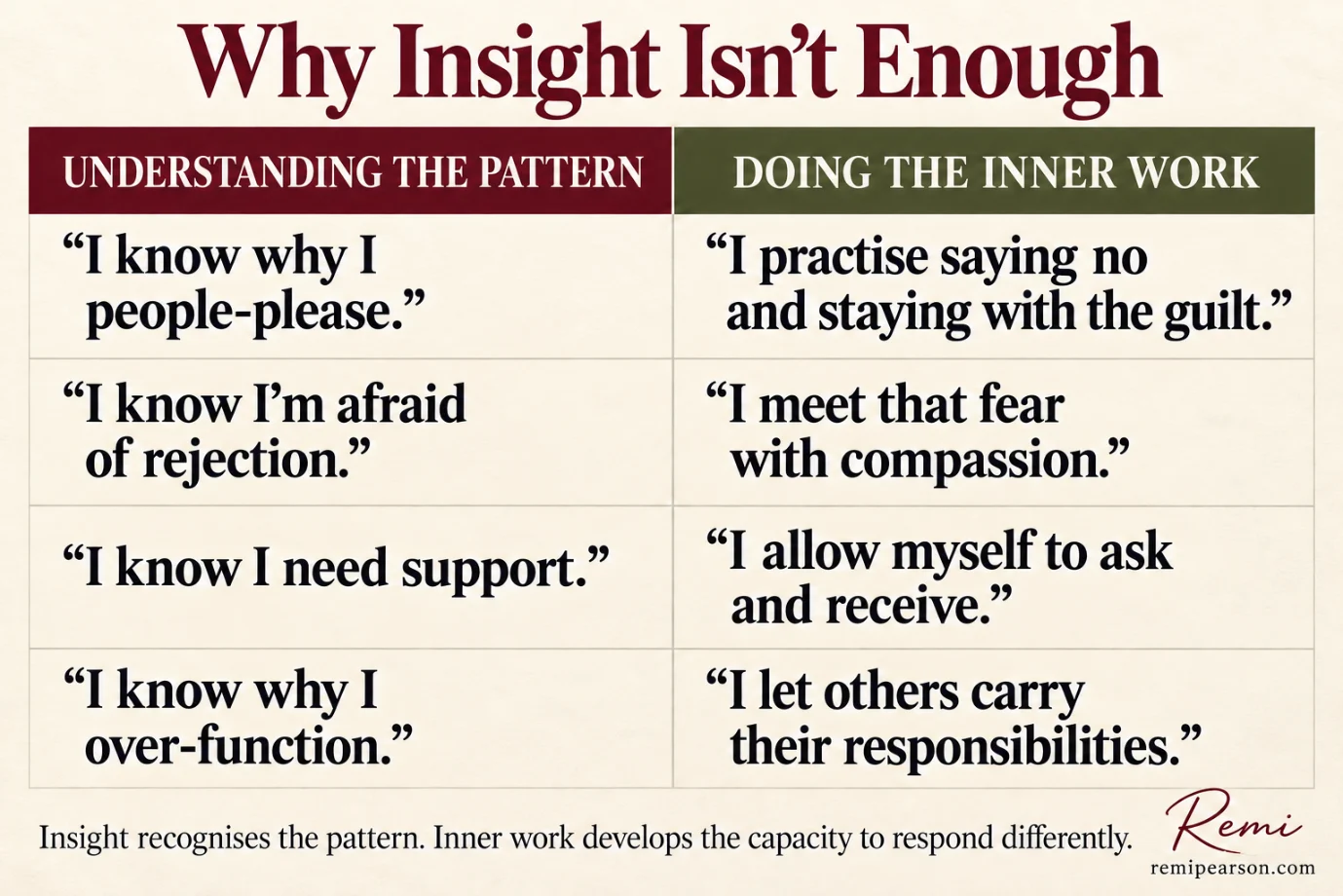
You can know exactly why you people-please and still say yes when everything in you wants to say no. You can recognise your fear of abandonment while watching yourself chase someone who keeps withdrawing. You can explain the family dynamics that taught you to become responsible for everyone and still find yourself carrying the emotional weight of a room before anyone has asked you to.
This is one of the most frustrating experiences in personal development. We have the insight. Sometimes we can see the pattern while we are doing it, which adds a particularly unpleasant layer of self-criticism … surely, if I know this much about myself, I should be able to do something different?
I have spent more than twenty years working with that gap. Understanding can be enormously helpful, but there comes a point when another explanation leaves us standing in much the same place. We need to become curious about what becomes possible when we bring our attention to the inner experience we have been explaining.
Why doesn’t self-awareness always lead to change?
Knowing that you learned to keep the peace tells you something about your history. It does not necessarily make conflict feel manageable today. You might understand that another person’s disappointment is theirs to experience, yet feel such intense guilt when it appears that you immediately surrender your boundary.
The understanding and the emotional capacity are different achievements. One allows you to recognise what is happening. The other develops as you become able to remain with feelings that previously required you to appease, withdraw, defend yourself or take control.
Courses can help us do this work. So can good books and thoughtful conversations. But we can also complete an extraordinary amount of learning without changing how we treat ourselves when we are frightened, ashamed or hurt. Our vocabulary develops while our inner world remains organised around the same old protections.
Can seeking insight become a form of avoidance?
Sometimes the search for understanding becomes a comfortable place to stay. We analyse our attachment style, investigate another framework and discover a more sophisticated explanation for our behaviour. Meanwhile, the grief we have never allowed ourselves to feel remains untouched.
I see intellectualising as a protective strategy when thinking about an experience keeps us at a distance from experiencing it. Someone can speak brilliantly about loneliness while barely allowing themselves to acknowledge how lonely they feel. They can describe their childhood with remarkable clarity and hurry past the sadness of what they needed and did not receive.
There is intelligence in that protection. At some point, understanding may have been safer than feeling. Inner work begins by respecting that history and becoming curious about whether we can now approach what has been kept at a distance, with enough support and gentleness for something different to happen.
What does doing the inner work actually mean?
My Self-Esteem Triad brings this work into focus through our relationship with emotions, emotional needs and boundaries. At its centre are the experiences of being worthy, lovable and enough. Each side asks us to consider how those experiences are expressed in the way we live.
Our relationship with emotions includes whether we can acknowledge hurt without calling ourselves weak, experience anger without immediately condemning it, or allow grief without imposing a deadline. Emotional integration involves becoming increasingly capable of being with what we feel, at a pace we can manage, while retaining a relationship with ourselves.
Research by Ford and colleagues (2018) found that habitually accepting thoughts and emotions without judging them was associated with better psychological health. Across laboratory, diary and longitudinal studies, acceptance was also linked with lower negative emotional responses to stress. The finding concerned accepting internal experiences; it did not require accepting the situations causing them.
Our emotional needs deserve that same attention. We may know we need connection, consideration or support and still behave as though asking would be unreasonable. The work includes discovering what happens inside us when our needs become visible. Do we feel embarrassed? Burdensome? Afraid that needing something will cost us the relationship?
Why are boundaries difficult even when we know what to say?
Many people know the boundary they need. They have rehearsed the words. What they struggle with is the feeling that arrives after they say them.
Someone becomes disappointed, and guilt appears. Someone challenges the boundary, and self-doubt takes over. We begin explaining, softening and negotiating until the boundary has quietly disappeared. Afterwards, we search for a better script, although the words may have been perfectly adequate.
Within the Triad, boundaries connect directly with emotions and emotional needs. Holding a boundary may require us to acknowledge our need for rest while allowing the discomfort of someone wishing we were available. We learn to consider that discomfort without automatically treating it as evidence that we have done something wrong.
How does over-functioning keep us disconnected from ourselves?
Over-functioning can be difficult to recognise because it is so often rewarded. We are capable, reliable and excellent in a crisis. People appreciate how much we carry, and we may have built a considerable part of our identity around being the person who copes.
Yet sometimes all that doing protects us from an uncomfortable inner experience. Being indispensable may feel safer than wondering whether we would still matter if we stopped helping. Managing someone else’s distress may spare us the helplessness of allowing them to struggle. Their needs become urgent while ours remain indefinitely postponable.
Fritz and Helgeson (1998) studied “unmitigated communion”, a focus on others to the exclusion of oneself. Across four studies, they distinguished this pattern from a caring orientation towards others and linked it with psychological distress, reliance on others for self-esteem and self-neglect. Their work gives us a useful way to examine the cost of caring when we repeatedly disappear from the equation.
Can self-improvement reinforce the feeling that I’m not enough?
I love learning. I also think we need to examine the promise we attach to it. If every course carries the hope that the next version of us will finally deserve acceptance, learning can become a way of repeatedly postponing our own worthiness.
Compassion offers another starting point. Breines and Chen (2012) found across four experiments that responding to mistakes or weaknesses with self-compassion increased several forms of motivation to improve, including effort after failure and motivation to make amends. We can take responsibility and develop without making contempt for ourselves the engine of change.
What becomes available through inner work is often very ordinary. We ask for support and allow ourselves to receive it. We acknowledge hurt without immediately explaining it away. We let someone be disappointed while remaining thoughtful about our boundary. We begin experiencing ourselves as someone whose feelings and needs belong in the conversation.
The pattern may still appear. This time, perhaps, we can stay with ourselves long enough to make a different choice.
References
- Breines, J.G. and Chen, S. (2012) ‘Self-compassion increases self-improvement motivation’, Personality and Social Psychology Bulletin, 38(9), pp. 1133–1143. doi: 10.1177/0146167212445599. Read the free full text.
- Ford, B.Q., Lam, P., John, O.P. and Mauss, I.B. (2018) ‘The psychological health benefits of accepting negative emotions and thoughts: Laboratory, diary, and longitudinal evidence’, Journal of Personality and Social Psychology, 115(6), pp. 1075–1092. doi: 10.1037/pspp0000157. Read the free full text.
- Fritz, H.L. and Helgeson, V.S. (1998) ‘Distinctions of unmitigated communion from communion: Self-neglect and overinvolvement with others’, Journal of Personality and Social Psychology, 75(1), pp. 121–140. doi: 10.1037/0022-3514.75.1.121. Read the free abstract.
 Talk to Remi