

Environment · The Visionary
The context and container: purpose, values, beliefs, attitudes, perceptions, attachment, culture and intangible limits.
Question: What is the world this situation is operating inside?



CAM Mini Profiler
The gap is never just the gap.
You can work harder, learn more and keep trying the same solution. But if the real gap is somewhere else, effort will not fix it.
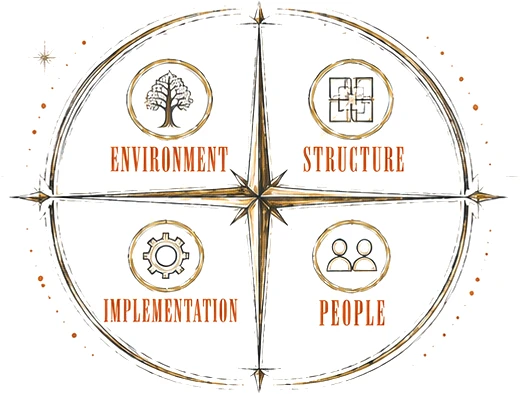
The Critical Alignment Model helps you see where alignment is breaking across four dimensions: Environment. Structure. Implementation. People.
A clearer picture of what your situation actually requires.
Answer a concise set of questions and receive a development map to help you see which dimension deserves attention first. Not a personality label. Not a diagnosis. A practical way to think more clearly.
 Take the mini profiler
 Answer at your own pace. No sales call. No application.
Different gap. Different intervention.
CAM helps us stop prescribing the same solution to every problem. It asks where the gap is actually occurring.
The context and container: purpose, values, beliefs, attitudes, perceptions, attachment, culture and intangible limits.
Question: What is the world this situation is operating inside?
Internal thinking and resources, plus external systems, plans, procedures and manuals.
Question: What needs to be designed or made visible?
What is actually happening in practice: action, autonomy, focus, follow-through and results.
Question: What is actually being done?
The relationships, capability, mentoring, social skill and mindful leadership involved.
Question: Who needs capability, clarity or support?
Different gap. Different intervention.
People come last because people come first.
Continue the assessmentSet yourself up for a useful result.
This is not a test of who you want to be. It is a snapshot of how you currently think, decide and behave in one real situation.
Choose a situation that is actually happening. Answer from what is true now, not how you imagine it, how you prefer it to be, or how you think it should be.
Choose the response that comes to mind first. Do not try to balance your answers or make your profile look good.
Answer based on what you currently are, not what you ideally would like to be. Only claim a behaviour you can recall demonstrating.
Be objective and accurate. If you need someone else to prompt you for an example, it probably does not describe you strongly.
The more truthful the answers, the more useful the picture.
Access the assessment Talk to Remi