

Free program with Remi Pearson Three videos + workbook
Your next big idea might be taking you away from what your business actually needs.
There’s no shortage of things you could do. Launch another offer. Upgrade your systems. Hire someone. Finally do something about the part of the business that keeps needing your attention.
The harder decision is knowing which deserves your time now. Especially when the new idea is exciting, the existing problem is frustrating, and both can make a convincing case for being your priority.
Core, Improve, Innovate gives you a practical way to make that decision. Learn to recognise what keeps your business working, where improvement will make a difference, and when a genuinely new direction deserves your investment.
Free program · Three videos and a workbook

- A$200MNearly, in cumulative business revenue
- 13,000+Coaches trained
You can work incredibly hard on the wrong thing.
You’ve spent the week doing things that seemed necessary. Your team needed answers. A new opportunity deserved a conversation. Something broke, something ran late, and an idea you were excited about took longer than expected.
By Friday, the work that would have made the business more dependable still hasn’t happened. The same delivery problem is waiting for you. A process still lives in your head. You’re making sales, but you’re not entirely confident that everything promised is happening consistently.
Then someone suggests another project.
When you run a business, almost anything can be made to sound like a priority. Without a way to examine those competing demands, you can spend months creating activity while the problem underneath it all becomes more expensive.
Core, Improve, Innovate helps you look at what each decision is actually doing for the business, including what it will take your attention away from.
Know what to protect, what to strengthen and where to go next.
These are different kinds of work. Understanding the difference changes how you approach them.
Core
Make the work your business depends on reliable.
Core is how your business delivers the value people pay for and remains viable. It includes attracting clients, delivering what you promised and collecting the income you’ve earned. It also includes the standards and knowledge that allow other people to do that work well.
When Core is unclear, the owner often becomes the person who catches everything. You explain it again, fix it yourself or step in because it feels quicker. The business keeps moving, but its reliability depends heavily on your availability.
Learn to identify what belongs in your Core, where it is vulnerable and what needs attention before you put more demand through it.
Improve
Make what already works work better.
A useful improvement solves an identifiable problem. It could make a handover clearer, reduce mistakes or help a team member deliver a result without needing you beside them.
The judgement comes in knowing what actually needs changing. Sometimes the process needs redesigning. Sometimes nobody is using the process you already have. Buying another platform won’t necessarily resolve that distinction.
Learn to recognise improvements that strengthen the business and examine whether the proposed solution addresses the real difficulty.
Innovate
Give new possibilities a sound business reason to exist.
A new offer, market or way of delivering your work can open a future your current business cannot reach. There are times when innovation deserves substantial attention, especially when what used to work is becoming less relevant.
It also requires resources. The time you spend developing something new has to come from somewhere, and your existing clients still need you to deliver.
Learn to examine a new direction with clear questions about demand, timing and what the business can support, while remaining willing to change a Core that no longer serves its future.
More sales won’t fix every business problem.
I once took my management team into a company that wanted help growing. Each of us examined a different part of the business, while I worked with sales.
The finance work revealed that, on roughly $10 million in ongoing payments due, around $1 million had become bad debt in collections. The company wanted new ways to bring in business. Meanwhile, a fundamental part of turning its existing sales into collected income was failing.
That company eventually collapsed. There was more to its story than one number, but the lesson stayed with me. More sales passing through a broken process can make the underlying problem bigger.
Core, Improve, Innovate gives you a way to examine those decisions before enthusiasm for growth carries you past something your business urgently needs you to see.
Three videos. A workbook. Your own business under examination.
Video 1
Find the Core your business depends on
Look at how your business creates value and what allows it to deliver that value consistently. Examine the role of your standards, systems and people, including the knowledge that may still sit almost entirely with you.
The practical benefit: a clearer view of what needs protecting or repairing, and where your business is relying on you to compensate for something that hasn’t been properly established.
Video 2
Decide what is worth improving
Explore how to distinguish a useful improvement from a change that simply creates more work. Look at the evidence behind a recurring problem and consider whether the answer belongs in the process itself, how it is used or the support around it.
The practical benefit: a more considered way to choose improvements, so effort goes towards a result you can describe and assess.
Video 3
Know when to innovate
Examine when a new direction deserves attention and how that decision changes with the stage of your business. Explore why an established business might protect a dependable Core, while a business facing a changing market may need to invest much more heavily in what comes next.
The practical benefit: a way to evaluate new opportunities without automatically chasing them or dismissing them because the current business keeps you busy.
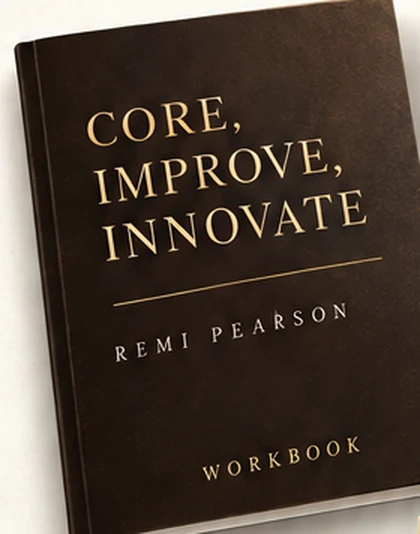
Your Core, Improve, Innovate workbook
Bring the model into the decisions already on your desk. Use the workbook to examine your current activities, identify what each is intended to achieve and consider the demands they place on the rest of the business.
You’ll work through questions including:
- What currently brings clients in, delivers the result they value and turns that work into collected income?
- Where does the business depend on me because the process or standard hasn’t been made clear?
- Which proposed changes address an evidenced problem?
- What will a new project take away from the work we already need to deliver?
- Is our current Core still capable of supporting the future we want?
What could change in the way you lead?
You could approach your next planning meeting with a clearer distinction between maintaining the business, strengthening it and taking it somewhere new. That gives you a more useful conversation than a long list of projects all competing to be called urgent.
When someone proposes a change, you can ask what problem it solves and what evidence supports it. When delivery keeps breaking down, you can examine the Core instead of repeatedly stepping in. And when an opportunity genuinely deserves your attention, you can consider how to resource it while continuing to care for the business you have.
The aim is to make decisions you can explain, with a clearer understanding of their consequences.
Leaving this unclear has a cost.
The projects you choose consume more than the hours you spend on them. Your team has to adjust. Existing work gets delayed. A system that needed attention has to hold together for another month.
Over time, the owner can become busier while the business becomes more dependent on them. New offers add complexity to unreliable delivery. Repeated changes leave people uncertain about what matters. The work everyone knows needs doing keeps being displaced by something more immediately compelling.
There is also a cost to protecting the familiar for too long. A business can become excellent at delivering something its market increasingly wants less of.
Knowing where you need stability and where you need change is part of leading a business that can keep earning its place.
Is this for you?
This program is for business owners and leaders who have real work underway and need a clearer way to decide where their effort belongs.
It will be particularly relevant if you’re:
- Pulled between looking after existing clients and developing your next offer.
- Regularly rescuing work that should be more dependable.
- Considering a new system, hire or project without being clear about the problem it needs to solve.
- Leading a team that is busy but unclear about priorities.
- Questioning whether what made the business successful is still right for its future.
You don’t need a large team to use the model. You do need a willingness to examine what is happening, including the parts you would prefer were already working.
If you’re looking for a fixed formula that makes every decision for you, this won’t provide one. The point is to improve your judgement about the business you actually have.

Learn from someone who has had to make these decisions.
Remi Pearson
I founded The Coaching Institute in 2004 and built an eight-figure business that generated nearly A$200 million in cumulative revenue before my exit in 2024. Over that time, we trained more than 13,000 coaches.
Building that business meant developing people who could deliver well, making our standards teachable and deciding where our attention belonged as the organisation grew. There were always more possibilities than there was time to pursue them.
Core, Improve, Innovate is one of the models I use to think through those choices. I teach it because a business owner needs a way to question a compelling idea, recognise a neglected responsibility and respond when something genuinely needs to change.
A few things you may be wondering
- Is the program free?
- Yes. Core, Improve, Innovate is a free program with three videos and a workbook.
- Do I need to have a team?
- No. You can apply the model to a business you run yourself. It is also useful when you’re developing a team and need more of the work to happen reliably without your direct involvement.
- Is this only useful when something is going wrong?
- No. It can help you assess opportunities and allocate attention in a business that is doing well. Growth creates its own decisions about what to preserve and what needs to evolve.
- Does the model tell me to focus on Core all the time?
- No. The balance changes with the business and its market. Sometimes making the existing business more reliable deserves most of your attention. Sometimes its future depends on developing something different.
Before you commit to another project, get clearer about what your business needs.
Bring the decisions you’re already facing. Use Core, Improve, Innovate to examine where your effort belongs and what deserves to happen next.
Three videos and a workbook. Free.
 Talk to Remi