










Remi Pearson smiling, in a burgundy top, in a sunlit room

Emotion Integration Technique Foundations With Remi Pearson

You can explain why you do it. Why can’t you stop doing it?

You know you withdraw when things get personal. You know you stay busy when something hurts. You can explain where the pattern began and what you’re probably protecting.

Then someone asks what you’re feeling, and you go blank. Or you know exactly what you feel, but immediately judge yourself for feeling it.

Understanding yourself hasn’t necessarily made it easier to stay with yourself when something uncomfortable comes up.

Emotion Integration Technique Foundations introduces a compassionate way to understand the feelings you avoid and the responses that help you keep them at a distance. Across five videos, I’ll explain the principles behind EIT, followed by a guided demonstration that shows how the approach works.

Five videos • Guided demonstration with Remi • Workbook

One payment. Learn at your own pace.

What do you do when you don’t want to feel what you’re feeling?

Sometimes it’s obvious. You leave the conversation, become defensive or insist you’re fine. At other times, it looks like being productive, staying positive or helping everybody else.

You may barely notice the moment you move away from your own experience.

  • You analyse the feeling instead of experiencing it. You can explain why you’re hurt, but struggle to acknowledge how much it actually hurts.

  • You get frustrated with yourself for having emotions at all. You feel sad, then tell yourself you’re being weak. You feel lonely, then criticise yourself for needing people.

  • You stay busy because stopping feels uncomfortable. There’s always another task, another person to help or something to check.

  • You go blank when someone asks how you feel. You search for an answer that makes sense, while your actual experience seems out of reach.

  • You rush to fix someone else’s distress. You offer reassurance or advice because staying with their sadness feels difficult.

  • You understand the idea of self-compassion, but can’t seem to feel it. You know you’re supposed to be kinder to yourself. That becomes another thing you think you’re failing at.

These responses can be exhausting. They can also leave you feeling strangely distant from yourself, even after years of personal development.

A woman at a kitchen table, chin in her hand, a mug and an open notebook in front of her

EIT begins with what you can honestly notice, including the frustration, numbness or “I don’t know”.

How much of your life is shaped by what you’re trying not to feel?

You turn down an opportunity because you don’t want to feel exposed. You avoid a conversation because you can’t bear the discomfort it might bring. You keep a relationship on the surface because closeness asks something of you that feels difficult to meet.

Avoidance may bring relief in the moment. Over time, it can narrow the experiences you feel able to have.

Learning to be with an uncomfortable emotion can create room for a different choice. You might still feel nervous and consider the opportunity. You might acknowledge hurt and express what matters. You might hear someone’s sadness without immediately trying to make it disappear.

That is the capacity this program introduces: becoming more able to stay connected with yourself while something difficult is present.

What if you can’t feel compassion for the part of you that struggles?

This question sits at the heart of Emotion Integration Technique.

Perhaps you understand why you withdraw, yet hate that you do it. Perhaps you know your numbness has served a protective purpose, but feel impatient with it. Being told to “have compassion for yourself” doesn’t help when compassion is precisely what you cannot access.

I developed EIT to begin with that difficulty.

The approach explores whether more room around an experience makes genuine compassion possible. From there, we gently consider how that compassion can be brought closer to the feelings and responses that have been difficult to meet.

You don’t have to produce the right emotional word or pretend to feel kind towards yourself. An honest starting point gives us something to work with.

Understand the principles, watch the guided demonstration and reflect with your workbook.

An olive tree with its roots spread wide beneath it, in soft light

What you’ll begin to understand about yourself

  1. Why insight and emotional capacity are different.

    Knowing why you respond a certain way doesn’t necessarily mean you can stay with the feeling beneath it.

  2. How protection can show up in ordinary behaviour.

    Analysis, busyness and withdrawal may help you avoid experiences that feel difficult to hold.

  3. Why judging your response adds another layer.

    Frustration about being numb or shame about feeling needy can become part of what needs understanding.

  4. How compassion can be approached when it feels unavailable.

    EIT begins with your actual experience and works at a pace you can meet.

  5. What integration means within this approach.

    Developing more capacity to feel an emotion without immediately rejecting it or letting it decide everything you do.

Welcoming an emotion doesn’t require acting on every impulse.

You can make room for anger and still take responsibility for how you speak. You can acknowledge loneliness while choosing thoughtfully how you seek connection.

Your five-video program

  1. The feelings you learned to keep at a distance

    Explore how you developed your relationship with emotion. Which feelings were welcomed? Which seemed inconvenient, embarrassing or unacceptable? We’ll look at how those experiences can influence what you allow yourself to feel today.

    What you’ll take from it: a more compassionate understanding of why some emotions feel familiar and others feel difficult to approach.

    A man resting his chin on his hand, looking out thoughtfully
  2. What your protective responses may be doing for you

    Explore the roles of intellectualising, staying busy, pleasing others and going numb. Using the language of parts, we’ll consider how a response can have a protective intention while also creating difficulties in your life.

    What you’ll take from it: a way to recognise protection without treating yourself as defective or overlooking the consequences of your behaviour.

    A woman smiling softly, chin in her hand
  3. When compassion feels out of reach

    Discover why asking yourself to be compassionate may not be enough. We’ll explore the EIT principle of creating more distance around a difficult experience until there is something you can genuinely meet with care.

    What you’ll take from it: an understanding of how EIT finds a starting point when “I should be kinder to myself” has become another source of pressure.

    Hands holding a speckled mug
  4. Bringing compassion closer

    Learn why EIT moves outward and then gently inward. We’ll explore how changing your relationship with frustration, numbness or another protective response can make room for further emotional experience.

    There is no prescribed sequence of feelings you are expected to discover.

    What you’ll take from it: a clearer understanding of how the approach respects protection while exploring what becomes available beneath it.

    A man looking into the distance, thinking
  5. What it means to integrate an emotion

    Explore integration as a growing ability to remain connected with yourself while an emotion is present. We’ll consider what that might mean in everyday life, including your ability to listen, acknowledge your needs and respond to other people.

    What you’ll take from it: a practical understanding of what greater emotional capacity could look like beyond the teaching.

    Hands resting together on a knee
Get EIT Foundations • AUD $49

Five videos • Guided demonstration with Remi • Workbook

The guided demonstration and your workbook

Remi Pearson smiling, in a burgundy top

See the principles come together in a guided demonstration

The separate guided demonstration with me shows how the principles of EIT come together in practice.

You’ll see the importance of beginning with what is actually present, recognising when compassion is unavailable and allowing enough room around the experience. The demonstration will help you understand the movement outward and inward, and why pace matters.

You can watch without needing to produce an emotional response of your own. There is nothing to prove by feeling more, going deeper or having a particular result.

The demonstration supports your understanding of EIT. It does not train you to facilitate the intervention with another person.
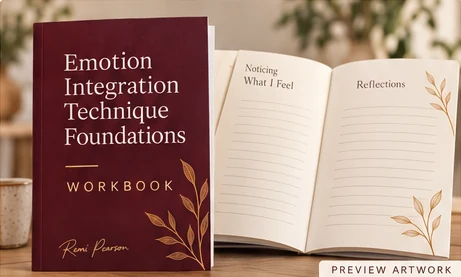

Preview artwork: the Emotion Integration Technique Foundations workbook beside its open Noticing What I Feel and Reflections pages

Your workbook

Use the workbook to connect the principles with your own experience, with space to explore:

  • Which emotions you tend to welcome, judge or avoid.
  • What you do when a feeling becomes uncomfortable.
  • How you respond to the parts of yourself you find difficult.
  • What you notice during the guided demonstration.
  • What greater capacity might look like in one ordinary situation.

You can work with everyday examples and leave anything you’re not ready to explore. The workbook is a place for honest reflection, without an expectation to uncover your deepest experience.

Get the complete program • AUD $49

Five videos, a guided demonstration with Remi and your workbook.

Remi Pearson smiling, in a burgundy top

A note from Remi

I’m Remi Pearson, author, founder of The Coaching Institute and creator of Emotion Integration Technique.

I developed EIT through working with people who could explain themselves brilliantly but struggled to access what they felt. Some became frustrated when asked to notice an emotion. Others understood their protective responses, yet couldn’t feel compassion towards the part of themselves that was protecting them.

I began paying closer attention to that difficulty. What happened if we worked with the distance someone needed, instead of asking them to move past it? What if numbness or frustration gave us the place to begin?

This foundations program introduces the principles that grew from that work. I want you to understand more of your own experience without turning emotional awareness into another test you have to pass.

A few things you might be wondering

Is this for me if I understand myself but still repeat the same patterns?

Yes. The program explores the gap between understanding a protective response and having the emotional capacity to meet what lies beneath it.

What if I don’t know what I feel?

You don’t need to identify a precise emotion before you can learn from the program. EIT begins with what is available, which may include blankness, frustration or the thought “I don’t know”.

What if I feel too much rather than too little?

The principles may help you understand your relationship with difficult emotions. You won’t be asked to intensify an experience or push through overwhelm. If emotion regularly feels unmanageable, individual support can offer pacing that a recorded program cannot.

Does compassion mean excusing my behaviour?

No. You can understand why you developed a response and still acknowledge its impact. Compassion and responsibility can exist together.

Will this get rid of uncomfortable emotions?

That isn’t the aim. Within EIT, integration means becoming more capable of being with an emotion that you previously needed to push away. Sadness, fear and anger remain part of being human.

Do I need to know about parts work?

No. I’ll introduce the language used in the program. EIT is my own approach, informed by my work with protective parts; it is not an official or endorsed Internal Family Systems method.

Is this practitioner training or individual therapy?

Neither. This is a foundations program for personal understanding, with a guided demonstration. It does not qualify you to facilitate EIT. If you experience significant dissociation or become overwhelmed, the demonstration should not be used as a substitute for individual support.

What does the $49 include?

All five teaching videos, one guided demonstration with Remi and the workbook. One payment of AUD $49, with learning at your own pace.

You don’t have to become better at explaining yourself before you begin.

Perhaps you already have the explanation. What remains difficult is being with the sadness, hurt or uncertainty when it appears.

Begin with the experience you recognise, including whatever makes it hard to approach. I’ll introduce you to the principles of EIT and show you how compassion can become part of that relationship.

Emotion Integration Technique Foundations With Remi Pearson

Five videos • Guided demonstration • Workbook
AUD $49 • One payment

Coming soon