


Holding Space Without Rescuing or Disappearing With Remi Pearson
When someone you love is upset, do you rush to fix it … or wish you could escape?
You want to help. But sometimes your advice lands badly, your reassurance closes the conversation down, or you find yourself getting defensive when you meant to be supportive. Other times, you simply don’t know what to say, and the distance between you grows.
Learn how to stay with a difficult conversation, understand what someone needs from you and offer support without taking responsibility for making their feelings go away.
Five videos + companion workbook · AUD $29
A self-paced program for people who want deeper connections and a more honest, sustainable way to be there for others.
You care about them. So why do these conversations keep going wrong?
Someone opens up, and you can already see what they should do. You offer a solution, perhaps several, and feel confused when they become frustrated. You were trying to help.
Or they tell you something has hurt them, and you begin explaining why it happened. By the time you have finished defending your intentions, the thing they wanted you to understand has almost disappeared from the conversation.
Perhaps your response is quieter. You nod and say very little, but inside you are waiting for it to be over. You avoid asking how they are because you’re not sure you can manage the answer.

You might recognise yourself here:
- You offer advice before someone has finished explaining what is happening.
- You feel responsible for making them feel better, and helpless when you can’t.
- You reach for “At least…” or “Try to look at the positives” because you don’t know what else to say.
- You have heard, “I don’t need you to fix it. I need you to listen.”
- Someone’s disappointment feels like an accusation, even when they are trying to let you into their experience.
- You become frustrated when they keep struggling with something you think they could resolve.
- You agree with things you don’t believe because disagreement feels uncaring.
- You take their problems away with you, then feel exhausted or resentful.
- You withdraw when a conversation becomes emotional, sometimes without explaining whether you will return.
These responses can happen in loving relationships. Caring about someone doesn’t automatically give us the capacity to be with everything they feel, particularly when their experience brings up something uncomfortable in us.
The price we pay when we keep missing each other
A conversation can end politely and still leave someone feeling alone.
They shared something painful, and received a solution they weren’t ready for. They tried to explain their disappointment, and ended up reassuring you that you’re a good person. They wanted a little company in their uncertainty, and felt pushed towards an answer.
Meanwhile, you may leave feeling unappreciated. You gave your time, tried to help and somehow got it wrong again.
When this becomes familiar, people may begin editing what they share. Certain subjects become too difficult. You can still talk about the day, organise dinner and get everything done, while knowing there are parts of your experience that rarely make it into the relationship.
If you want deeper connections, how you receive someone matters.
Holding space gives you something to practise in those moments. It helps you become more available to the person in front of you, while remaining aware of your own feelings, limits and responsibilities.
- Listen beyond your first interpretation
- Care without carrying every outcome
- Repair when you miss the moment

What does holding space actually involve?
Holding space means giving someone room to have their experience while you remain attentive and responsive. You listen closely enough to discover what they mean, rather than assuming you already know. You allow some uncertainty without immediately trying to remove it.
That can sound simple until someone is disappointed in you, making a choice you disagree with or feeling something you desperately want to make better.
This is where the work becomes personal. Can you notice the urge to take over without automatically following it? Can you acknowledge their hurt before explaining yourself? Can you remain interested when there is no quick solution?
You also remain a person in the conversation. Your perspective matters. Your capacity matters. Holding space includes knowing what you can offer and communicating that honestly.
Holding Space Without Rescuing or Disappearing introduces these skills through five videos and a companion workbook, with examples you can recognise and bring into your own relationships.
What could become different in your conversations?
This program will help you begin practising how to:
- Respond when you don’t have an answer. Offer something useful when advice cannot resolve what someone is going through.
- Listen beyond your first interpretation. Find out what matters to them before deciding what the conversation needs.
- Understand what support is wanted. Check whether they want to be heard, think something through or receive practical help.
- Receive hurt without immediately defending yourself. Give their experience some room while retaining the opportunity to share your perspective.
- Care without carrying every outcome. Support someone’s ability to choose rather than quietly taking ownership of their decisions.
- Allow emotion without rushing it away. Recognise when reassurance, positivity or advice is arriving before understanding.
- Set a limit without leaving someone guessing. Be clear about your availability and follow through on what you agree.
- Repair when you miss the moment. Notice that you have interrupted, minimised or taken over, and find your way back into the conversation.
Five videos to help you be there when it matters
What happens in you when someone else is struggling?
Explore your own responses to another person’s emotion. You might rush to solve, feel pressure to reassure or become impatient when nothing seems to help. You may go quiet because you feel overwhelmed or uncertain.
You’ll begin recognising what happens inside you, and how that shapes what the other person receives.
What you’ll take away: A clearer understanding of the moments when your discomfort starts directing the conversation.

Listening so someone can actually feel heard
Learn how to follow someone’s meaning, reflect what you understand and check whether you have understood them accurately. Explore the difference between silence that allows someone room and silence that leaves them wondering whether you are still with them.
You’ll see how small responses can either invite someone to continue or move the conversation away from what they were trying to share.
What you’ll take away: Practical ways to communicate attention and understanding without needing a perfect answer.

Understanding their feelings without agreeing with everything
What happens when you understand that someone is hurt, but disagree with their explanation? Or when their hurt concerns something you have done?
Explore how to acknowledge emotional experience while leaving room for different perspectives, honest disagreement and responsibility for behaviour.
What you’ll take away: A way to remain receptive without agreeing automatically or abandoning what you believe.

Supporting someone without taking over
Advice can be useful. Timing and permission matter.
Learn how to ask what kind of support would help, notice when your suggestions become pressure and leave the other person room to make their own decisions. Explore the frustration that can arise when someone doesn’t take your advice, and what that tells you about the role you have assumed.
What you’ll take away: More clarity about what is yours to offer and what belongs to the other person.

Staying present without losing yourself
Explore how to communicate your limits, ask for a pause and make a clear agreement about returning. Learn how to recognise when a conversation needs support beyond what you can provide, and how to repair after you have become defensive, started rescuing or withdrawn.
What you’ll take away: A more sustainable way to stay involved in difficult conversations, including the ones you don’t handle well at first.

You do not have to get every response right.
Learning to notice what happened and return with genuine interest gives you somewhere to begin.
Holding Space Without Rescuing or Disappearing
A workbook to bring this into your own life
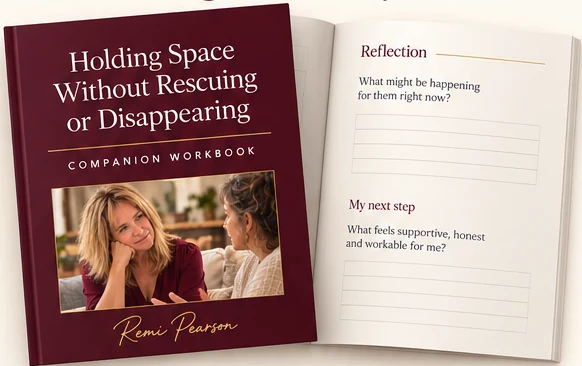
It is easy to recognise yourself in a video and then respond in exactly the same way when a familiar conversation becomes difficult. The workbook gives you a place to slow down and look at what is happening in your relationships.
Use it alongside the videos to:
- Identify your usual response when someone becomes upset.
- Revisit a conversation and separate what was said from what you assumed.
- Explore the difference between acknowledging a feeling and agreeing with an interpretation.
- Practise asking what kind of support someone wants.
- Clarify your availability, limits and commitments.
- Choose a real conversation in which to practise, then reflect on what you noticed.
The aim is to develop your understanding so the words you use are your own.
This is for you if you want more depth in your relationships
Perhaps you want your partner to feel able to tell you something difficult. You want to be a friend who can hear pain without immediately searching for a positive. You want to support an adult child without directing their life, or listen to someone at work without turning every concern into a task you must solve.
You may already be the person everyone comes to, and need a way to care that doesn’t leave you carrying everything afterwards.
Or you may recognise that you often retreat when people need you emotionally, even though connection matters to you.
You can begin learning this from wherever you honestly are. You don’t need a coaching background or knowledge of psychological terminology.

A note from Remi
Over the years, I’ve spent a great deal of time with people who are trying to say something they don’t yet have clear words for. Those moments ask something of us. It can be uncomfortable to listen when we cannot resolve the situation, especially when we care deeply about the person.
I’m interested in what happens when we become a little more willing to stay curious. When we notice that the answer we are about to offer might be arriving because we want relief from the uncertainty. When we can hear something difficult without immediately making the conversation about our intentions.
I also care about the person doing the listening. Being available to others cannot depend on repeatedly overriding yourself. There needs to be room for your honesty and your limits, alongside your willingness to remain connected.
That is what I want to help you explore in this program. We all miss each other sometimes. There is something worth learning about how we find our way back.
Your program includes
- Five teaching videos with Remi Pearson
- A companion workbook for reflection and practice
- Self-paced learning so you can work through the material in your own time
AUD $29 · One payment
Get Holding Space Without Rescuing or Disappearing · AUD $29A few questions you might have
Does holding space mean I should never give advice?
No. Advice and practical help can be useful and welcome. You’ll explore how to understand what someone needs before offering your solution, and how to check whether they want suggestions. You’ll also look at what happens when advice becomes a way to hurry someone out of a feeling.
What if I disagree with what they are saying?
You can recognise someone’s emotional experience while questioning their interpretation or disagreeing with their decision. The program explores how to make room for understanding without pretending you share a view you don’t hold.
What if they are upset with me?
That is often when listening becomes hardest. You’ll explore how to notice defensiveness and make room for their account of what happened. You can hear the impact of your behaviour, take responsibility where appropriate and still have a perspective of your own.
What if I become overwhelmed?
Your capacity matters too. You’ll learn about communicating a pause, being clear about what you can offer and agreeing on a return where appropriate. You are not being asked to remain endlessly available.
Does this mean tolerating harmful behaviour?
No. Understanding a feeling does not require accepting threats, insults or coercion. You can acknowledge distress and set a boundary around behaviour. Holding space does not obligate you to remain in an unsafe conversation.
I already do all the listening. Will this ask me to give even more?
The program includes looking at over-responsibility, limits and whether the support you offer is sustainable. Learning to hold space does not make a one-sided relationship reciprocal, and it does not remove your need to be heard and supported too.
What if I tend to shut down rather than take over?
The program includes both patterns. You’ll explore what happens when you withdraw, how to communicate your capacity and ways to return to a conversation rather than leave the other person uncertain about where you have gone.
Is this different from Self-Regulation When It Matters?
Yes. Self-Regulation When It Matters focuses on your response to emotional pressure. This program focuses on how you listen and respond to another person, including what happens when their feelings bring up discomfort in you.
Is this a professional qualification or therapy training?
No. This is a focused educational program for everyday conversations and relationships. It does not qualify you to provide therapy or manage someone else’s mental health needs.
What do I receive for $29?
Five teaching videos with Remi and a companion workbook. The program is self-paced, so you can work through the material in your own time.
When someone opens up to you, what happens next matters
You may not be able to change what they are facing. You can learn to notice when you are moving too quickly, ask a question that helps you understand and leave room for something you haven’t heard yet.
Over time, those are the moments in which a relationship can become more honest. Someone gets to finish what they were trying to say. You discover that you don’t have to supply every answer. A difficult conversation has a little more room for both of you.
If you want to become more capable of being there, this is a place to begin.
Holding Space Without Rescuing or Disappearing
Five videos with Remi Pearson + companion workbook
AUD $29 · One payment · Self-paced
Coming soon
 Talk to Remi