

Why Do Relationships Trigger Me So Much?
Why loving someone brings old patterns to the surface, and how we begin responding differently.
You can be perfectly capable in the rest of your life and find yourself almost unrecognisable when someone you love pulls away. You check your phone, rehearse what to say and wonder whether you have asked for too much. Or you experience the opposite. Someone wants to talk about feelings, and suddenly you cannot find any of yours. You become practical, defensive or unavailable, even though the relationship matters to you.
Relationships have an extraordinary talent for finding the places where our emotional capacity is still developing. We may have understood a pattern years ago, yet closeness brings us into contact with the feelings underneath it. Knowing we fear rejection does not necessarily make rejection easier to experience. Knowing we disappear to keep the peace does not automatically help us remain present when someone is disappointed.
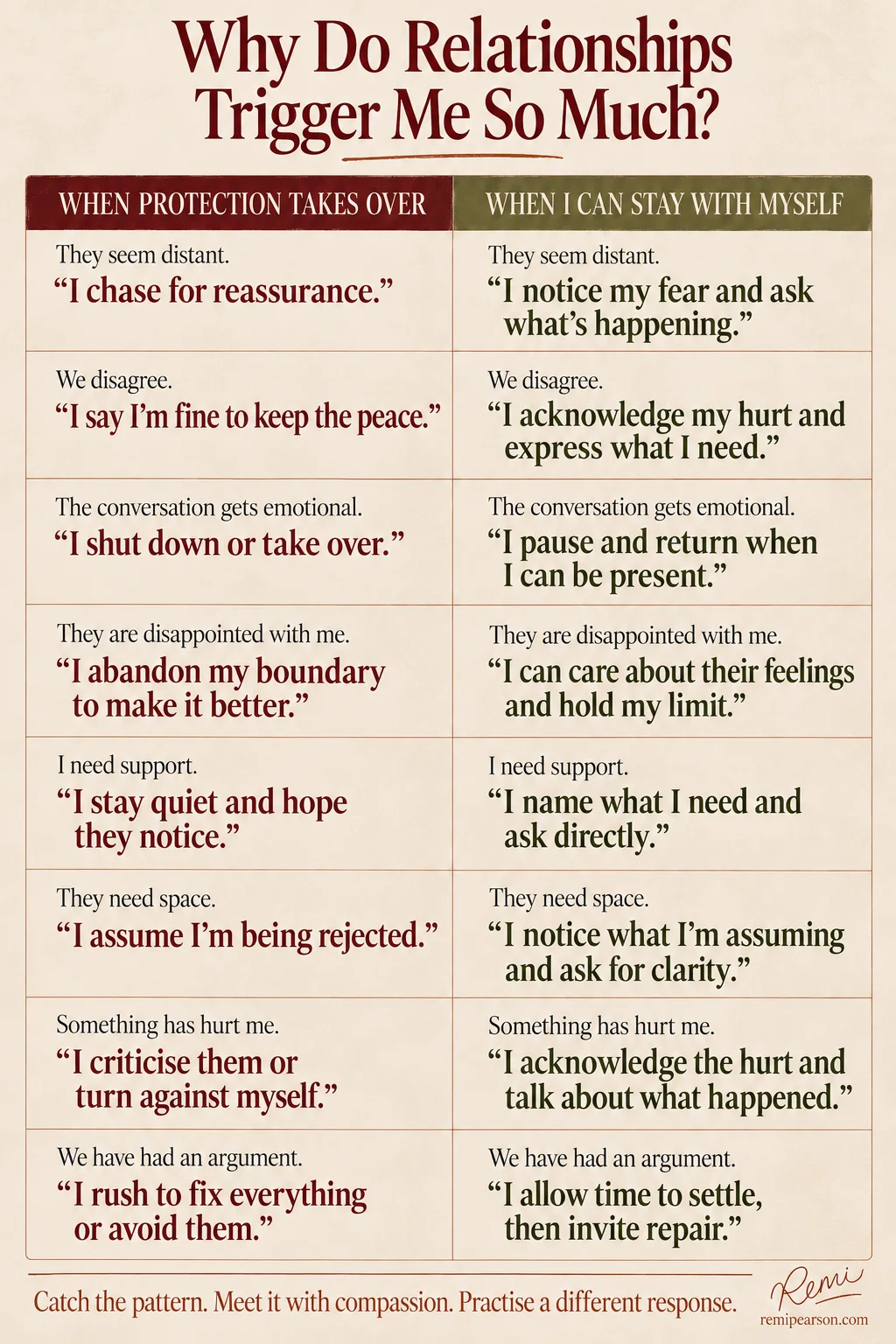
Why does closeness bring out my protective patterns?
When someone matters to us, their availability carries weight. We have something we want to protect, something we could lose, and needs that may feel uncomfortable to acknowledge. A change in their tone can become a question about our worth. A disagreement can begin to feel like the end of the relationship.
Attachment research helps explain these responses. Simpson and Rholes (2017) describe how attachment anxiety and avoidance shape reactions to stressful situations in romantic relationships. Some people intensify their efforts to obtain reassurance; others distance themselves or suppress their need for support. Our expectations of ourselves and other people influence what we notice, what we fear and how we respond.
Those responses can have a history, but the present deserves attention too. A partner who is inconsistent, contemptuous or unwilling to repair creates real difficulties. Understanding our attachment patterns should help us assess a relationship more accurately, including whether it offers enough care and reciprocity.
How do we get caught in the same relationship cycle?
Something happens. We give it meaning, often very quickly. Protection begins, the other person reacts, and the cycle gathers momentum. One person pursues harder while the other retreats further. Someone becomes silent, so their partner presses for an answer. Both may want connection while responding in ways that make it harder to find.
Within Internal Family Systems, these responses can be explored as protective parts. A part may please, withdraw or control because it fears what would happen without that strategy. IFS emphasises developing a respectful relationship with protectors and listening to their concerns, rather than trying to eliminate them (IFS Institute, n.d.).
This gives us somewhere useful to begin. What am I afraid will happen if I stop carrying the whole relationship? What feeling becomes available when I stop explaining everything away? We can explore these questions while keeping responsibility accurately placed. Recognising our response does not make us responsible for another person’s conduct.
How can I stay connected to myself when I’m triggered?
I call the moment we begin moving away from ourselves our Point of Departure. We may feel it as tightness, urgency, blankness or an immediate need to fix something. Catching that moment gives us an opportunity to notice what is happening before the familiar response makes every decision.
My Emotion Integration Technique works with the protection that can make emotional contact difficult. When compassion is unavailable, we begin with what is accessible, including frustration, numbness or not knowing. Through facilitated work, we move outward until genuine compassion becomes available, then bring it inward towards the experience being protected (Pearson, 2026).
That work develops capacity. We become more able to acknowledge hurt, express a need or hold a boundary while discomfort is present. We can listen without immediately rescuing, and ask what someone means before responding to what we fear they mean. These abilities develop through experience, support and practice.
Where can I begin creating a healthier relationship?
The Five Paths to a Healthy Relationship brings this work into a practical starting point. It explores staying connected to yourself, recognising the attachment cycle, communicating needs and boundaries, repairing after rupture, and creating emotional safety together.
Perhaps you already recognise where you disappear, chase or take too much responsibility. The next step is learning how to meet those moments with more honesty and capacity. The Five Paths gives you short lessons and a workbook to begin applying the ideas to your own relationship patterns, in your own time.
References
- IFS Institute (n.d.) ‘The Internal Family Systems model outline’. Available at: IFS Institute (Accessed: 30 September 2026).
- Pearson, R. (2026) ‘Emotion Integration Technique’. Remi Pearson. Available at: Remi Pearson
- Simpson, J.A. and Rholes, W.S. (2017) ‘Adult attachment, stress, and romantic relationships’, Current Opinion in Psychology, 13, pp. 19–24. doi: 10.1016/j.copsyc.2016.04.006. Read the free full text.
 Talk to Remi