


With Remi Pearson
The Five Paths to a Healthy Relationship
You love each other. So why do you keep ending up hurt, unheard or miles apart?
Learn how to recognise the patterns that pull you apart, respond to each other’s needs and begin building a relationship with more closeness and room for both of you.
Five videos + companion worksheet · AUD $29
A focused, self-paced introduction to what a healthy relationship asks of us, and how to begin putting it into practice.
You can care deeply about someone and still struggle to reach them
You try to explain what hurt, and somehow end up arguing about whether you should feel hurt at all. One of you wants to talk now; the other wants space. You eventually settle down, but the original concern remains, waiting for the next disagreement.
Or perhaps there is very little arguing. You manage the household, check in about practical things and get through another week. Yet you miss being asked a question that shows genuine interest. You miss laughing together. You miss feeling chosen in the ordinary moments when nobody is making a grand gesture.
You may know that something needs attention without knowing where to begin.
The Five Paths to a Healthy Relationship gives you a way to understand what is happening and identify something useful to practise. Through five teaching videos and a companion worksheet, you’ll explore the everyday capacities that help two people remain connected while being honest about who they are and what they need.

Does any of this feel familiar?
- You keep having versions of the same argument, even after promising it will be different.
- You want reassurance, but the way you ask seems to push your partner further away.
- You withdraw to avoid making things worse, then struggle to return to the conversation.
- You feel that keeping the peace depends on you saying less.
- You know your partner’s schedule better than you know what they are worried about or looking forward to.
- You apologise, resume normal life and wonder why the hurt keeps resurfacing.
- One person does most of the adjusting, initiating or repairing.
- You still love each other, but you miss enjoying each other.
- You want to understand your own contribution without being made responsible for everything.
You don’t need to wait for a crisis to pay attention to your relationship. You can begin with the moments you already recognise.
What can it cost when these patterns go unaddressed?
The cost is often felt in ordinary life. A conversation you stop attempting. Affection you hesitate to offer. Something important you decide to keep to yourself because sharing it feels like too much work.
Here are five ways that distance can develop.
You begin editing yourself to keep the peace
You avoid subjects, soften your needs or agree before you have considered what you want. The relationship may appear calmer, while less of you is actually present in it.
Small attempts to connect become easier to miss
A story, a question or a moment of affection passes without much response. When reaching out repeatedly feels unrewarding, someone may gradually stop trying.
Old reactions keep directing new conversations
A disappointment quickly becomes “I don’t matter.” A request sounds like criticism. You respond to what the moment seems to mean, and struggle to understand what the other person was actually trying to communicate.
Hurt accumulates beneath the return to normal
The argument ends, but there is little acknowledgment or follow-through. The next disagreement carries the weight of things that were never properly addressed.
You become efficient at sharing a life, while feeling less connected within it
There may be reliability and routine, yet little curiosity or shared enjoyment. You know how to keep everything running, but are less sure what you are creating together.
Recognising these patterns gives you something to work with. It also helps you ask a more useful question than “Why can’t we just get along?”
What does our relationship need that we haven’t yet learned how to give it?
What you’ll begin learning
This program will help you:
- Understand your reactions more clearly, so you can notice when fear, hurt or an assumption is directing what you do next.
- Ask for support more openly, without expecting your partner to guess what you need or take full responsibility for how you feel.
- Recognise everyday invitations to connect, including the small moments that are easy to dismiss as unimportant.
- Bring curiosity back into the relationship, rather than assuming you already know everything about each other.
- Express needs before resentment becomes the messenger.
- Make room for both perspectives, including when you disagree.
- Recognise the difference between compromise and repeatedly abandoning yourself.
- Approach a difficult conversation with greater care, while still addressing what matters.
- Understand what repair involves beyond saying sorry or becoming calm again.
- Create small, meaningful agreements, so the relationship you want has a place in your everyday life.
The aim is to give you a clearer understanding of what to practise and why it matters. A healthy relationship develops through how both people participate over time.

A thought worth bringing into your relationship
“When you’re in pain, the world stops and I listen.”
There is something deeply reassuring about knowing your experience matters to the person beside you. Learning how to offer that attention, and how to ask for it, is part of the work we explore here.
Your five paths
Path One · Understand What You Bring
Recognise what happens in you when closeness becomes difficult.
You bring a history into a relationship, including expectations about whether your needs matter, what disagreement means and how available someone will be when you need them.
In this video, you’ll begin recognising the reactions that can take over when you feel uncertain or hurt. You’ll explore the difference between an event and the meaning you assign to it, and how to ask for comfort without making your partner solely responsible for restoring your emotional balance.
You’ll also keep an essential distinction in view: taking responsibility for your response does not mean dismissing something hurtful that happened.
You’ll explore how to:
- Notice familiar responses such as pursuing, withdrawing, pleasing or controlling.
- Identify what you are assuming in an emotionally charged moment.
- Ask for support more directly.
- Take responsibility for your behaviour while expecting care and respect from your partner.
What this makes possible: A clearer understanding of your part in a recurring pattern, with somewhere practical to begin.

Path Two · Turn Towards Each Other
Recognise the small moments when someone is asking for connection.
Your partner tells you about their day, shows you something funny or reaches for your hand. These moments can seem ordinary, but they offer opportunities to communicate interest and affection.
This video introduces emotional bids and the practice of responding to them. You’ll also explore curiosity, appreciation and the importance of continuing to discover who your partner is becoming.
You’ll explore how to:
- Recognise invitations to connect that you might otherwise overlook.
- Respond with genuine interest.
- Express appreciation in ways that feel specific and personal.
- Make your own invitations clearer.
- Create more room for affection, humour and enjoyment.
What this makes possible: More deliberate connection in the life you already share.

Path Three · Make Room for Both People
Build closeness without requiring one person to disappear.
A relationship needs room for two sets of needs, preferences and perspectives. That becomes difficult when one person routinely adjusts while the other assumes everything is fine.
In this video, you’ll explore expressing needs, respecting boundaries and allowing your partner’s perspective to influence you. You’ll consider where compromise works, and where it has become a habit of overriding yourself.
You’ll explore how to:
- Put words to a need before frustration builds.
- Hear a limit without automatically treating it as rejection.
- Consider a perspective that differs from your own.
- Notice whether care and accommodation are reciprocal.
- Remain connected while retaining your individuality.
What this makes possible: A clearer picture of whether both people have a meaningful place in the relationship.

Path Four · Work Through Differences and Repair
Learn what needs attention after you have hurt or disappointed each other.
Differences are inevitable. How you approach them, and what happens afterwards, deserves care.
This video introduces familiar patterns such as criticism, defensiveness and withdrawal, alongside ways to raise concerns and respond more constructively. You’ll explore the difference between ending an argument and addressing the hurt that occurred.
You’ll explore how to:
- Describe a concern without turning it into an attack on someone’s character.
- Listen to impact before explaining intention.
- Take a pause with a clear agreement about returning.
- Acknowledge your contribution to what happened.
- Connect an apology with meaningful follow-through.
What this makes possible: A starting point for repair that goes beyond hoping the issue will disappear.

Path Five · Build a Relationship You Both Want
Give your shared life some deliberate attention.
What do you want it to feel like to be together? What matters to each of you beyond getting through the week? Which promises are reflected in how you actually spend your time?
This final video explores shared meaning, everyday rituals and supporting each other’s aspirations. You’ll begin thinking about the relationship you want to participate in and the small commitments that could help you create it.
You’ll explore how to:
- Talk about what matters to each of you.
- Identify expectations you may never have discussed.
- Choose a meaningful ritual of connection.
- Support individual interests alongside a shared life.
- Make agreements you are willing to follow through on.
What this makes possible: A more intentional direction for your relationship, with a manageable place to start.

Bring the five paths into your own experience
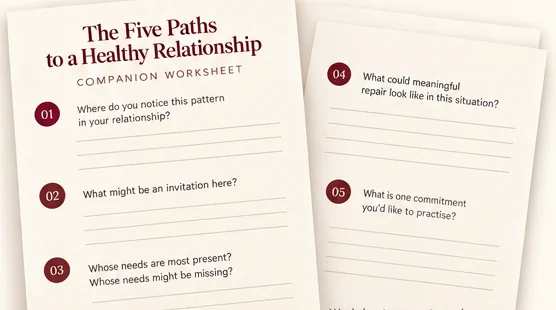
Your companion worksheet gives you space to connect the teaching with real moments in your life.
Use it to:
- Identify a recurring reaction and what tends to set it off.
- Notice an invitation to connect and how you respond.
- Reflect on where each person’s needs receive attention.
- Consider an unresolved hurt and what meaningful repair would involve.
- Choose one practical commitment to begin with.
You can work through it privately or use the prompts to open a conversation with a willing partner. There is no requirement to disclose anything before you are ready.
Who is this for?
This program is for you if you want to understand what helps a relationship become healthier, whether you are beginning something new or paying attention to a longstanding partnership.
It may be particularly useful if:
- You care about your relationship and want more than simply avoiding arguments.
- You recognise repeated patterns but don’t know what to do with that awareness.
- You want to feel closer without losing your voice.
- You want to take responsibility for your contribution while remaining clear about what you need from someone else.
- You are single and want to reflect on past relationships and what you want to bring into a future one.
You can begin learning on your own. Creating a mutually healthy partnership will still require participation from both people.

A note from Remi
Relationships can bring us face to face with things we find difficult to admit. We may want closeness and then become defensive when someone tells us how they experience us. We may long to be understood while making very little room for a perspective that unsettles our own.
I’m interested in those moments because they give us something real to work with. We can become more aware of what we do, learn to express what matters and consider how our behaviour affects someone we love.
I also care about what happens when one person keeps trying to carry the relationship. Taking responsibility for yourself needs to sit alongside an honest view of whether the other person is willing to participate.
I’ve brought these five paths together to give you a useful introduction. My hope is that you finish with a clearer understanding of what your relationship needs, what is yours to work on and a conversation or practice you feel ready to begin.
What’s included
The Five Paths to a Healthy Relationship
- Five teaching videos with Remi Pearson.
- A companion worksheet for reflection and practice.
- Self-paced learning so you can work through the material in your own time.
AUD $29 · One payment
A focused introduction you can begin with, without committing to an extensive program.
Frequently asked questions
- Do we have to do this together?
- No. You can begin individually and reflect on your own responses, expectations and needs. If your partner is willing, the material can also provide a starting point for conversations together. Learning on your own does not make you responsible for doing both people’s work.
- What if my partner thinks there is nothing wrong?
- You can still develop greater clarity about what you are experiencing and what you want to discuss. The program cannot make someone else willing to engage, and it does not ask you to keep compensating for their lack of participation.
- Is this useful if our relationship is already good?
- Yes. You may want to strengthen everyday connection, revisit expectations or become more deliberate about what you are building together. The material gives you questions to explore before difficulties become entrenched.
- Can I do this if I’m single?
- Yes. You can use the videos and worksheet to reflect on previous patterns, clarify your expectations and consider how you want to participate in a future relationship.
- Will this teach me how to manage my triggers?
- It introduces recognising triggers, taking responsibility for your responses and asking for support. It does not provide an extensive self-regulation or emotional-processing course. Remi’s Self-Regulation When It Matters and Emotion Integration Technique Foundations explore those areas further; neither is required to begin this program.
- Does taking responsibility mean my partner’s behaviour is my problem?
- No. You are responsible for how you respond, and your partner remains responsible for how they treat you. Recognising your history or sensitivity does not require excusing disrespect or dismissing a legitimate concern.
- Is this a Gottman Institute program?
- No. This is an independently created program by Remi Pearson. The teaching draws on relationship ideas from John and Julie Gottman, alongside relevant work by John Bradshaw and Nicole LePera. It is not affiliated with or endorsed by The Gottman Institute or those authors.
- Is this couples therapy?
- No. It is a focused educational introduction. It does not provide individual assessment or therapy, and it is not designed to address abuse, coercion or threats. Where those are present, specialist support and safety take priority over joint relationship exercises.
- Will five videos fix our relationship?
- Five videos can give you a clearer understanding and useful practices to begin. What changes depends on how the learning is applied and whether both people are willing to participate. The program does not promise to resolve every difficulty or save a relationship.
- What do I receive for $29?
- Five teaching videos with Remi Pearson and a companion worksheet. The program is self-paced, with a single payment of AUD $29.
What would you like to become possible between you?
Perhaps you want to raise something difficult without losing the whole evening to an argument. Perhaps you want to feel more interested in each other again, or know that your needs can be heard without someone having to win.
You can begin by understanding what happens between you and choosing something specific to practise. The five paths give you a way into that conversation, including the one you may need to have with yourself.
The Five Paths to a Healthy Relationship
Five videos + companion worksheet
AUD $29 · One payment · Self-paced
Coming soon
 Talk to Remi