

Benchmarking Business & leadership
What good actually looks like.
How can your team meet a standard that only exists in your head?
You know when something has been done well. You also know when it hasn’t, which is often when you find yourself stepping back in, explaining it again or fixing it yourself. Somewhere between what you expected and what someone else understood, the standard went missing.
Learn how to make that standard clear, measure the work that contributes to better results, and give your team something more useful than “we need to do better”.

- Built The Coaching Institute
- Nearly A$200M in cumulative revenue
“I thought that was obvious” is an expensive way to run a business.
An enquiry gets answered, but the customer’s question remains unresolved. A task gets marked complete, but you wouldn’t send it to a client. Everyone has been busy all week, yet the work that would move the business forward is still waiting.
People can be working hard and working to entirely different definitions of success. When expectations remain implicit, you become the person who interprets them, checks them and repeatedly explains what you meant.
Benchmarking gives you a way to decide, in advance, what a good result looks like and what needs to happen along the way. It makes expectations usable.
Know what to improve while you can still influence the result.
Lag measures
Revenue, sales and customer retention tell you something important about what has happened. These are lag measures. By the time you review them, the work that produced them has already taken place.
Lead measures
Lead measures focus your attention on actions you can influence now that are expected to contribute to the outcome. You can see whether those actions are happening, examine their quality and test whether they are making a difference.
Combined with clear benchmarks, this gives you a more useful conversation than “Why didn’t we hit the target?” You can examine where the process broke down and decide what to change.
Turn your expectations into something people can work with.
Through this program, you’ll learn how to:
Define what good looks like.
Translate broad expectations into observable standards, so people know what they are aiming for.
Learn from people who already do it well.
Study the practices behind their results and adapt what fits your business and values.
Measure the process as well as the outcome.
Identify the actions worth tracking alongside the results you want.
Make feedback more specific.
Discuss the gap between the agreed standard and what happened, with a clearer basis for improvement.
Build consistency into everyday work.
Document useful benchmarks so the standard can be repeated and refined.
You can apply the method to your own work, a team workflow or an area of the business that keeps coming back to you.
What this looks like in practice
Consider customer enquiries. “Deliver excellent service” leaves a great deal open to interpretation. “Reply within 24 hours” is clearer, but speed alone doesn’t tell you whether the response helped.
Your benchmark can define both. What must a useful reply include? Who owns the next step? Where is follow-up recorded? What happens when the enquiry needs someone else’s input?
You can then monitor whether the agreed actions are happening and review the resulting customer experience. If the team meets the response-time standard but customers keep contacting you about unresolved questions, you have something specific to investigate.
The same thinking applies to sales follow-up, client onboarding and the work you are trying to delegate. You begin with a real outcome and make the practices behind it visible.
Inside the program
Four focused video lessons
1. What good actually looks like
Understand benchmarking and identify where unclear expectations are costing you time, consistency or results.
2. Find and adapt a model of excellence
Learn how to examine what works, identify the practices behind it and choose what fits your values and circumstances.
3. Measure what you can influence
Connect your benchmarks with lead and lag measures, so you can review both the work being done and the outcomes it produces.
4. Put it to work in your business
Follow practical examples and build a set of benchmarks for one area of your own business.
Your implementation workbook
Work through your chosen outcome, your current standard and the gap you want to close. Define the process and outcome benchmarks, select useful measures, and establish who will review them and when.
You’ll have a working document to use in your business and revisit as you learn what produces better results.
Learn from someone who used this thinking to build her business.
Remi Pearson founded The Coaching Institute in 2004 and built an eight-figure business that generated nearly A$200 million in cumulative revenue before her exit in 2024.
Benchmarking informed the everyday work behind that growth, from customer support and sales processes to website testing. Her approach also recognises that a successful method elsewhere may clash with your values. When the sales approaches she studied didn’t fit the way she wanted to serve people, she developed Ultimate Influence.
This program brings that practical judgement to your business: learn from excellence, test what fits, and make the standards that matter clear enough to use.

For the owner or leader who keeps thinking, “Why am I explaining this again?”
This program is for you if work comes back for correction, delegation still requires constant checking, or your team tracks results without a clear understanding of the actions that influence them.
It is equally useful when you work alone. Clear benchmarks give you a way to evaluate your own work beyond how busy you’ve been or how you feel about the week.
Choose one area, work through the lessons and use the workbook to make your expectations explicit.
Give your team a clearer standard to work towards.
Start with one recurring frustration. Define what a good outcome looks like, make the process visible and decide how you’ll know whether it is improving.
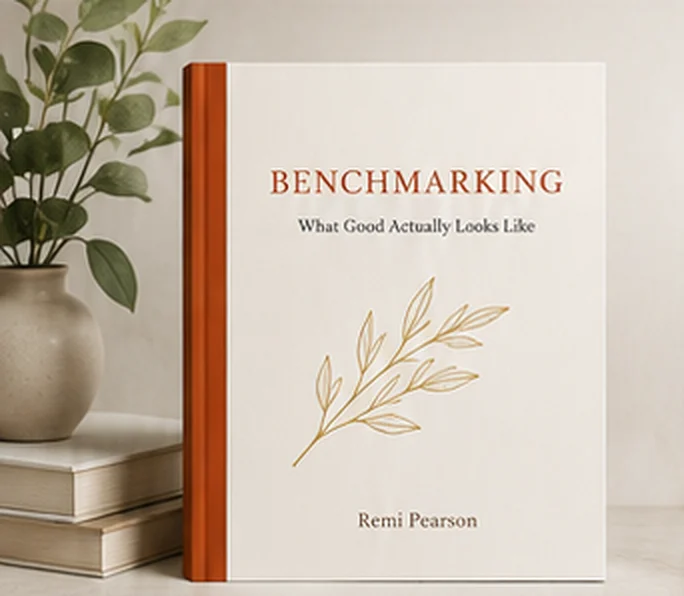
Benchmarking: What Good Actually Looks Like
$29 AUD · Four video lessons and an implementation workbook
Leave your name and email to hear when the program opens.
 Talk to Remi