

Critical Alignment Model for Leaders With Remi Pearson
Before you solve the problem, make sure you’re solving the right one.
A project keeps slipping. Someone isn’t performing. Your team agrees in the meeting, then returns to doing things the way they’ve always done them. You can see that something needs to change … working out exactly what to change is where leadership gets interesting.
The Critical Alignment Model gives you a practical framework for assessing what’s happening, comparing it with what excellence would look like, and deciding where to intervene.
Use it to make decisions, design projects, lead teams, manage performance and bring structure to your work with clients.

Nine videos with Remi • Workbooks • Practical examples • Downloadable transcripts • Free Mini Profiler access
$79AUD + GST
$86.90 AUD including GST
One payment. Self-paced. Immediate access.
How much effort goes into fixing something you haven’t accurately assessed?
A leader sends someone to training when expectations were never clear. A business introduces another system while people work towards different priorities. A project gets more meetings, yet nobody has established what success means.
Each response can sound reasonable. Whether it helps depends on what the situation actually needs.
CAM gives you somewhere to look beyond your first interpretation. You can compare what exists with what would support the result you want.

A framework for recognising what excellence requires.
Purpose
What is this for? What result are we working towards, and why does it matter?
Purpose gives your assessment its direction.Environment
What context and conditions will support that purpose?
Examine direction, culture, values and standards.Structure
How does this need to be designed?
Examine roles, responsibilities, systems, resources and how the elements fit together.Implementation
What needs to happen in practice?
Examine execution, priorities, follow-through and evidence of progress.People
What do people need to contribute successfully?
Consider capability, communication, relationships, support and accountability.
Environment and Structure sit above the line. Implementation and People sit below it.
Learn how the dimensions influence one another.
A benchmark for your decisions.
Which part of leadership do you naturally bring?
Some people see where an organisation needs to go. Some design the framework. Others get things moving, while others notice what is happening between people.
The Visionary | Environment
Holds the wider context and direction, keeping culture and values in view.
The Architect | Structure
Designs how the work will function, giving an intention a framework that supports it.
The Dynamo | Implementation
Brings movement and execution, translating decisions into what gets done.
The Collaborator | People
Attends to the people and relationships through which the work happens.



These archetypes help you notice which contributions are present and which need strengthening. Assess what the situation needs beyond your preferred response.

What you’ll be able to do
- Assess a situation with greater accuracy.
- Define what good would actually look like.
- Compare current practice with that benchmark.
- Make decisions you can explain.
- Design projects with a coherent foundation.
- Bring clarity to performance conversations.
- Facilitate with a deliberate structure.
- Apply the framework across different contexts.
$79AUD + GST
$86.90 AUD including GST
Imagine you’re planning a facilitation day with your team.
Without a framework, you might collect activities, prepare some slides and hope the day produces a useful conversation. People could enjoy it. You might still struggle to say what it changed or how the discussion will translate into their work.
With CAM, begin by establishing the purpose. What needs to be different because the day happened?
Environment
Assess the context, relevant values and standards you want to bring into the room.
Structure
Design the sequence and format so the activities contribute to the purpose.
Implementation
Plan how the day will run and how agreed actions will be carried forward.
People
Consider who is involved, what they need and how they will contribute.
Together, the dimensions provide a complete framework for the day and a way to review whether it achieved what you intended.

For people whose work requires sound judgement.
Business owners • Leaders • Managers • Consultants • Coaches • Speakers • Trainers • Facilitators • Product designers • Project managers
CAM is cross-contextual and content-free. Bring different situations to the same framework. The questions and answers become specific to your work.
You can apply what you learn in paid professional work, including client conversations, project planning and facilitation.
No prior knowledge of CAM required.
Your nine-video program
Introduction
Meet the framework and its applications in leadership and professional work.
Overview of the whole model
See how the five dimensions fit together, including above and below the line.
Purpose
Establish what you are trying to achieve and use it to guide your assessment.
Environment
Explore context, culture, values and standards. The contribution of the Visionary.
Structure
Examine how work needs to be designed and supported. The contribution of the Architect.
Implementation
Bring the framework into execution and progress. The contribution of the Dynamo.
People
Assess what people need to contribute successfully. The contribution of the Collaborator.
How the dimensions interact
Examine how a change in one area affects the others.
Conclusion and applying the model
Bring your learning together and apply CAM to a real situation.
Also included
Workbooks • Practical examples • Downloadable video transcripts
Access to the free CAM Mini Profiler, also available separately at no cost.
$79AUD + GST
$86.90 AUD including GST
One payment. Self-paced.
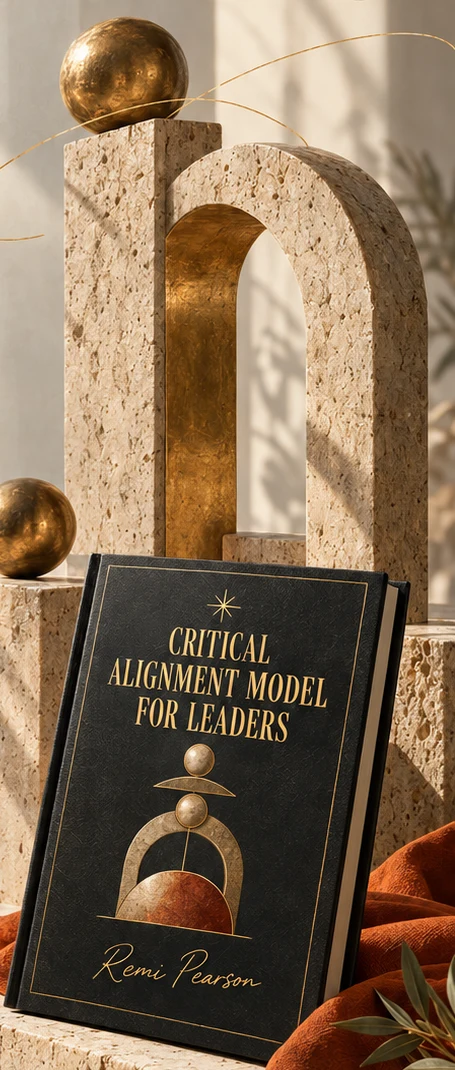
Learn it with the woman who created it.
I’m Remi Pearson, founder of The Coaching Institute and creator of the Critical Alignment Model.
I started my business cold-calling from my bedroom and built a company that turned over more than $200 million across twenty-three years, before exiting in 2024.
CAM was a framework I used in that work. It gave me a way to examine a situation, establish what excellence required and identify where our current approach fell short.
In this program, I’ll teach you the model and show you how to apply it. You’ll have a framework you can return to when the situation changes or your first answer needs a closer look.
Questions before you begin
- Is this live or self-paced?
- Self-paced recorded videos.Immediate access after purchase.
- What is included?
- Nine videos, workbooks, examples, transcripts and free Mini Profiler access.
- Can I use it with paying clients?
- Yes, including consulting, coaching, training and facilitation.
- Is this a subscription?
- No. $79 AUD + GST.$86.90 AUD including GST.One payment.
- Does it teach Purpose?
- Yes, within the overview and in a dedicated video.
- What about refunds?
- No change-of-mind refunds for this immediate-access digital product.Applicable consumer rights remain unaffected.
Use the model.
Share the opportunity.
100% of the proceeds from your sales
After purchasing, you can become an ambassador for this product, sell it to others and keep 100% of the proceeds from your sales. I receive no share of those sales.
Payment processing fees, taxes and other costs associated with your sales remain yours to account for. Participation is optional. The ambassador terms explain how it works.
I’m offering this because I want useful work to reach more people. If CAM earns a place in how you think and work, you have an opportunity to introduce it to others and earn from the sales you make.
Bring a real situation. Learn how to assess it.
Start with something you’re responsible for now. Examine what is happening, what excellence would require and where the gap sits.

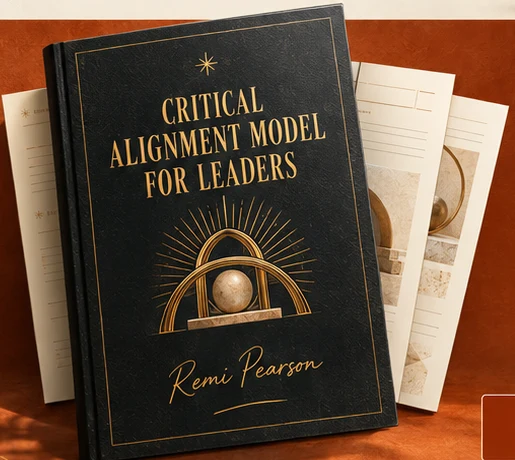
Critical Alignment Model for Leaders
With Remi Pearson
Nine videos • Workbooks • Practical examples • Downloadable transcripts • Free Mini Profiler access
$79AUD + GST
$86.90 AUD including GST
One payment. Self-paced. Immediate access.
Coming soon
 Talk to Remi