

How Do I Stop Micromanaging My Team?
How to lead without carrying everybody, using the Critical Alignment Model.
You delegate something, explain what needs to happen and get back to your own work. Then come the questions. You answer them, clarify a few things, check progress and discover something has been missed. Eventually you take it back because doing it yourself feels quicker than having another conversation about it. By Friday, you’re exhausted and wondering why nobody seems capable of making a decision without you.
It’s tempting to conclude that you need better people. Sometimes there genuinely is a capability issue. But before you make that judgement, there’s a question worth sitting with … have you created the conditions in which someone can succeed without constantly returning to you?
Why does my team rely on me for everything?
A team can become dependent on its leader through ordinary, repeated interactions. Someone brings a problem and you solve it. They make a decision and you change it, without explaining the thinking behind the change. They wait for approval because the last time they acted independently, they discovered a standard nobody had mentioned.
You may be working incredibly hard while remaining the person who holds the context, remembers the priorities and decides whether something is good enough. Your team has tasks. You still have most of the thinking.
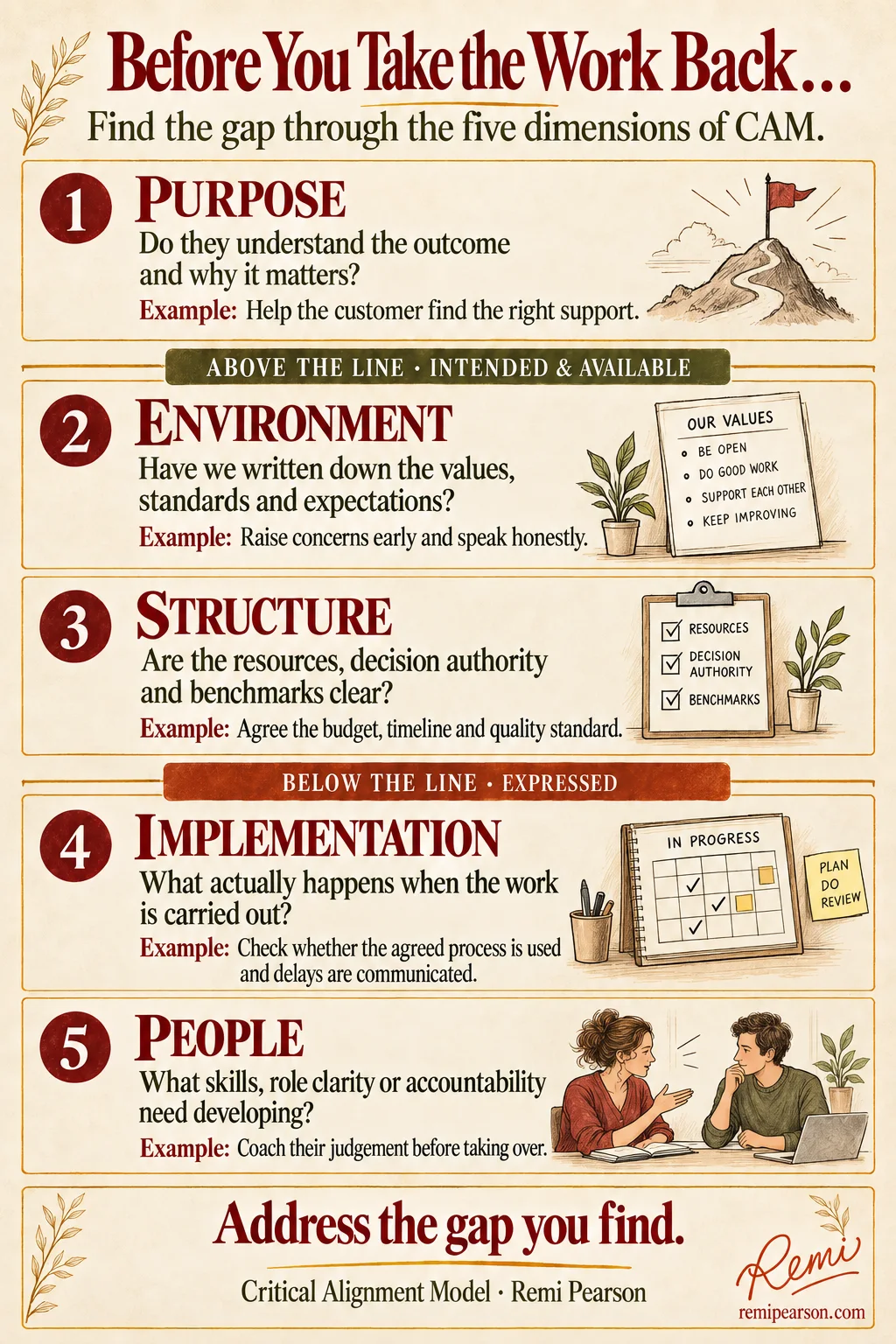
The Critical Alignment Model helps us examine this through five dimensions: Purpose, Environment, Structure, Implementation and People. We establish what matters and what supports it, then examine what happens in practice and what capacity needs developing (Pearson, 2026).
One principle I teach is, “People come last, because People come first.” If we haven’t attended to the preceding dimensions, we can end up judging people for struggling within arrangements that were never clear enough to support them.
How do I give my team clear direction?
Purpose comes first. What are we trying to achieve, and why does it matter? Someone who understands the purpose can begin evaluating options. Someone who has only been given a task will often need another instruction when circumstances change.
“Respond to customer enquiries” leaves plenty unresolved. Are we trying to help people make an informed decision, resolve a concern or find the right support? What would a successful interaction look like? Those distinctions shape the response.
Purpose also helps us assess priorities. Everything can look urgent when nobody understands what matters most. A leader needs to make that thinking available, so the team can increasingly use it themselves.
How do I build a culture of ownership?
Environment concerns the vision, values, standards and expectations we explicitly establish. If we want initiative, what does that mean here? Which decisions can someone make? What should they raise early? How do we expect people to handle disagreement or acknowledge a mistake?
Then we examine whether those written ground rules match the unwritten ones. You might say, “We welcome ideas,” while becoming defensive whenever someone questions your approach. You might ask for ownership while rewarding the person who checks every detail with you.
Amy Edmondson’s study of 51 work teams found that psychological safety was associated with team learning behaviours, including discussing errors, seeking feedback and asking for help (Edmondson, 1999). A team needs room to reveal what it doesn’t understand if we expect it to learn.
If this discrepancy feels familiar, The Ground Rules No One Wrote Down, is a relevant place to explore it. Pay attention to what a new team member would learn by watching what gets accepted around here.
How do I delegate without losing control?
Structure gives people something reliable to work within. It includes the resources, systems, sequence and benchmarks that support the outcome. Before handing something over, establish what success looks like, who owns it, what authority they have and where it connects with other people’s work.
Imagine asking someone to organise an event. They need access to the budget, the delivery standards, the timeline and the decisions they can make. If that information stays in your head, questions are inevitable.
Benchmarking matters here. “Do a great job” offers very little guidance. A benchmark makes the standard observable: enquiries answered within an agreed timeframe, information checked before publication, or the room ready before participants arrive. The benchmark should serve the purpose, rather than become another number we collect because we can.
Benchmarking… What Good Actually Looks Like focuses on this part of the work. Clear standards give both of you a basis for assessing progress beyond your personal impression of how things are going.
Research also supports looking beyond individual attitude. Seibert, Wang and Courtright’s meta-analysis found that leadership, support and work characteristics were associated with psychological empowerment, while team empowerment was positively related to team performance (Seibert, Wang and Courtright, 2011).
How do I hold people accountable without micromanaging?
Implementation examines what actually happens. Are the agreed systems used? Are priorities translated into scheduled work? Do people communicate delays while there is still time to respond, or wait until the deadline has passed?
In my CAM Top Five system, weekly priorities connect with longer-term goals, and progress is made visible through an agreed review rhythm. Regular responsibilities also need their own schedule. Otherwise, the leader becomes the reminder system for things everyone already knows must happen (Pearson, 2026).
That rhythm gives you somewhere to assess progress without constantly interrupting. It also helps you distinguish between someone who needs support and an agreement that isn’t being honoured. Both require attention, but they lead to different conversations.
What if my team genuinely needs more development?
People brings us to skills, roles and accountability. Having clarified the preceding dimensions, we can assess capability more fairly. Can the person do what the role requires? Can they explain their decisions, recognise a problem and ask for appropriate support?
Feedback should help develop their thinking. Ask what they noticed, which options they considered and what they would do differently. If you only provide the answer, they may complete today’s task while remaining just as dependent tomorrow.
Your own capacity belongs in this examination too. Can you tolerate someone doing things differently when the agreed outcome is still achieved? Can you stay with the discomfort of a learning curve without immediately taking over? Being needed can feel reassuring, even while you’re complaining about how much everyone needs you.
Where do I begin changing this?
Choose one responsibility that repeatedly returns to you and examine it through all five dimensions. Clarify its purpose, establish the expectations and support, observe what happens, then address the capability or accountability gap you actually find.
Critical Alignment Model for Leaders is the next step if you want to apply this thinking to your own team. Bring the recurring problem you’re tired of solving. Look carefully at what you have established, what remains dependent on you and what needs to develop.
The aim is a team that can increasingly understand, decide and follow through, with you available for the leadership the situation genuinely requires.
References
- Edmondson, A. (1999) ‘Psychological safety and learning behavior in work teams’, Administrative Science Quarterly, 44(2), pp. 350–383. doi: 10.2307/2666999. Accessible full text.
- Pearson, R. (2026) ‘Critical Alignment Model for Leaders’, Remi Pearson. Drawing on the author’s training materials on Critical Alignment, written and unwritten ground rules, benchmarking and the CAM Top Five system. Available at: Critical Alignment Model and Critical Alignment Model for Leaders.
- Seibert, S.E., Wang, G. and Courtright, S.H. (2011) ‘Antecedents and consequences of psychological and team empowerment in organizations: A meta-analytic review’, Journal of Applied Psychology, 96(5), pp. 981–1003. doi: 10.1037/a0022676. Accessible abstract and publication details.
 Talk to Remi