


How do I lead without
carrying everybody?

If everything depends on your vigilance, energy and ability to hold it all together, you are not leading a capable system. You are compensating for one.



Where has leadership become carrying?
It can look like commitment from the inside. Until you notice nobody else is becoming more capable.
You see the gap, anticipate the problem and step in before anything breaks. It feels responsible. It may even be necessary for a while. But every time your capability compensates for somebody else’s, the system learns to need you.
- What I’m carrying
- I hold the overview, spot what has been missed and follow through when nobody else does.
- Who it belongs to
- Some of this belongs to people with the authority and ability to notice and act for themselves.
- What I’m preventing
- I prevent mistakes, but I may also prevent others from seeing the consequences of what they haven’t taken ownership of.
- What leadership requires
- Make responsibilities and standards clear, then let the right people own the work and its follow-through.
Every question comes back to you, including decisions others could make. You become the quickest route to an answer, so people keep using it. Eventually, the team’s pace is limited by your availability.
- What I’m carrying
- I make routine decisions, settle uncertainty and give permission for work to move.
- Who it belongs to
- Decisions within someone’s role should belong to them, with clear limits for when they need to involve me.
- What I’m preventing
- I reduce the chance of a poor decision, but I also reduce opportunities for people to develop judgement.
- What leadership requires
- Define who decides what, share the criteria for a good decision and support people as they begin making their own.
You agree on an outcome, then find yourself reminding, checking and chasing until it happens. The work may get done, but you’ve become responsible for someone else’s responsibility. That is exhausting, and it tells you something about how expectations are being set and followed through.
- What I’m carrying
- I remember commitments, track progress and initiate every conversation when something slips.
- Who it belongs to
- The person who accepted the responsibility owns the result and should raise problems early.
- What I’m preventing
- My reminders protect deadlines, but they can hide unclear agreements or a lack of ownership.
- What leadership requires
- Agree on the outcome, owner, deadline and check-in point. Then address missed commitments directly rather than quietly taking the work back.
You work to keep people connected, smooth over tensions and protect the atmosphere. But if respect and honesty depend on your constant presence, they have not yet become shared ways of working. The culture needs to be practised by the team, including when you are not in the room.
- What I’m carrying
- I manage tensions, translate between people and try to keep everyone engaged.
- Who it belongs to
- Everyone has a part in how they speak, work through disagreement and treat one another.
- What I’m preventing
- By smoothing things over, I may be keeping important conversations from happening.
- What leadership requires
- Make the expected behaviours explicit, model them and address breaches with the people involved.
You review, correct and hold the detail because you know what good work looks like. When you stop checking, the quality drops. That is useful information: the standard may be clear in your head, but it has not yet been built into the team’s way of working.
- What I’m carrying
- I act as the final quality check for work that should meet the standard before it reaches me.
- Who it belongs to
- The people doing the work need to understand the standard and check their own work against it.
- What I’m preventing
- My corrections protect quality, but they can conceal missing skills, weak processes or expectations that were never made clear.
- What leadership requires
- Show what good looks like, build useful checks into the process and develop the capability to meet the standard without me.
You step in when someone struggles, takes too long or might get something wrong. It comes from wanting them to succeed. Yet if you repeatedly remove the difficult part, they lose the chance to build the capacity you need them to have.
- What I’m carrying
- I solve problems, finish tasks or absorb consequences that someone else could manage.
- Who it belongs to
- The person responsible for the work needs room to attempt it, ask for support and learn from the result.
- What I’m preventing
- I prevent discomfort and some mistakes, but I may also prevent growth and honest accountability.
- What leadership requires
- Offer guidance, resources and clear expectations. Stay available without taking the responsibility away.
Meet the T.R.U.S.T.M.E. model
People do not all make sense of the world from the same place. T.R.U.S.T.M.E. reveals the level of thinking shaping what a person, group or organisation notices, values, fears and can take responsibility for.
Under pressure, our natural level becomes easier to see.
- 7EvolutionWhat serves the whole now?
- 6MeaningWhat are we contributing beyond ourselves?
- 5TenacityHow do we improve and achieve?
- 4SystemsHow do we make this stable and repeatable?
- 3UniquenessWho am I when I stop conforming?
- 2RelatabilityWhere do I belong and whose truth do I trust?
- 1TrustCan I survive and am I enough?
You cannot lead everyone from the same place
The level of thinking present determines what kind of leadership can actually be heard.
- You cannot skip a levelEach stage has problems that must be solved before the next becomes available.
- Every level can be functional or dysfunctionalBelonging can create trust or conformity. Systems can create freedom or bureaucracy.
- The thinking that created the problem cannot solve itThe leader must respond from the level the situation requires.
Leadership is not dragging everyone to where you are.
It is seeing what thinking is present and creating the conditions for the next capability.
When you stop carrying
You do not abandon people. You stop doing the developmental work that belongs to them.
- Clarify accountabilityMake ownership visible before stepping in.
- Match the role to the readinessDo not confuse potential with current capability.
- Build systems that holdReplace memory, heroics and rescue with repeatability.
- Let the best person leadAt Evolution, function matters more than status.
Ready to see the level you’re leading from?
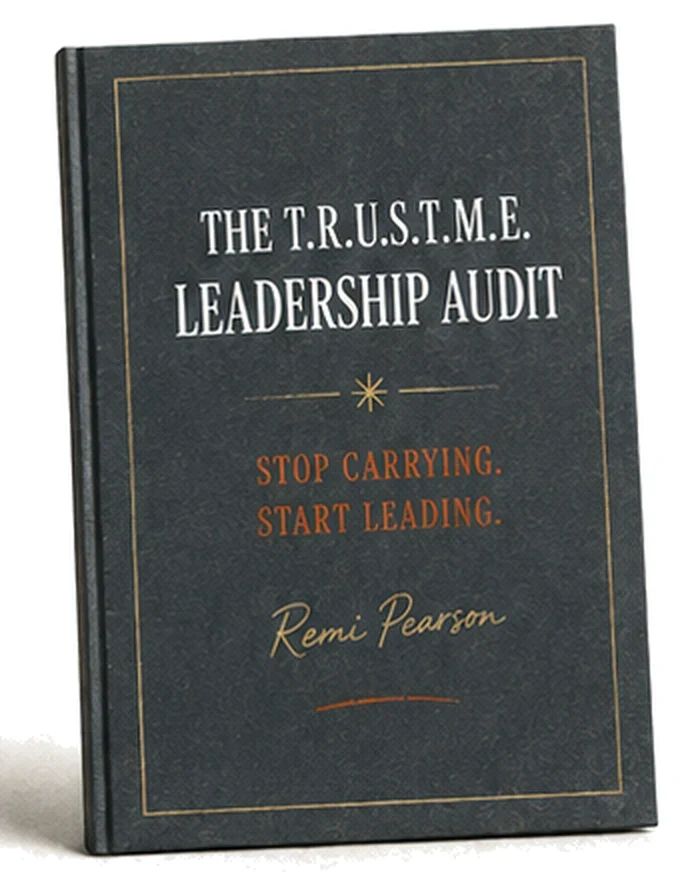
The T.R.U.S.T.M.E. leadership audit

AUD $29
A clear, self-directed assessment for seeing the level of thinking shaping your leadership, where you are over-functioning and what the next shift requires.
- Identify where you lead from under pressure
- See where you are carrying instead of leading
- Recognise the thinking present around you
- Choose the next shift without rescuing
Work through it in your own time. No classes. No calls. No weekly obligation.
The bestselling book behind the question
Leadership is not about becoming more indispensable.
It is about creating the capability, thinking and culture that allow people and organisations to grow beyond you.
Conversations to disappear into
Because leadership gets interesting when we stop talking in slogans.

Nothing important stays in one box

I’ll write when I have something worth saying
Thoughtful ideas, new conversations and the occasional invitation.
 Talk to Remi