

How Do I Find the Root Cause of Problems in My Business?
Using the Critical Alignment Model to make better decisions, develop your team and close the gap between intention and results.
You’ve discussed the problem, clarified what needs to happen and made sure everyone understands. For a while, things improve. Then the missed deadlines return, the same questions arrive at your desk and another project needs your intervention to get it over the line. You begin wondering whether you need better people, tighter accountability or another system.
Perhaps you do. But before choosing a solution, how confident are you that you’ve understood the problem?
As a founder, you can become extraordinarily skilled at keeping things moving while overlooking what makes your intervention repeatedly necessary. Your competence absorbs the consequences. The client gets looked after, the launch eventually happens and the team carries on … but the business continues relying on you to bridge something that hasn’t been properly examined.
The Critical Alignment Model gives us a way to investigate that gap before committing more energy to the wrong solution.
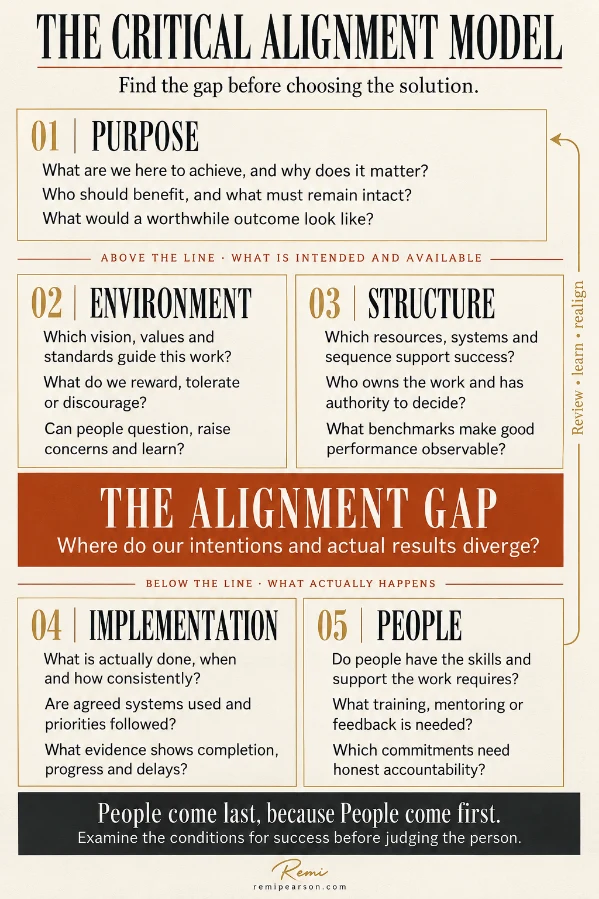
What is the Critical Alignment Model?
The Critical Alignment Model, or CAM, is a framework I developed for examining how five dimensions work together: Purpose, Environment, Structure, Implementation and People. We begin with what we are here to achieve, examine the conditions and architecture supporting it, then compare those intentions with what actually happens and how people are equipped to contribute (Pearson, 2026).
CAM can be applied to an entire business, a department, a product launch or one conversation. The scale changes, but the questions remain connected. What matters here? What supports it? What happens in practice? Where is alignment breaking?
One principle sits at the heart of the model: “People come last, because People come first.” Before concluding that someone has failed, we examine whether we established the conditions in which they could reasonably succeed.
This makes accountability more precise. It also asks something of us as leaders: the willingness to investigate our own contribution before settling on the most convenient explanation.
How do I identify the real business problem?
Start by describing what you can observe, rather than the judgement you’ve attached to it. “The team lacks ownership” is an interpretation. “Three launch decisions waited for my approval, and nobody raised the delay until the deadline” gives us something to investigate.
Consider a product launch that repeatedly runs late. You might initially see poor time management. Looking more closely, you discover that the offer keeps changing, nobody knows who can approve the copy, and the designer receives material after the agreed production window.
A productivity workshop would leave much of that untouched.
CAM helps us trace the relationships between these conditions. We use the sequence to organise our inquiry, then revisit earlier dimensions as new evidence emerges. A missed deadline might reveal an unclear decision process; that process might reveal a founder who asks for ownership while retaining every meaningful decision.
If you want to practise this with a recurring problem in your own business, the Critical Alignment Model program provides a series of modules and workbooks to support that examination.
How do I align business decisions with purpose?
Purpose comes first. What are we here to achieve, and why does it matter? A revenue target tells us something about the result we want. Purpose helps us judge how that result should be achieved, whom it serves and what must remain intact along the way.
An example from my business makes this distinction very clear.
We used to send a physical gift pack to people enquiring about our programs. It contained useful resources to support their thinking and help them make a decision. The experience mattered too. Someone received something tangible, thoughtful and useful from us before choosing whether to become a student.
While I was away, the pack was replaced with electronic resources. The reasoning was understandable: faster delivery, lower cost and greater efficiency. But the original purpose had become less visible in the decision.
The physical experience disappeared. Measurement of that pathway fell away, the electronic material became outdated, and eventually it wasn’t being sent consistently either.
The lesson concerns how we make changes. Before improving a process, establish what it exists to achieve. Otherwise, we can optimise one feature while quietly dismantling the value the whole process was designed to create.
How do I build a culture that supports performance?
Environment includes the vision, values, beliefs, standards and expectations surrounding the work. It shapes what people believe is possible, what they feel permitted to question and what they learn will be rewarded.
In our launch example, the business might say it values initiative. Yet whenever someone makes a decision, the founder changes it without explaining the criteria. People soon learn that waiting is safer than acting.
That learned expectation matters more than the word “initiative” in the induction pack.
Research by Amy Edmondson found that psychological safety was associated with learning behaviour across 51 work teams. People need to be able to reveal mistakes, seek help and discuss uncertainty if a team is going to learn effectively (Edmondson, 1999).
As founders, we need to notice what our responses teach. When someone brings an emerging problem, do we help them think it through, or make them regret mentioning it? When they challenge an assumption, do we examine it, or defend our authority?
Culture becomes visible through those ordinary moments. The written expectations give us a starting point; repeated experience tells us whether they are believable.
What business systems actually support better results?
Structure is the architecture supporting the outcome. In my teaching, I examine four areas within it: categories, infrastructure, strategies and benchmarks.
Categories help us break a broad concern into areas we can influence. “Marketing isn’t working” is too general to guide a useful decision. Is the issue lead generation, the experience after someone enquires, or conversion? Within each area, what specifically requires attention?
Infrastructure concerns the resources available. Strategies include the documented processes, sequence and responsibilities. Benchmarks establish observable evidence of success.
For the product launch, structure includes the offer brief, production schedule, budget, approval authority, handovers and publication checks. Someone needs to know what they own, what they can decide and what must happen before the next person can proceed.
A benchmark also needs to serve the purpose. Publishing a page on time is one measure. Whether the page accurately communicates the offer and helps the intended customer make an informed decision matters too.
The Critical Alignment Model modules and workbooks support you to examine these dimensions together. A beautifully documented process can still preserve a poor decision if nobody questions the outcome it was built around.
Why does my team stay busy without making enough progress?
Implementation examines what actually happens: the decisions made, priorities followed, systems used, work completed and information communicated.
A documented approval process belongs in Structure. Whether approvals arrive when agreed belongs in Implementation. That distinction helps us find the intervention required.
In my CAM Top Five system, weekly priorities connect with longer-term goals. The team establishes what needs to move forward, makes those commitments visible and reviews progress. Recurring responsibilities have their own schedule, so routine maintenance doesn’t disappear whenever a major project becomes demanding.
There is research supporting progress monitoring more broadly. Harkin and colleagues’ meta-analysis of 138 experimental studies found that interventions encouraging monitoring improved goal attainment on average, with larger effects when progress was recorded or reported (Harkin et al., 2016). This supports the practice of making progress visible; it is separate from evidence about CAM itself.
For our launch, a useful review establishes which decisions are complete, which dependencies remain unresolved and whether the timeline is still credible. “We’re working on it” tells us very little. Evidence gives us somewhere to go next.
How do I distinguish a systems problem from a people problem?
People brings us to capability, role suitability, relationships, development and accountability. Once we’ve examined the preceding dimensions, we can have a much more useful conversation about what someone needs to learn or honour.
Can they perform the work? Have they been trained and given feedback against clear standards? Can they recognise a problem, explain their thinking and communicate its implications?
When I built my business, I worked across three connected areas: training delivery, business operations and team development. I documented how our programs were delivered, systemised recurring operations, and established onboarding, mentoring and cultural reviews. Replacing myself required all three.
The development of culturally positive team members was part of that architecture. Vision and values informed daily feedback, while a 90-day onboarding and mentorship process helped us assess how someone contributed alongside their ability to do the job.
There will still be occasions when a person cannot or will not meet an established requirement. CAM helps us address that clearly, with evidence, rather than repeatedly changing systems to avoid a necessary conversation.
How do I close the gap between strategy and execution?
In CAM, Environment and Structure sit above the line: the intended conditions and written ground rules. Implementation and People sit below it: what is expressed through behaviour and lived experience. Purpose gives the whole model direction.
The distance between intention and reality is the alignment gap.
We investigate that gap rather than assuming its cause. If the team repeatedly bypasses a process, is it poorly designed, difficult to access, contradicted by another expectation or simply being disregarded? Each possibility requires a different response.
Choose one recurring problem and work through all five dimensions. Gather evidence, identify the gap, make an informed change and observe what follows. Then revisit your thinking. The aim is to develop a business that can learn from reality instead of depending on your repeated rescue.
If you’re ready to apply this to your own decisions, systems and team, explore the Critical Alignment Model program. The modules and workbooks give you a place to work with a real situation in your business, so the model becomes something you can use when the next difficult decision arrives.
Further resources
- Your First 90 Days as LeaderArticle coming soon
- The Four Non Negotiables in BusinessArticle coming soon
- The 21 Laws of Small Business SeriesArticle coming soon
- Why Do Leaders Revert to Old Habits Under Pressure?Article
- Disruptive LeadershipFree · Introduction level
- The Performance Management BlueprintAUD $29 · Introduction level
- Your First 90 Days as a LeaderAUD $29 · Introduction level
- The Ground Rules Nobody Wrote DownAUD $29 · Intermediate level
- The 90-Day ReviewAUD $29 · Intermediate level
- Benchmarking: What Good Actually Looks LikeAUD $29 · Intermediate level
- From Practice to EnterpriseAUD $79 · Intermediate level
- Core, Improve, InnovateFree · Introduction level
- Trust That HoldsAUD $49 · Advanced level
- Build Beyond the FounderBundle investment AUD $129
References
- Edmondson, A. (1999) ‘Psychological safety and learning behavior in work teams’, Administrative Science Quarterly, 44(2), pp. 350–383. doi: 10.2307/2666999. Available at: Harvard University open-access repository.
- Harkin, B., Webb, T.L., Chang, B.P.I., Prestwich, A., Conner, M., Kellar, I., Benn, Y. and Sheeran, P. (2016) ‘Does monitoring goal progress promote goal attainment? A meta-analysis of the experimental evidence’, Psychological Bulletin, 142(2), pp. 198–229. doi: 10.1037/bul0000025. Available at: White Rose Research Online, accessible manuscript.
- Pearson, R. (2026) ‘The Critical Alignment Model’, Remi Pearson. Available at: The Critical Alignment Model. Practical examples and applications also draw on the author’s supplied business and leadership training materials.
 Talk to Remi