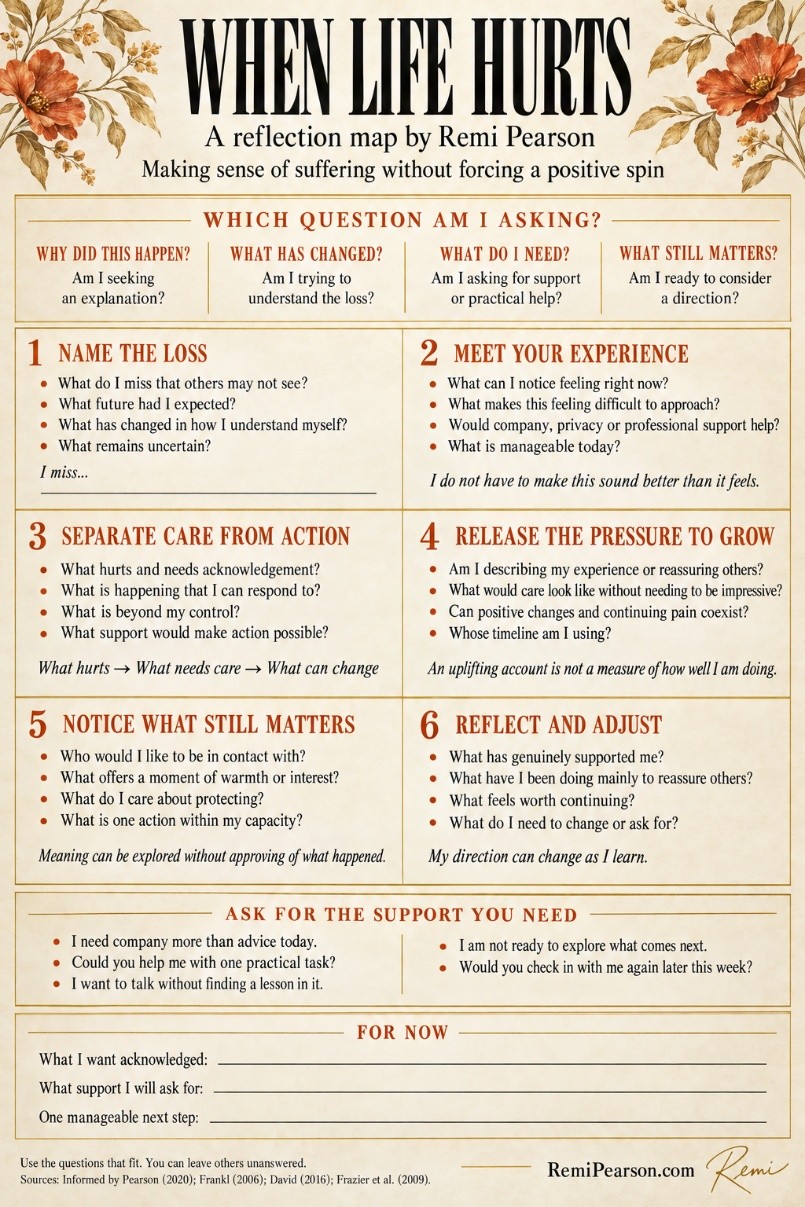

How Do I Make Sense of Suffering Without Forcing a Positive Spin?
A reflection on what has been lost, what you need now and what still matters, without turning pain into a lesson.
After her marriage ended, Helen became very good at reassuring other people. She told them she was learning a lot, enjoying her independence and looking forward to what came next. Some of that was true. But she also missed the ordinary life she had expected to keep living: someone in the kitchen while she cooked, familiar plans for the weekend, the assumption that there would be another person beside her as she grew older. When a friend said the experience would make her stronger, Helen smiled. Later, she wondered whether anyone could bear to hear that she was simply sad.
This fictional example raises a difficult question: how do we make sense of suffering when the available explanations feel too small for what has happened? Exploring it can help you recognise the pressure to turn pain into a lesson, identify the support you actually need, and consider what remains meaningful without demanding that the experience itself become something you are grateful for.
What does making sense of suffering mean?
Making sense may involve understanding what happened, recognising what it has changed, or finding a way to live with questions that remain unanswered. These are different tasks, and you may be ready for some while having little capacity for others.
It helps to distinguish the questions:
| The question | What you may be seeking |
|---|---|
| Why did this happen? | An explanation of the event or its causes. |
| What has this changed for me? | An understanding of the loss and its consequences. |
| What do I need now? | Support, protection or practical help. |
| What still matters to me? | A possible direction within changed circumstances. |
You may find an answer to one without resolving the others. Knowing why a relationship ended does not necessarily make the loneliness easier. Finding something worth doing tomorrow does not settle why the loss happened.
In my master’s capstone, I distinguish meaning-making in response to adversity from the broader experience of meaning in ordinary life. They are related inquiries, but they should not be treated as interchangeable (Pearson, 2020, p. 3).
Why this matters
When someone is suffering, there can be considerable pressure to help them feel better. We offer an explanation, identify an opportunity or remind them that other people have it worse. Sometimes we are trying to comfort them. Sometimes we are trying to relieve our own discomfort with a situation we cannot fix.
Susan David’s bestselling Emotional Agility encourages meeting difficult emotional experiences with openness and compassion while considering how to act in alignment with our values (David, 2016).
That gives us room to acknowledge pain without making it the sole organiser of every decision. It also allows us to stop treating sadness as evidence that someone is approaching their life incorrectly.
A useful coaching question … “What becomes possible if you do not have to make this sound better than it feels?”
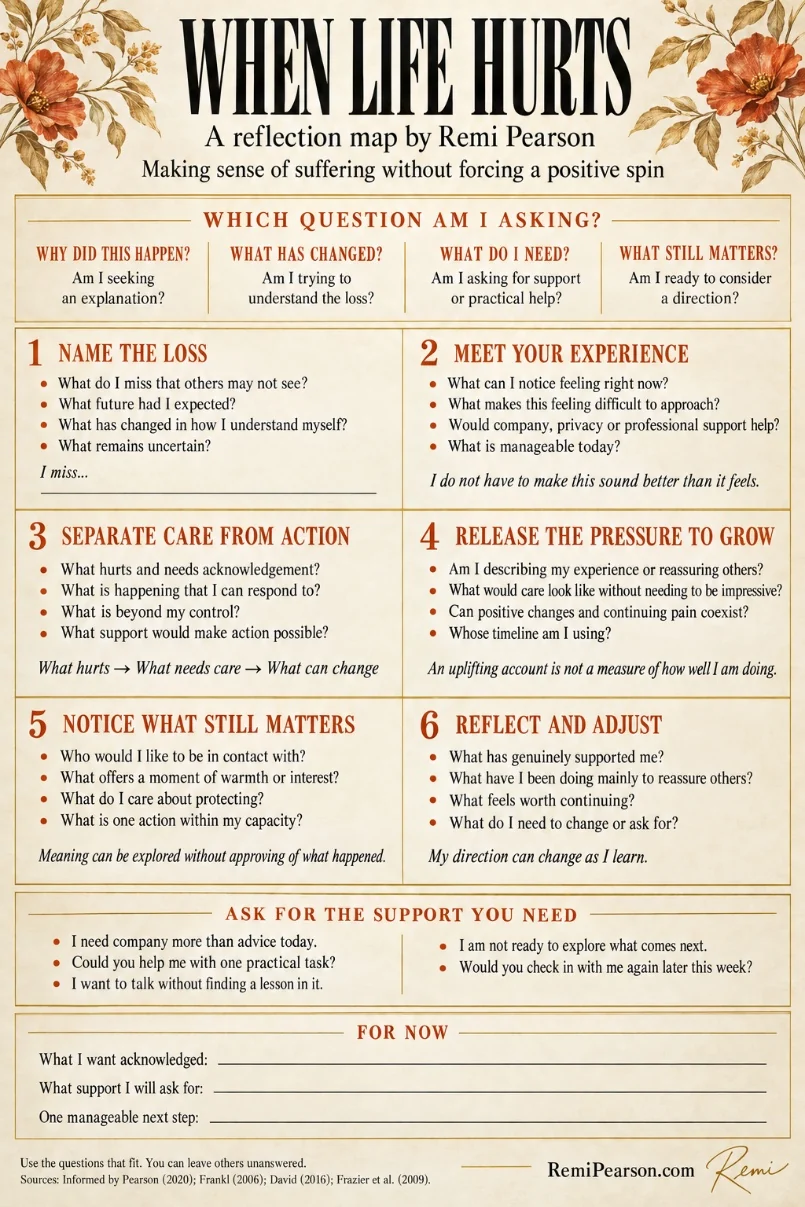
What can forced positivity cost us?
A positive interpretation may genuinely help someone. The difficulty begins when it becomes the expected response, especially when the person is still trying to understand what they have lost.
They may begin to:
- Edit their experience: sharing the hopeful parts while keeping the difficult parts private.
- Feel ashamed of continuing pain: believing they should have learned the lesson by now.
- Lose access to support: reassuring people who might otherwise understand what is needed.
- Overlook necessary action: searching for a lesson while an ongoing source of harm remains unaddressed.
- Perform recovery: looking settled while feeling increasingly alone.
Hope deserves room too. The question is whether there is also room for the experience that does not fit the hopeful account.
Read How to Support Someone You Love Without Losing Yourself for more on remaining present when you cannot resolve what another person is feeling.
Does everything happen for a reason?
People hold different philosophical and spiritual beliefs about this. Some find genuine comfort in believing that events belong to a larger purpose. Others experience that explanation as painful or implausible. It is worth allowing the person living through the experience to decide what fits.
Viktor Frankl’s Man’s Search for Meaning explores the human capacity to seek meaning even amid devastating adversity (Frankl, 2006).
I would be careful about turning that possibility into an obligation. Someone may eventually find meaning in how they respond to an experience while still wishing, wholeheartedly, that it had never happened. Those positions can coexist.
If we were exploring this in coaching, I would ask:
“Does this explanation help you meet what is happening, or does it make you feel you should stop being affected by it?”
1. Name what has actually been lost
A painful event can contain losses that are difficult to explain. Helen had lost her marriage, but she was also grieving companionship, familiar routines and an imagined future.
Consider:
- What do I miss that other people may not see?
- Which expectations can I no longer rely on?
- What has changed in how I understand myself?
- What remains uncertain?
You could write a few sentences beginning with “I miss…” or “I had expected…”. There is no requirement to end the exercise with a positive conclusion. Its purpose is to help you recognise the experience you are asking yourself to carry.
2. Make room for feelings at a pace you can manage
You may feel sadness, anger, relief or very little at all. You may move between them. Begin with what you can notice, rather than what you believe you ought to feel.
My Emotion Integration Technique explores supported contact with emotional experience, including when understanding yourself has not made those feelings accessible (Pearson, n.d.a).
Ask yourself:
- What am I aware of feeling right now?
- What makes contact with that feeling difficult?
- Would company, privacy or professional support help?
- What would be manageable today?
You do not need to force yourself into an overwhelming experience to demonstrate that you are doing the work. For further exploration, visit Emotion Integration Technique Foundations.
3. Separate what needs acknowledging from what needs action
Some pain concerns something that cannot be reversed. Some concerns a situation that is continuing and may require a response. Often both are present.
You might need to grieve a relationship while also establishing boundaries around current contact. You might need emotional support after a loss while also asking for help with the practical work it has created.
Consider this sequence:
What hurts → What needs care → What can be changed → What support will help
You are not responsible for every circumstance that has affected you. You can still examine the choices available now, including seeking help when those choices are constrained.
Where a practical problem needs clearer examination, my Critical Alignment Model offers a way to explore purpose and the conditions supporting action. It does not need to provide an explanation for the loss itself.
4. Question the pressure to emerge “better”
People can experience positive changes after adversity. That possibility deserves recognition, but claims about growth need careful interpretation.
In one prospective study of students who reported a traumatic event between assessments, self-reported posttraumatic growth generally did not correspond to measured change in the domains examined (Frazier et al., 2009). This finding concerns how growth was measured; it does not establish that genuine growth is impossible.
For the reader, I would draw a modest conclusion: an uplifting account is not the only way to understand how someone is doing.
Ask:
“What would caring for myself look like if I did not have to become impressive because of this?”
You may notice changes over time. You may also continue to feel the cost of what happened. There is room for an account that includes both.
5. Explore what remains meaningful
When you have some capacity, you might begin considering what deserves your attention within the life you now have. This can be a small inquiry. It need not become a new mission.
In my capstone, I proposed the Values Alignment Model as a research-informed coaching framework connecting values with personally meaningful goals, action and reflection. It was a proposed framework and study, rather than a completed trial of its effectiveness (Pearson, 2020, pp. 16–19).
Applied gently here, questions might include:
- Who do I still want to be in contact with?
- What offers a moment of interest or warmth?
- What do I care about protecting?
- What is one action within my capacity?
For Helen, it might mean asking a friend to come for dinner and telling the truth about how the evenings feel. Another person might want to return to something creative or contribute to a cause. The choice needs to fit the person’s experience.
Read How Do I Find Meaning in Life When Everything Feels Pointless? and explore the accompanying Meaning Into Life coaching map when that inquiry feels useful.
6. Let your direction change as you learn
Reflection is part of my Values Alignment Model because goals and the way we pursue them may need adjustment as we understand more about what matters (Pearson, 2020, p. 19).
After a while, you might ask:
- What has supported me?
- What have I been doing mainly to reassure others?
- What feels worth continuing?
- What do I need to change or ask for?
My Values Alignment Technique explores these choices while recognising that circumstances alone cannot tell us what someone values (Pearson, n.d.b).
You can also explore When Your Values and Your Life Stop Matching if a major change has prompted you to reconsider your direction.
Helen might eventually be able to tell her friend, “There are things I’m discovering, and I’m still sad about what I’ve lost.” She could ask for company without offering a lesson in exchange. Whether meaning arrived as a new direction or remained, for a while, in the ordinary act of letting someone know her, she would have somewhere more honest to begin.
Further resources
- How to Support Someone You Love Without Losing YourselfArticle
- How Do I Find Meaning in Life When Everything Feels Pointless?Article
- Emotion Integration Technique FoundationsAUD $49 · Advanced level
- When Your Values and Your Life Stop MatchingAUD $29 · Intermediate level
References
- David, S. (2016) Emotional Agility: Get Unstuck, Embrace Change, and Thrive in Work and Life. New York: Avery.
- Frankl, V.E. (2006) Man’s Search for Meaning. Boston, MA: Beacon Press.
- Frazier, P.A., Tennen, H., Gavian, M., Park, C., Tomich, P. and Tashiro, T. (2009) Does self-reported posttraumatic growth reflect genuine positive change? Psychological Science, 20(7), pp. 912–919. doi: 10.1111/j.1467-9280.2009.02381.x.
- Pearson, R. (2020) A practitioner’s perspective on coaching for meaning in life. Master of Applied Positive Psychology capstone project. University of Melbourne.
- Pearson, R. (n.d.a) Why Can’t I Feel My Emotions Even When I Understand Myself? Emotion Integration Technique. Available at: https://www.remipearson.com/ideas-models/emotion-integration-technique (Accessed: 5 October 2026).
- Pearson, R. (n.d.b) Values Alignment Technique. Available at: https://www.remipearson.com/ideas-models/values-alignment-technique (Accessed: 5 October 2026).
 Talk to Remi