
How to Support Someone You Love Without Losing Yourself
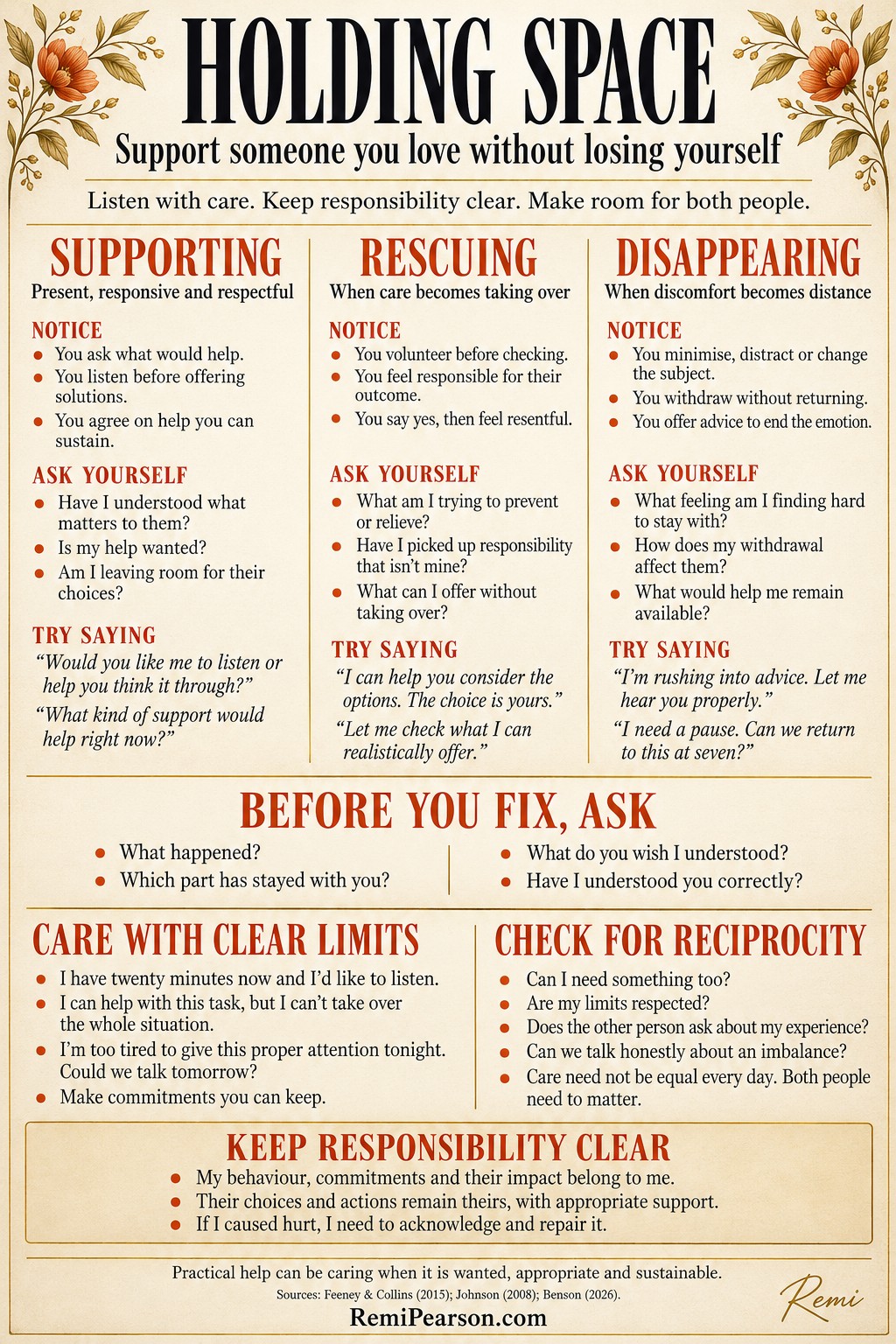
Holding space: how to listen with care, keep responsibility clear and make room for both people.
Claire could hear it in her sister’s voice before the conversation had properly begun. Another difficult week, another problem at work, another evening that would end with Claire trying to work out what to do. She loved her sister and wanted to help, so she listened, offered suggestions and eventually volunteered to make a few calls. An hour later, her own dinner was cold and she felt strangely resentful. Her sister had not asked her to take over. Claire had stepped into the familiar role almost automatically, then wondered why caring for someone so often left her feeling depleted.
This fictional example raises a question many of us recognise: how do you support someone you love when their distress matters to you, without gradually taking responsibility for their life? Understanding how to hold space can help you listen more fully, offer useful support and express your limits before exhaustion turns into resentment. It also gives you a way to examine the other end of the pattern, when someone’s feelings become uncomfortable and you find yourself disappearing.
What does it mean to hold space for someone?
Holding space means giving someone attentive, respectful room to experience and express what is happening for them. You listen, seek to understand and remain in contact with your own experience while they share theirs.
Sometimes this involves a conversation. Sometimes it means sitting beside someone who has very little to say. Practical help may be welcome too, but you check what would help rather than assuming you know.
Sue Johnson’s bestselling Hold Me Tight places emotional openness and responsiveness at the centre of connection. Her work asks us to consider whether the people we love can reach us emotionally when they need us (Johnson, 2008).
Holding space asks something of both your attention and your tolerance for discomfort. Can you stay interested when someone’s feelings have no immediate solution? Can you let them be disappointed without urgently trying to turn the conversation towards optimism?
A useful starting question … “Can I be here with you without needing your feelings to change?”
Why emotional support matters
Being able to turn towards someone when life is difficult is part of what makes a relationship meaningful. We also need encouragement when we are considering a possibility, taking a risk or growing into something unfamiliar.
Feeney and Collins’ research review proposes that relationships support thriving in both contexts: through adversity and through opportunities for growth. Their model describes support that offers comfort while also strengthening a person’s ability to engage with life (Feeney and Collins, 2015).
That is a useful way to assess your support. After spending time with you, does the person feel more understood and able to consider their next step? Or have you become the person expected to decide, organise and carry it?
What does unhealthy support cost us?
Over time, a pattern of taking over can change how a relationship feels. You may begin anticipating problems before they arrive, while the other person becomes accustomed to you handling them. At the other extreme, repeatedly withdrawing from emotional conversations can leave someone feeling that your presence depends on their being easy to be around.
The costs may include:
- Resentment: you give more than you can comfortably sustain.
- Loss of honesty: you say yes while privately wishing you could say no.
- Less agency: decisions and responsibilities migrate towards the helper.
- Emotional loneliness: difficult feelings receive advice or avoidance before they receive attention.
- Unequal care: one person’s experience consistently occupies the relationship.
In Why Do I Lose Myself in Relationships?, I explore how preserving connection can become a habit of editing yourself out of it (Pearson, n.d.b).
If we were exploring this in coaching, I would ask:
“What are you giving freely, and what are you giving because you are afraid of what might happen if you stop?”
Supporting, rescuing and disappearing: what is the difference?
The distinction becomes clearer when you look at what you actually do.
| Your response | What it might look like | A question worth asking |
|---|---|---|
| Supporting | Listening, checking what would help and agreeing on what you can offer. | Am I making room for their experience and choices? |
| Rescuing | Taking over decisions or tasks without checking, then feeling responsible for the outcome. | Have I volunteered for something they could decide or do? |
| Disappearing | Changing the subject, minimising the feeling or repeatedly withdrawing without returning. | What am I finding difficult to remain present to? |
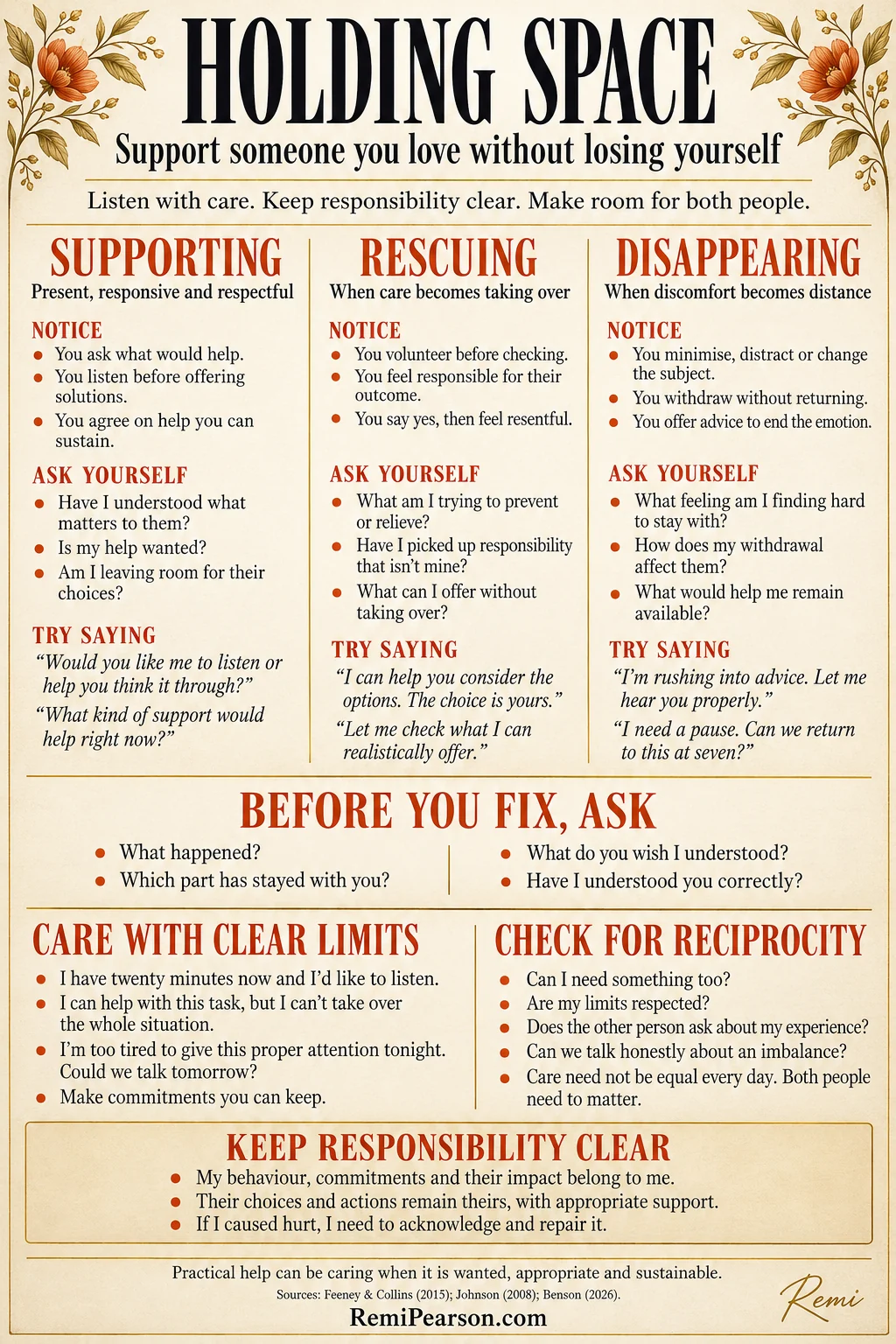
Practical help can be deeply caring. Someone who is ill, grieving or overwhelmed may need meals, transport or help with everyday tasks. The question is whether that help is wanted, appropriate and sustainable, and whether you are respecting the person rather than quietly taking charge.
1. Ask what kind of support would help
You do not have to guess. A simple question can prevent you from offering an elaborate solution to someone who wanted ten minutes of understanding.
Try:
“Would you like me to listen, or would it help to think through what you could do?”
Or:
“Is there something practical I could help with?”
If they are unsure, begin by listening. You can check again once you understand more.
In guidance published by the Gottman Institute, Kyle Benson explains John Gottman’s emphasis on understanding a person’s feelings and perspective before offering advice (Benson, 2026).
For Claire, this might have changed the entire evening. Her sister may have wanted to talk through an upsetting meeting, rather than have Claire intervene at work.
Coaching question … “Have I asked what would help, or have I appointed myself to a role?”
2. Listen long enough to discover what matters
When you are already preparing your answer, you can miss the part that matters most. Someone may begin with a complaint about work and gradually reveal that they feel overlooked, ashamed or frightened about their future.
Put down the phone. Let them finish. Ask a question that helps you understand rather than steering them towards your conclusion.
Useful possibilities include:
- “Which part has stayed with you?”
- “What did that mean to you?”
- “What do you wish someone understood about this?”
- “Have I understood you correctly?”
You can recognise the emotional experience without agreeing with every interpretation. “I can hear how hurt you felt” leaves room to explore what happened. Declaring that everyone involved is terrible may close that room quite quickly.
Read What Are Emotional Bids? How Small Moments Build Connection for more on recognising the everyday moments when someone reaches towards you.
3. Notice your own urge to fix or leave
Another person’s distress may bring something up in you. You might become anxious, irritated, helpless or suddenly busy. Before acting on that response, see whether you can understand it.
Ask yourself:
“What am I hoping will stop if I solve this immediately?”
Perhaps you cannot bear seeing someone disappointed. Perhaps you learned that being useful was how you earned your place. Or perhaps emotional conversations feel demanding, and you retreat before discovering what the person is asking of you.
In Why Do Relationships Trigger Me So Much?, I explore recognising the moment a protective response begins organising the interaction (Pearson, n.d.c).
You can acknowledge what is happening without making the other person take care of it:
“I notice I’m rushing into advice. Let me slow down and hear you properly.”
4. Keep responsibility clear
There are things you can offer and things you cannot determine. You can listen carefully, keep an agreement or help with a task you have accepted. You cannot guarantee that another person will feel better, make a particular decision or follow the advice they requested.
A useful distinction:
My responsibility → my behaviour, commitments and the impact of what I do.
Their responsibility → their choices and actions, with appropriate support where needed.
If your behaviour caused the hurt, keeping responsibility clear includes owning that impact. “Your feelings are yours” is a poor substitute for acknowledging that you broke an agreement.
My Self-Esteem Triad brings together emotions, emotional needs and boundaries. These help us consider our experience and needs while recognising where one person’s responsibility ends and another’s begins (Pearson, n.d.a).
Coaching question … “What belongs to me here, and what have I picked up without being asked?”
5. Express your limits while you still have warmth available
Waiting until you are exhausted makes a caring limit much harder to communicate. Be specific about what you can offer, and make commitments you can keep.
For example:
“I have twenty minutes now and I’d like to hear what happened.”
“I can help you compare the options. I won’t make the decision for you.”
“I care about this, and I’m too tired to give it proper attention tonight. Could we talk tomorrow morning?”
A limit may disappoint someone. You can acknowledge that disappointment without automatically reversing your decision. You can also listen to their feedback about a pattern of unavailability; having boundaries does not remove the need to examine how reliably you show up.
Read How to Set Boundaries Without Feeling Guilty for more on expressing limits.
6. Check whether care has room to move both ways
Reciprocity does not mean equal minutes or identical contributions. During illness, grief or another demanding period, one person may need considerably more support. The broader question is whether both people matter in the relationship.
Consider:
- Do they ask about your experience?
- Can you need something without feeling inconvenient?
- Are your limits respected?
- Do they notice the care you offer?
- Can you talk honestly about an imbalance?
If you have become the permanent helper, try making your own need visible:
“I’d like some time to talk about what’s been happening for me. Could you listen for a while?”
Then notice the response over time. Your ability to offer care cannot create another person’s willingness to reciprocate.
What if I have already taken over or withdrawn?
You can begin with an honest acknowledgement and a different agreement. Claire might tell her sister that she has been volunteering for too much and becoming resentful, then ask what support is actually wanted. Someone who has repeatedly withdrawn might acknowledge how lonely that has felt for their partner and agree on a way to return to unfinished conversations.
Read Why Saying Sorry Isn’t Enough: How to Repair a Relationship and How to Reconnect After Conflict: Harmony, Disharmony and Repair for more on making that acknowledgement meaningful.
For a deeper exploration, visit Holding Space Without Rescuing or Disappearing. You can also explore The Five Paths to a Healthy Relationship and the Love Without Losing Yourself collection.
Claire could still love her sister, listen to a difficult evening and offer help. She could also eat her dinner while it was warm. There was something they needed to learn together about making room for both of them.
Further resources
- Why Do I Lose Myself in Relationships?Article
- Why Do Relationships Trigger Me So Much?Article
- What Are Emotional Bids? How Small Moments Build ConnectionArticle
- How to Set Boundaries Without Feeling GuiltyArticle
- Why Saying Sorry Isn’t Enough: How to Repair a RelationshipArticle coming soon
- How to Reconnect After Conflict: Harmony, Disharmony and RepairArticle
- Holding Space Without Rescuing or DisappearingAUD $29 · Intermediate level
- The Five Paths to a Healthy RelationshipAUD $29
- Love Without Losing YourselfBundle investment AUD $97
References
- Benson, K. (2026) Understanding must precede advice. The Gottman Institute. Originally published 24 May 2017; updated 19 May 2026. Available at: https://www.gottman.com/blog/understanding-must-precede-advice/ (Accessed: 5 October 2026).
- Feeney, B.C. and Collins, N.L. (2015) A new look at social support: A theoretical perspective on thriving through relationships. Personality and Social Psychology Review, 19(2), pp. 113–147. doi: 10.1177/1088868314544222.
- Johnson, S. (2008) Hold Me Tight: Seven Conversations for a Lifetime of Love. New York: Little, Brown and Company.
- Pearson, R. (n.d.a) How Do You Build Self-Esteem That Lasts? The Self-Esteem Triad. Available at: https://www.remipearson.com/ideas-models/self-esteem-triad (Accessed: 5 October 2026).
- Pearson, R. (n.d.b) Why Do I Lose Myself in Relationships? Available at: https://www.remipearson.com/articles/the-moment-you-leave-yourself (Accessed: 5 October 2026).
- Pearson, R. (n.d.c) Why Do Relationships Trigger Me So Much? Available at: https://www.remipearson.com/articles/why-relationships-trigger-me (Accessed: 5 October 2026).
 Talk to Remi