
How Do I Find Meaning in Life When Everything Feels Pointless?
What feels absent, whose priorities you are living by, and how to give what matters a place in your actual life.
Louise was sitting in her car outside the office when she realised she did not particularly want to go inside. Nothing dramatic had happened. Her business was doing well, her team liked her, and the life she had worked towards was largely the life she now had. Yet lately, every achievement seemed to lead straight into another obligation. She missed having something she wanted to talk about that had nothing to do with work. When a friend asked what she was looking forward to, Louise mentioned a project deadline and then laughed … apparently, that was what she had available.
This fictional example captures a question that can be surprisingly difficult to admit: what if the life you have built no longer feels meaningful? Exploring that question can help you understand what feels absent, distinguish your own priorities from inherited expectations, and begin making choices that give what matters to you a place in your actual life.
What does it mean to have meaning in life?
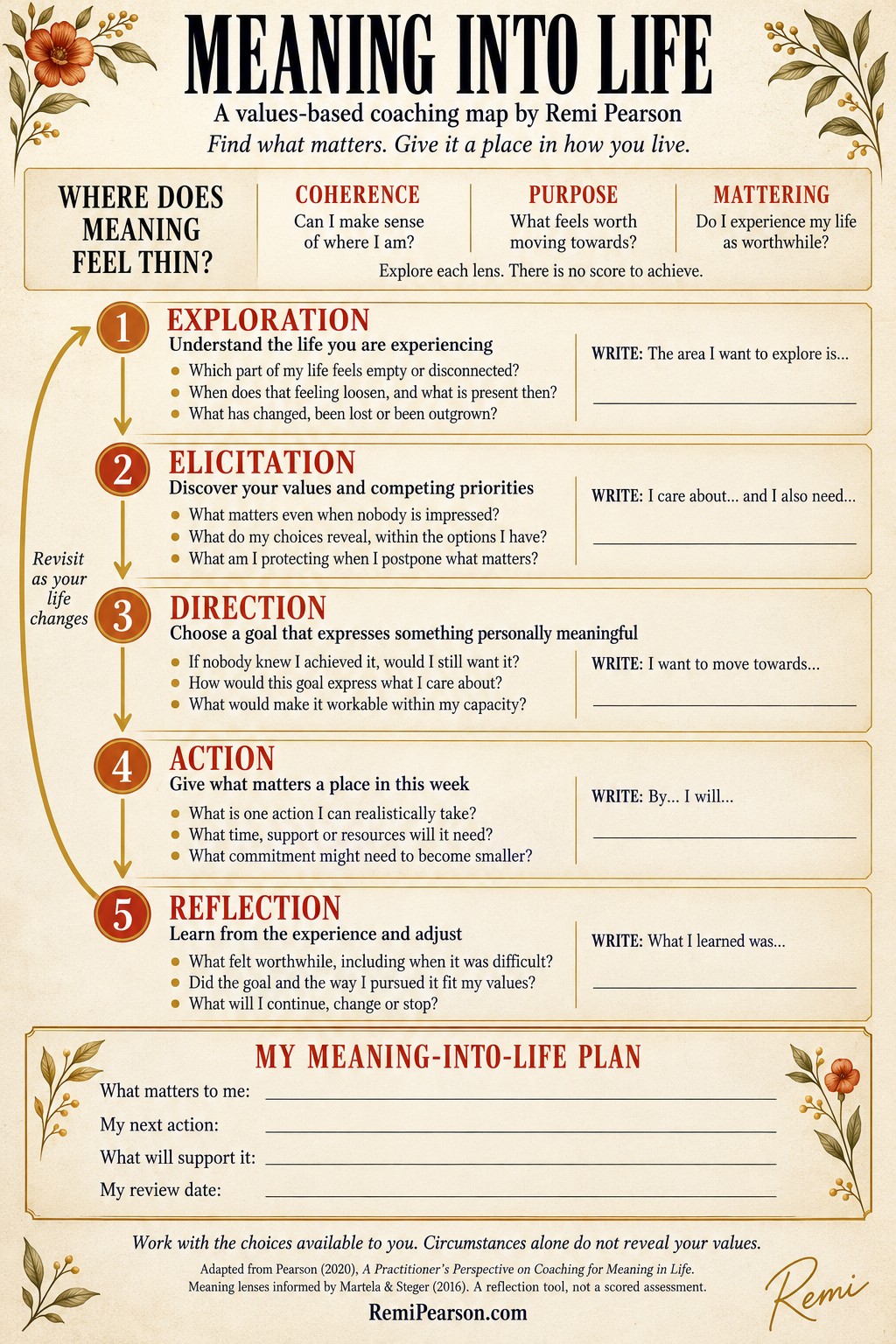
Meaning involves a sense that your life makes some sense, has direction and is worth living. These experiences overlap, but they are worth considering separately.
Researchers Frank Martela and Michael Steger distinguish coherence, purpose and significance as facets of meaning in life (Martela and Steger, 2016).
| Part of meaning | What it involves | A question to explore |
|---|---|---|
| Coherence | Some understanding of your life and experiences. | Can I make sense of where I am and how I arrived here? |
| Purpose | Goals or a direction that matter to you. | What feels worth moving towards? |
| Significance | A sense that your life has value. | Do I experience my life as worthwhile? |
This distinction helps because “I need to find my purpose” may be only part of what you are experiencing. You might have a clear direction and still feel that your days have become emotionally thin. Or a major change may have unsettled the way you understood your life, even though you still care deeply about the people in it.
Why finding meaning matters
Meaning gives us something to consider when pleasure, approval or achievement cannot answer the question of what to do next. It can help us assess whether a difficult commitment remains worth making, or whether a familiar ambition has stopped expressing anything we care about.
In Man’s Search for Meaning, Viktor Frankl places the pursuit of meaning at the centre of his account of human motivation. His work explores the possibility of finding meaning even under devastating circumstances (Frankl, 2006).
You do not need a crisis before this inquiry becomes legitimate. In my master’s capstone, A Practitioner’s Perspective on Coaching for Meaning in Life, I explored a values-based coaching framework for people seeking greater meaning in ordinary life (Pearson, 2020, pp. 3–4).
That remains an important question to me … how do we help someone engage with what matters before another decade passes in a life they are quietly tolerating?
What happens when we leave this question unattended?
Feeling disconnected from meaning can invite several responses. We may fill the calendar, set another target or decide we should be grateful and stop making such a fuss. Those responses can keep us moving while leaving the original question untouched.
You might recognise:
- Achievement without satisfaction: reaching a goal brings relief, followed by another demand.
- Living on postponement: the things you care about are reserved for a future with fewer obligations.
- Borrowed ambition: you pursue something because it makes sense to everyone except you.
- Loss of interest: curiosity has little room in a life organised around completing tasks.
- Quiet resentment: you keep fulfilling commitments you have never reconsidered.
These experiences do not establish why you feel empty. Exhaustion, grief and circumstances can matter too. They do, however, give you somewhere more useful to begin than accusing yourself of being ungrateful.
If this connects with your experience, read Why Don’t I Feel Good Enough, No Matter What I Achieve?.
1. Ask what “pointless” means in your particular life
Before searching for an answer, get more specific about the question. What feels pointless: your work, the way you spend your time, the pursuit of another goal, or the sense that nobody really knows you?
Consider:
- When did this feeling become noticeable?
- Where is it strongest?
- Are there moments when it loosens?
- What do those moments contain?
- What have I lost, stopped doing or outgrown?
Louise might discover that her work still matters to her, but it has expanded until almost everything else has become peripheral. That would call for a different response from discovering that the work itself no longer feels worth doing.
If we were exploring this in coaching, I would ask: “Which part of your life are you asking to change when you say you need more meaning?”
2. Explore your values before setting another goal
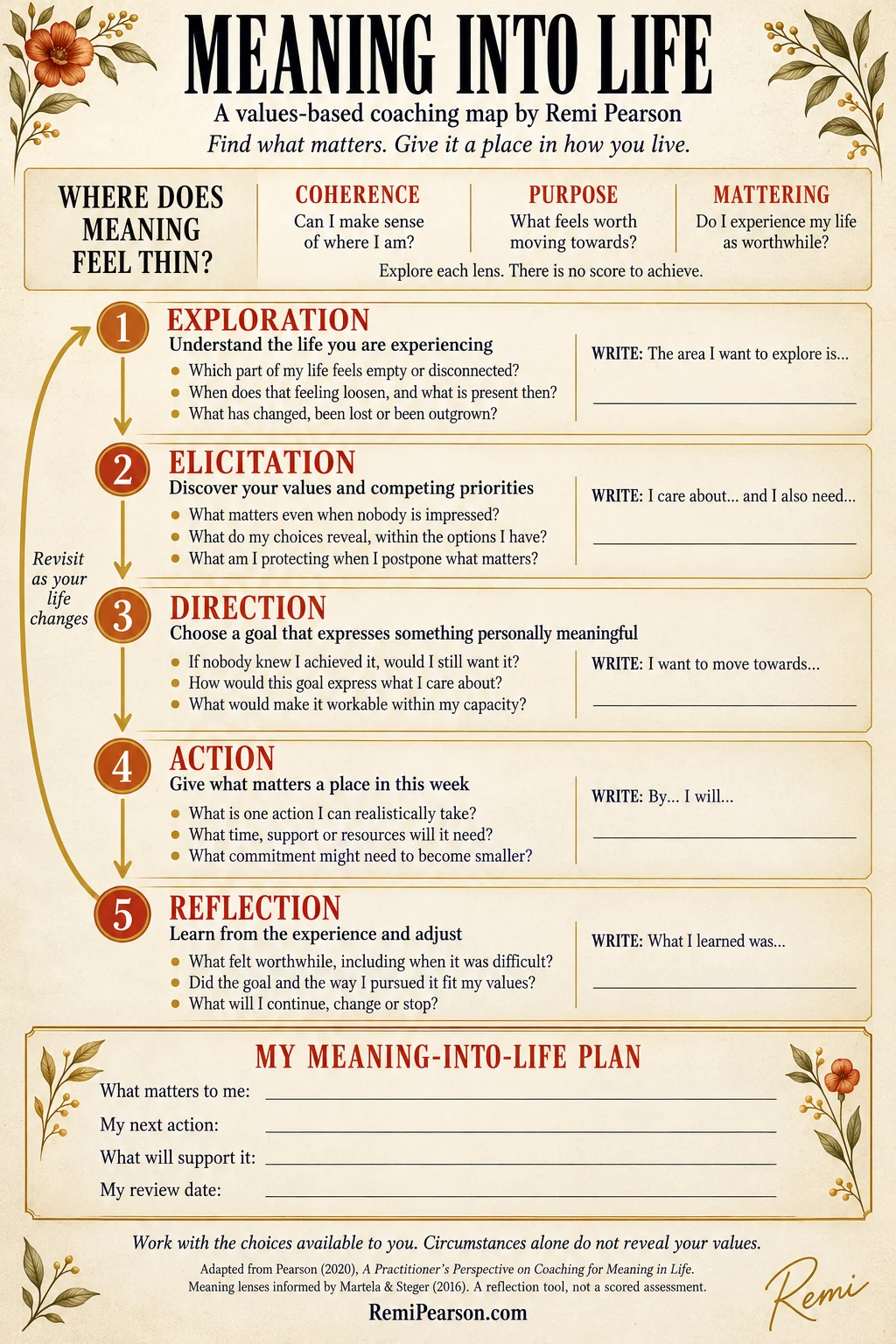
In my capstone, I proposed the Values Alignment Model, which moves through exploration, values elicitation, direction, action and reflection. It was a research-informed framework and proposed study, rather than a report of completed intervention results (Pearson, 2020, pp. 16–19).
Its practical relevance begins with giving values some attention before rushing towards a target.
Ask yourself:
- What do I care about even when nobody is impressed?
- What do I miss participating in?
- What am I proud to have contributed?
- Which commitments would I still choose if I did not need them to establish my worth?
My current Values Alignment Technique also examines what is already directing our choices. What we say matters and what we repeatedly organise our lives around may differ, and that difference deserves curiosity (Pearson, n.d.).
Circumstances need careful interpretation here. Limited money, illness or caring responsibilities can restrict your options. A crowded calendar alone cannot tell us what you value; we need to understand the choices available and what you are doing within them.
3. Examine whether your goals belong to you
Self-concordance describes the extent to which your goals express your interests and values. Sheldon and Elliot found that people pursuing more self-concordant goals sustained greater effort and were more likely to attain them, with attainment associated with greater well-being through psychological need satisfaction (Sheldon and Elliot, 1999).
That does not mean a personally meaningful goal will be easy. It gives you a reason to examine whose priorities it expresses.
Take one goal and ask:
“If nobody ever knew I achieved this, would I still want the experience it gives me?”
Then consider what the answer reveals. You may genuinely want to grow your business. You may also discover that a particular growth target has become a way to secure approval, while the work you love receives less attention.
In my capstone, self-concordance is a proposed link between values and goals, helping the inquiry move towards actions with personal significance (Pearson, 2020, pp. 10–11).
For related work, explore When Your Values & Your Life Stop Matching.
4. Give what matters a place in this week
An insight about meaning can remain wonderfully abstract unless something changes in how you participate in your life. Choose one thing you care about and identify an action within your current capacity.
| What matters to me | An action I could take |
|---|---|
| Friendship | Invite someone to spend time together, with a specific suggestion. |
| Creativity | Give an unfinished piece of work an hour of attention. |
| Contribution | Offer a useful skill to a person or cause I care about. |
| Learning | Begin exploring a question that interests me beyond its usefulness. |
The action may feel awkward or ordinary. You are giving yourself an opportunity to discover how engaging with that part of life actually feels.
What matters → An action I can take → Something I can learn from
Louise’s first step might be returning to the drawing class she left when her business became busy. She would not need to turn it into a side business, justify it through productivity or become particularly good at it.
Read How to Overcome Fear of Failure and Find the Courage to Live Fully if beginning brings up the fear of getting it wrong.
5. Consider what will need less of your attention
Oliver Burkeman’s bestselling Four Thousand Weeks examines our relationship with limited time and the question of how to use it (Burkeman, 2021).
This matters when exploring meaning because adding another activity to an already exhausting life may leave you with another obligation. Something may need to become smaller, be delegated or end.
Ask:
- What am I continuing because stopping would require an uncomfortable conversation?
- Which commitment still deserves what it costs me?
- What could be done adequately rather than perfectly?
- What would make room for something I keep claiming matters?
There may be trade-offs you cannot resolve neatly. Naming them honestly gives you a better chance of choosing than pretending sufficient efficiency will eventually accommodate everything.
For support with those conversations, read How to Set Boundaries Without Feeling Guilty.
6. Reflect, then adjust
The reflection stage of my Values Alignment Model asks whether the goals and the way they are being pursued continue to express the person’s values. It allows for adjustment as experience provides new information (Pearson, 2020, p. 19).
After a few weeks, consider:
- What felt worthwhile, including when it was difficult?
- What did I enjoy more than I expected?
- Where did I feel obliged to perform an identity?
- What would I like to continue, change or stop?
Meaning can also be present in experiences without a finish line. An unhurried conversation, caring for someone or making something simply because it interests you may deserve a place alongside achievement.
Louise may discover that she still loves her business. She may want to change it. Either way, she has begun asking a question her project deadlines could never answer: what else does she want to give her life to?
Further resources
- How Do I Make Sense of Suffering Without Forcing a Positive Spin?Article
- Why Don’t I Feel Good Enough, No Matter What I Achieve?Article
- Why Do I Never Have Enough Time, Even When I’m Productive?Article
- How to Set Boundaries Without Feeling GuiltyArticle
- How to Overcome Fear of Failure and Find the Courage to Live FullyArticle
- When Your Values and Your Life Stop MatchingAUD $29 · Intermediate level
References
- Burkeman, O. (2021) Four Thousand Weeks. London: The Bodley Head.
- Frankl, V.E. (2006) Man’s Search for Meaning. Boston, MA: Beacon Press.
- Martela, F. and Steger, M.F. (2016) The three meanings of meaning in life: Distinguishing coherence, purpose, and significance. The Journal of Positive Psychology, 11(5), pp. 531–545. doi: 10.1080/17439760.2015.1137623.
- Pearson, R. (2020) A practitioner’s perspective on coaching for meaning in life. Master of Applied Positive Psychology capstone project. University of Melbourne.
- Pearson, R. (n.d.) Values Alignment Technique. Available at: https://www.remipearson.com/ideas-models/values-alignment-technique (Accessed: 5 October 2026).
- Sheldon, K.M. and Elliot, A.J. (1999) Goal striving, need satisfaction, and longitudinal well-being: The self-concordance model. Journal of Personality and Social Psychology, 76(3), pp. 482–497. doi: 10.1037/0022-3514.76.3.482.
 Talk to Remi