

How to Stop Overthinking and Trust Yourself
How to tell useful reflection from a loop that leaves you more distressed and no better informed, and how to step back into your life.
Imagine Anna driving home after a meeting that went reasonably well. She answered the questions, contributed an idea and agreed on the next steps. But halfway home, she remembers a colleague pausing before replying. Was her suggestion ridiculous? Had she talked too much? By dinner, she has mentally rewritten the conversation several times. Later, she opens her laptop to check something she already knows, then drafts an email explaining what she meant. Her partner asks how her day was, and she barely hears the question. She is still in the meeting.
You may recognise that experience … an ordinary moment becoming hours of private analysis. Learning how to stop overthinking can help you distinguish useful reflection from thinking that leaves you more distressed and no better informed. This article explores why those loops develop, what they cost us and practical ways to recover perspective, make decisions and participate more fully in the life happening around us.
What Is Overthinking?
Overthinking is an everyday term for repetitive thinking that becomes difficult to leave and produces little useful progress. It can involve replaying the past, anticipating problems or repeatedly questioning a decision.
Two related patterns are:
- Rumination: repeatedly dwelling on distressing experiences, their meaning or what they suggest about us.
- Worry: repeatedly anticipating possible difficulties and what might happen next.
Thinking carefully is useful. Returning to a problem can help us understand it. Edward Watkins’s review of repetitive thought shows that its consequences depend partly on the content, context and whether our thinking stays abstract or becomes concrete and specific (Watkins, 2008). The distinction is more helpful than deciding that we simply “think too much”.
Useful reflection → new understanding, a decision or a practical next step.
An unhelpful loop → the same questions, rising distress and little new information.
Why Do We Overthink?
Sometimes we have a real problem that needs attention. Sometimes we are trying to think our way into certainty about something we cannot know.
Anna cannot establish what her colleague meant by a pause. Yet another replay feels as though it might finally reveal the answer. Her thinking has become an investigation with very little evidence and no clear stopping point.
In his bestselling book Chatter, psychologist Ethan Kross explores how our inner voice can help us reflect and plan, while also becoming a source of repetitive negative thinking (Kross, 2021). Having an inner conversation is ordinary. The difficulty comes when it absorbs our attention and we struggle to change perspective.
There may also be an emotion asking for our attention. In Emotional Agility, bestselling author Susan David encourages approaching difficult thoughts and feelings with curiosity and kindness, while creating enough distance to choose how we respond (David, 2016).
For Anna, the useful question might be, “What felt uncomfortable about that moment?” Perhaps she felt exposed after sharing an idea she cared about. Recognising that feeling gives her something clearer to work with than another hour of guessing.
Why Learning to Stop Overthinking Matters
Our attention is part of how we experience our lives. When it is repeatedly pulled into an imagined conversation or an unresolved possibility, we have less available for what is actually happening.
We can become so occupied with reviewing our participation that we struggle to participate. A pleasant evening passes while we analyse the afternoon. A decision remains unfinished because each possible option generates another round of questions.
Self-trust grows through experience of making considered choices and responding to their consequences. If we keep reopening every decision, we have fewer opportunities to discover that we can handle an imperfect outcome.
What Does Overthinking Cost Us?
Watkins and Roberts’s review describes how rumination can prolong negative mood, interfere with problem-solving and action, and maintain stress responses (Watkins and Roberts, 2020).
In everyday life, those costs can look like:
- Delayed decisions: repeatedly revisiting options without gathering useful information.
- Lost attention: being physically present while mentally occupied elsewhere.
- Unfinished work: spending more time anticipating judgment than completing the task.
- Emotional exhaustion: carrying the same concern through much of the day.
- Reduced confidence in our judgment: treating every uncomfortable feeling as a reason to reconsider.
You can end a day feeling as though you have worked very hard, because you have. But much of that effort may have gone into an internal conversation that has left you in the same place.
1. Recognise When Thinking Has Become a Loop
Before trying to solve the concern again, examine the process.
Ask yourself:
- Have I learned anything new?
- Is there information I need to obtain?
- Is there a decision or action available?
- Am I repeating a question that cannot currently be answered?
If there is useful work to do, identify it. If you are replaying the same material, acknowledging that can help you stop treating each repetition as a fresh discovery.
“I need to understand this” → “What would understanding allow me to do?”
That question gives the thinking a purpose and helps reveal when its purpose has become elusive.
2. Move From Broad Judgments to Specific Questions
“Why am I always like this?” is difficult to answer and easy to revisit. “What happened in that meeting, and is there anything I need to follow up?” gives us a smaller, more workable problem.
Watkins’s research identifies the importance of abstract versus concrete processing in whether repetitive thinking becomes helpful or harmful (Watkins, 2008). A practical application is to replace global judgments with questions about the situation in front of us.
For example:
- “Why do I ruin everything?” → “Which part went wrong, and can I repair it?”
- “What if this is a terrible decision?” → “What information would change my choice?”
- “What does everyone think of me?” → “Did anyone give me feedback I need to consider?”
Specific questions have a better chance of leading somewhere.
3. Separate What Happened From What You Imagine It Means
Anna knows that her colleague paused. She imagines the pause meant disapproval. Those are different kinds of information.
A simple written distinction can help:
What I observed: My colleague paused before answering.
What I inferred: She thought my idea was foolish.
What remains unknown: What she was thinking.
This leaves room for checking something that matters without treating an interpretation as established fact. David’s approach encourages this greater flexibility with our internal experiences, so they do not automatically determine our actions (David, 2016).
4. Speak to Yourself With a Little More Perspective
Kross and colleagues studied how the language of self-talk influences responses to social stress. Across seven studies, using one’s own name or non-first-person pronouns helped create psychological distance. In public-speaking and first-impression tasks, participants using this approach showed less distress and better performance than those using first-person language (Kross et al., 2014).
You could try:
“Anna, what would be a reasonable response here?”
The wording may feel unfamiliar. Its purpose is to help you approach your experience with some of the perspective you might offer someone you care about.
You can still acknowledge the discomfort. Perspective does not require pretending that the situation meant nothing to you.
5. Give the Feeling Some Attention
If embarrassment or fear is present, another round of analysis may leave the feeling untouched. You might understand every possible explanation and still feel exposed.
David encourages willingly facing difficult emotions rather than ignoring them or insisting on positive thinking (David, 2016).
Pause and notice what you feel. Can you name it more precisely? What mattered to you in that moment? Perhaps you wanted to contribute well, and being uncertain about how you were received hurts.
That admission can be much more honest than continuing to debate an unknowable pause. From there, you can decide whether you need clarification, support or simply some time before returning to the issue.
6. Choose an Action, Then Allow Experience to Inform You
Some questions need information from the world. Thinking alone cannot provide it.
If clarification matters, ask a focused question. If a decision needs making, identify your criteria and choose a proportionate next step. If there is nothing useful to do tonight, give yourself permission to return to the evening.
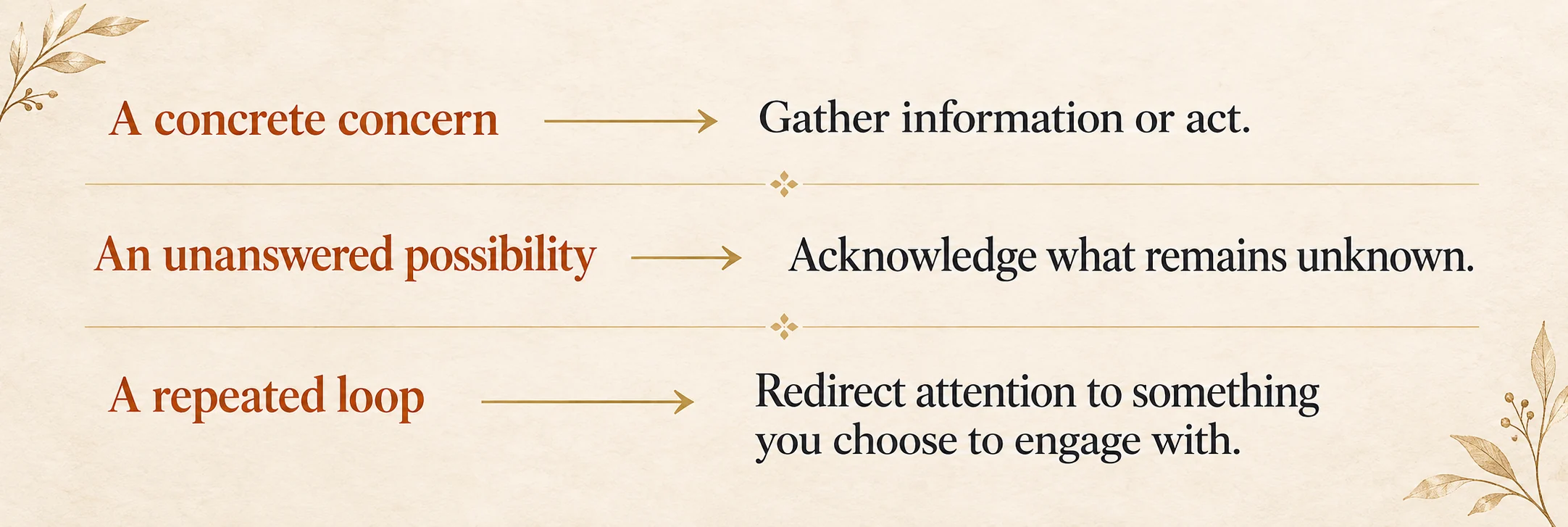
Anna may decide that no follow-up email is needed. She contributed an idea, the meeting moved forward and nothing requires repair. Her uncertainty may linger, but she can close the laptop and listen to the person beside her.
That is a small decision with a real consequence. Part of her evening becomes available again.
Further resources
References
- David, S. (2016). Emotional agility: Get unstuck, embrace change, and thrive in work and life. New York: Avery.
- Kross, E. (2021). Chatter: The voice in our head, why it matters, and how to harness it. New York: Crown.
- Kross, E., Bruehlman-Senecal, E., Park, J., Burson, A., Dougherty, A., Shablack, H., Bremner, R., Moser, J. and Ayduk, O. (2014). Self-talk as a regulatory mechanism: How you do it matters. Journal of Personality and Social Psychology, 106(2), pp. 304–324. doi: 10.1037/a0035173.
- Watkins, E.R. (2008). Constructive and unconstructive repetitive thought. Psychological Bulletin, 134(2), pp. 163–206. doi: 10.1037/0033-2909.134.2.163.
- Watkins, E.R. and Roberts, H. (2020). Reflecting on rumination: Consequences, causes, mechanisms and treatment of rumination. Behaviour Research and Therapy, 127, article 103573. doi: 10.1016/j.brat.2020.103573.
 Talk to Remi