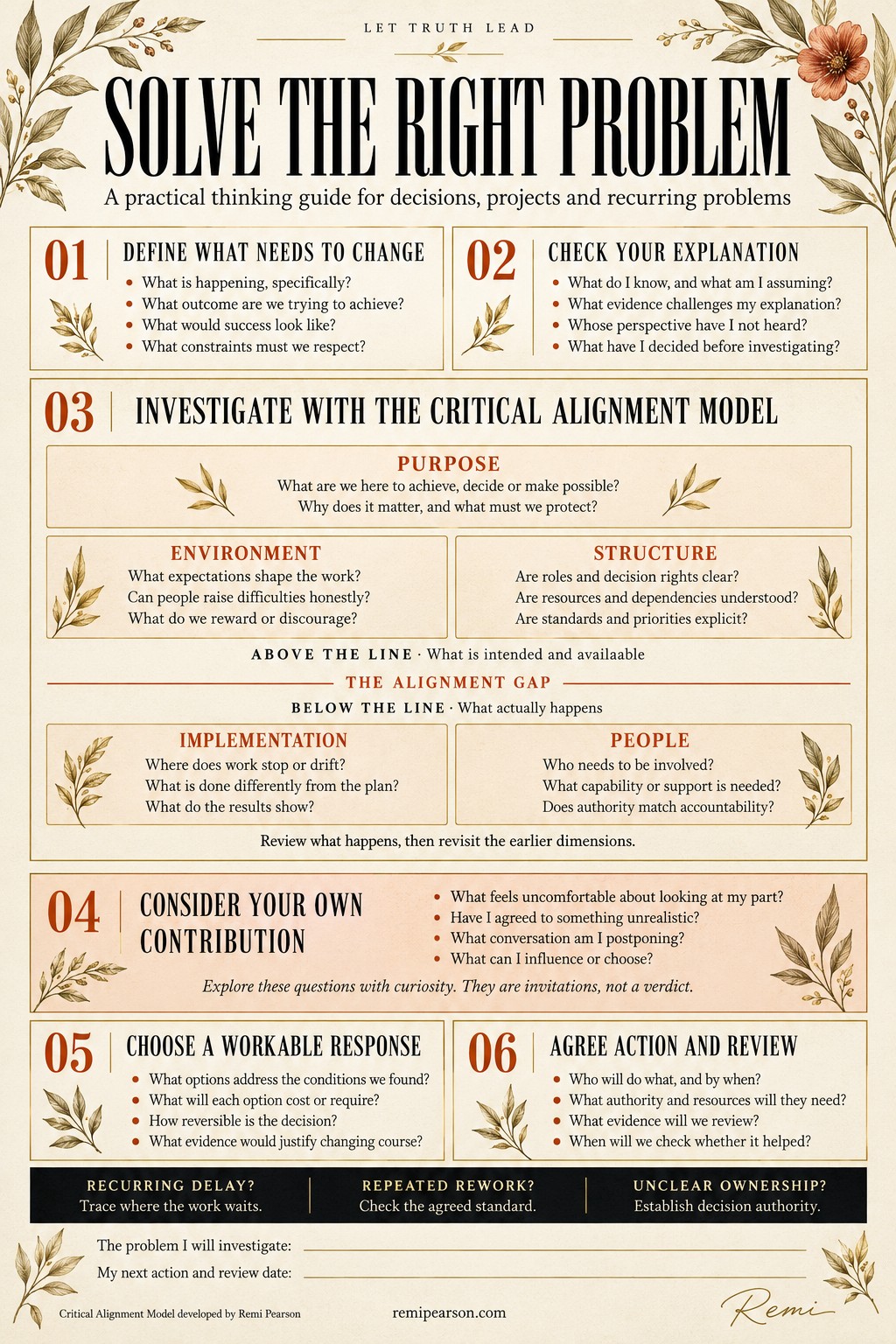

How Do I Solve the Right Problem Instead of Staying Busy Fixing the Wrong One?
A practical way to investigate a recurring problem, make a clearer decision and turn it into work someone can own.
Consider Catherine, a capable leader whose team has missed another project deadline. She has already introduced weekly updates, a shared task board and more frequent check-ins. Now she is working late, chasing approvals and wondering whether she has hired people who simply do not care enough. During a conversation about the project, someone quietly explains that three executives keep changing its priorities. Another person reveals that work regularly waits several days for Catherine’s approval. The deadline has stayed the same, even as the scope has grown. Catherine feels uncomfortable as she listens. She has been asking for greater accountability without examining whether the arrangements she oversees make delivery possible.
If you have ever worked harder on a problem that keeps returning, this article will help you pause, investigate and choose a more useful response. We will explore how to identify the problem worth solving, make decisions with clearer evidence and turn those decisions into action someone can actually deliver.
What does it mean to solve the right problem?
Solving the right problem means identifying what is producing an unwanted result and choosing an intervention that addresses those conditions.
A symptom tells us that something needs attention. It does not, by itself, explain what needs to change.
For example:
- A missed deadline might reflect unrealistic scope, delayed approvals, insufficient capability or poor follow-through.
- Repeated mistakes might reflect unclear instructions, inadequate training or a process that invites error.
- An overloaded leader might be carrying decisions that other people could make with appropriate authority.
- A stalled project might have several competing definitions of success.
These are possibilities to investigate. We cannot responsibly select one simply because it sounds convincing.
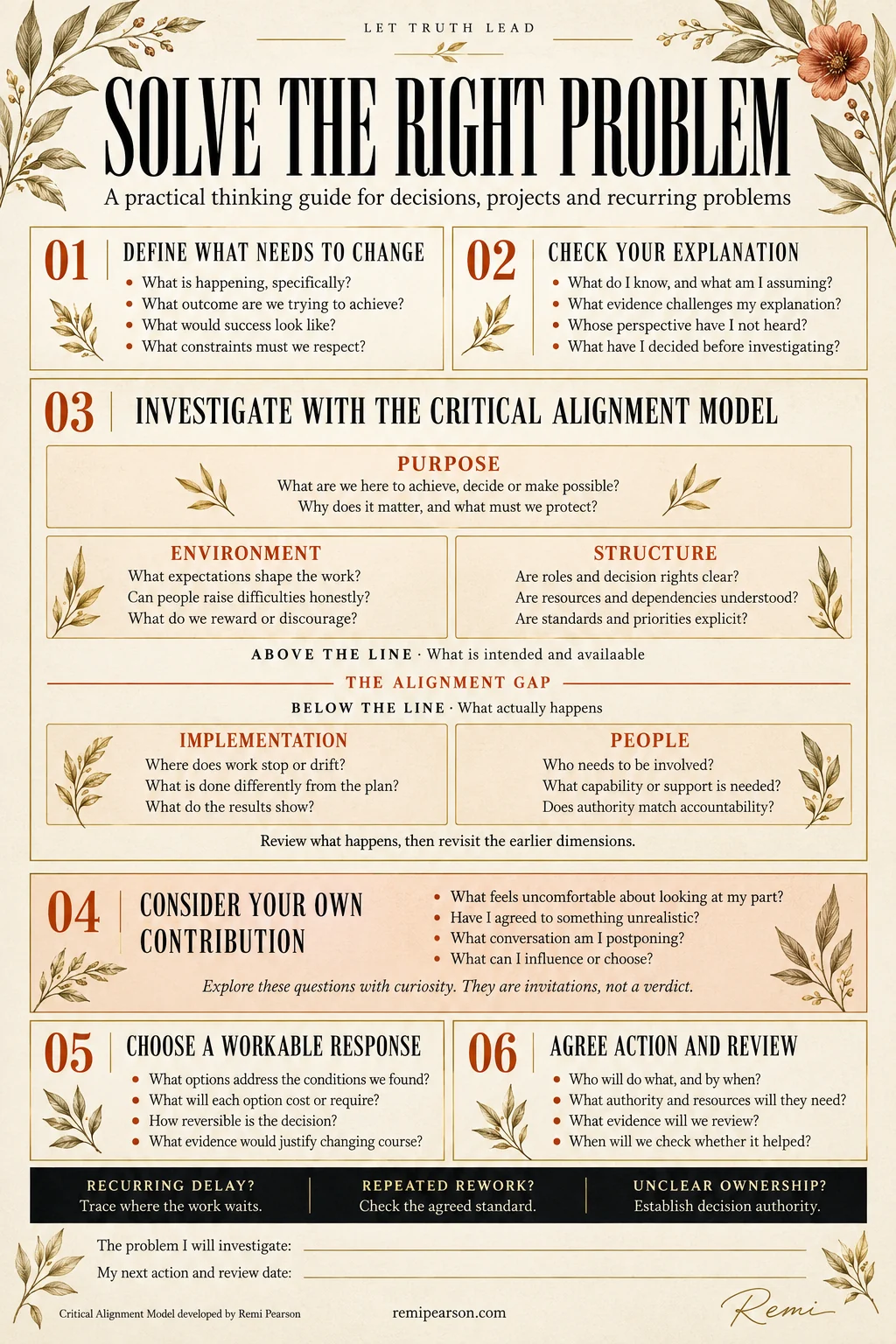
In my Critical Alignment Model, I begin with Purpose, then examine Environment, Structure, Implementation and People. The model gives us a way to investigate before deciding where the failure sits (Pearson, n.d.a).
A useful coaching question: What have I decided is the problem before I have properly investigated it?
Why better problem-solving matters
The explanation we choose determines the action we take.
If Catherine concludes that her team lacks commitment, she may increase supervision. If the evidence shows that approvals are the main bottleneck, additional supervision could consume time while leaving that bottleneck intact.
There is also a human cost to inaccurate diagnosis. Imagine working conscientiously within an impossible arrangement, then being told that your attitude is the problem. Eventually, you may stop explaining what you need because experience has taught you that the explanation will be heard as an excuse.
Thoughtful problem-solving gives people a fairer opportunity to succeed. It also gives leaders a firmer basis for accountability when expectations are clear and someone still does not meet them.
What does solving the wrong problem cost us?
The costs can accumulate quietly:
- Time: the same issue returns, requiring another meeting or intervention.
- Money: new tools, additional staff or training may address something other than the actual constraint.
- Trust: people become reluctant to disclose difficulties when disclosure leads to blame.
- Capacity: capable people spend their energy compensating for preventable confusion.
- Confidence: repeated failure can become a personal verdict, even when important conditions remain unexamined.
- Opportunity: work that matters waits while everyone attends to recurring disruption.
Have you considered how much of your workload consists of correcting something that could be designed more carefully?
That question connects with Why Do I Never Have Enough Time, Even When I’m Productive?. Sometimes the calendar is revealing a problem we keep recreating.
1. Define the outcome before choosing the solution
Before asking what to do, ask what needs to be different.
“Improve communication” is too broad to guide a useful decision. For Catherine’s project, a clearer outcome might be:
Deliver the agreed customer onboarding process by 30 November, within the approved budget, with the required security checks completed.
Now the team can discuss whether that outcome is feasible and what it requires.
NASA’s decision-analysis guidance places decisions within the context of intended outcomes and constraints, then considers criteria and alternatives before selecting a course of action (NASA, n.d.).
Try these questions:
- What are we trying to achieve?
- Who needs this outcome, and why?
- How will we recognise success?
- What constraints must we respect?
- What are we willing to change if the current combination of scope, resources and deadline is unrealistic?
Unclear outcome → clarify success before prescribing action.
If your team regularly discovers the standard only after work is rejected, explore Benchmarking… What Good Actually Looks Like and register your interest.
2. Separate observations from explanations
Write down what you know, then distinguish it from what you think it means.
| Observation | Initial explanation | What to investigate |
|---|---|---|
| Three milestones were missed | “The team lacks discipline.” | Where did work stop, and why? |
| Tasks await approval | “People lack initiative.” | Who has authority to proceed? |
| Deliverables require rework | “The quality is poor.” | Were acceptance criteria agreed beforehand? |
| Priorities change each week | “We need to be more agile.” | Who authorises changes and assesses their impact? |
Julia Galef’s The Scout Mindset encourages an intellectually honest interest in what is true, including information that challenges what we would prefer to believe (Galef, 2021).
For a leader, that can mean asking a question whose answer might implicate your own decisions.
If we were coaching this together, I might ask:
What evidence would make you reconsider your explanation?
If you cannot imagine any evidence changing your mind, it may be worth examining how attached you have become to that explanation.
3. Use CAM to widen the investigation
The Critical Alignment Model provides five areas of inquiry. These questions are a practical application of that architecture (Pearson, n.d.a).
| CAM dimension | Questions for your project |
|---|---|
| Purpose | Do we agree on the outcome and why it matters? |
| Environment | What expectations and permissions shape the work? Can difficulties be raised honestly? |
| Structure | Are resources, roles, dependencies, authority and standards clear? |
| Implementation | What actually happens? Where does work stop or depart from the plan? |
| People | What capability, support and accountability are required? |
Apply these questions to one recent delay. Trace the work from its beginning to the point where it stopped. Speak with the people involved and check the records rather than relying entirely on recollection.
For Catherine, the investigation might reveal that work is completed promptly but waits for approval. It might also reveal that a late change requires substantial rework. Those findings would suggest a different response from another reminder to meet deadlines.
For a broader introduction, read How Do I Find the Root Cause of Problems in My Business?.
4. Notice what makes an explanation comfortable
Some explanations let us remain in familiar territory. “They need to take ownership” may feel easier to say than “I have retained authority while expecting others to carry responsibility.”
In my Safe Problems, Risky Truths work, I explore how a familiar problem can protect us from an experience or recognition that feels more exposing. Applying that inquiry to leadership invites curiosity about our own contribution without assuming that every external difficulty originates within us (Pearson, n.d.c).
You might gently ask:
- What feels uncomfortable about examining my part in this?
- Have I agreed to something I knew was unrealistic?
- What conversation have I been postponing?
- Where do I have enough influence to make a useful change?
Allow time for an honest answer. People rarely think more clearly because they have been cornered.
You can explore the related introduction, Safe or Risky Problems, and register your interest.
5. Compare options and make the trade-off explicit
Investigation needs to lead somewhere. Once you have a credible understanding of the problem, compare responses.
Catherine’s options could include:
- reducing the scope while protecting essential requirements;
- adding suitable capacity;
- changing the delivery date;
- delegating approvals within agreed limits;
- establishing a process for assessing proposed changes.
Some options may need to be combined. Each has costs and consequences.
NASA recommends defining decision criteria, evaluating alternatives and documenting the basis for the decision (NASA, n.d.).
A small project may need only a brief written comparison. A costly or difficult-to-reverse decision deserves more investigation.
A coaching question worth sitting with: What am I expecting this team to deliver that our current resources and decisions do not support?
6. Turn the decision into work someone can own
“We need clearer approvals” is an intention. Make the arrangement specific enough to use.
For example:
| Agreement | Practical detail |
|---|---|
| Action | Delegate routine approvals within agreed limits |
| Owner | Project lead |
| Authority | Approve work meeting documented criteria |
| Escalation | Refer exceptions to the sponsor |
| Review | Examine approval delays and rework after two weeks |
Then ask the owner whether the arrangement is workable. Check what information, time or support they need.
Before leaving the conversation, establish:
Who will do what → with what authority → by when → reviewed against what evidence?
7. Review the result and remain willing to rethink
Adam Grant’s Think Again makes the case for questioning assumptions and revising our understanding as we learn (Grant, 2021).
At the review, ask:
- Did the intervention improve the result?
- What remained difficult?
- Did we create another problem?
- What does the evidence now suggest?
Pressure can make this difficult. In my T.R.U.S.T.M.E. Model, I examine how the thinking we can sustain changes under pressure, including the shift towards control or exhausting achievement (Pearson, n.d.b).
For more on this, read Why Do Leaders Revert to Old Habits Under Pressure?. If uncertainty is keeping you in analysis, How to Stop Overthinking and Trust Yourself offers a related inquiry.
Let truth lead your next decision
Return to Catherine’s project. Suppose delegated approvals shorten the waiting time, but delivery still slips. She now has useful evidence. She can examine the remaining constraint, reconsider scope and make the next decision with greater clarity.
That is a more workable position than continually demanding greater effort from everyone, including herself.
Choose one problem that keeps returning. Before adding another task, write down:
What is happening? What do I know? What am I assuming? What needs to change?
If you want to develop this approach in your leadership, explore Critical Alignment Model for Leaders and register your interest.
There is something deeply relieving about giving a difficult situation our honest attention. We can stop carrying the responsibility to know everything immediately and begin doing the work of finding out.
Further resources
- How Do I Find the Root Cause of Problems in My Business?Article
- Why Do Leaders Revert to Old Habits Under Pressure?Article
- Why Do I Never Have Enough Time, Even When I’m Productive?Article
- How to Stop Overthinking and Trust YourselfArticle
- Critical Alignment Model for LeadersAUD $79 · Advanced level
- Benchmarking: What Good Actually Looks LikeAUD $29 · Intermediate level
- Safe or Risky Problems?Free · Introduction level
References
- Galef, J. (2021) The Scout Mindset: Why Some People See Things Clearly and Others Don’t. New York: Portfolio.
- Grant, A. (2021) Think Again: The Power of Knowing What You Don’t Know. New York: Viking.
- NASA (n.d.) 6.8 Decision analysis. Available at: https://www.nasa.gov/reference/6-8-decision-analysis/ (Accessed: 5 October 2026).
- Pearson, R. (n.d.a) The Critical Alignment Model. Available at: https://www.remipearson.com/ideas-models/critical-alignment-model (Accessed: 5 October 2026).
- Pearson, R. (n.d.b) The T.R.U.S.T.M.E. Model. Available at: https://www.remipearson.com/ideas-models/trustme-model (Accessed: 5 October 2026).
- Pearson, R. (n.d.c) Why do we keep trying to solve the same problem? Safe Problems, Risky Truths. Available at: https://www.remipearson.com/ideas-models/safe-problems-risky-truths (Accessed: 5 October 2026).
 Talk to Remi