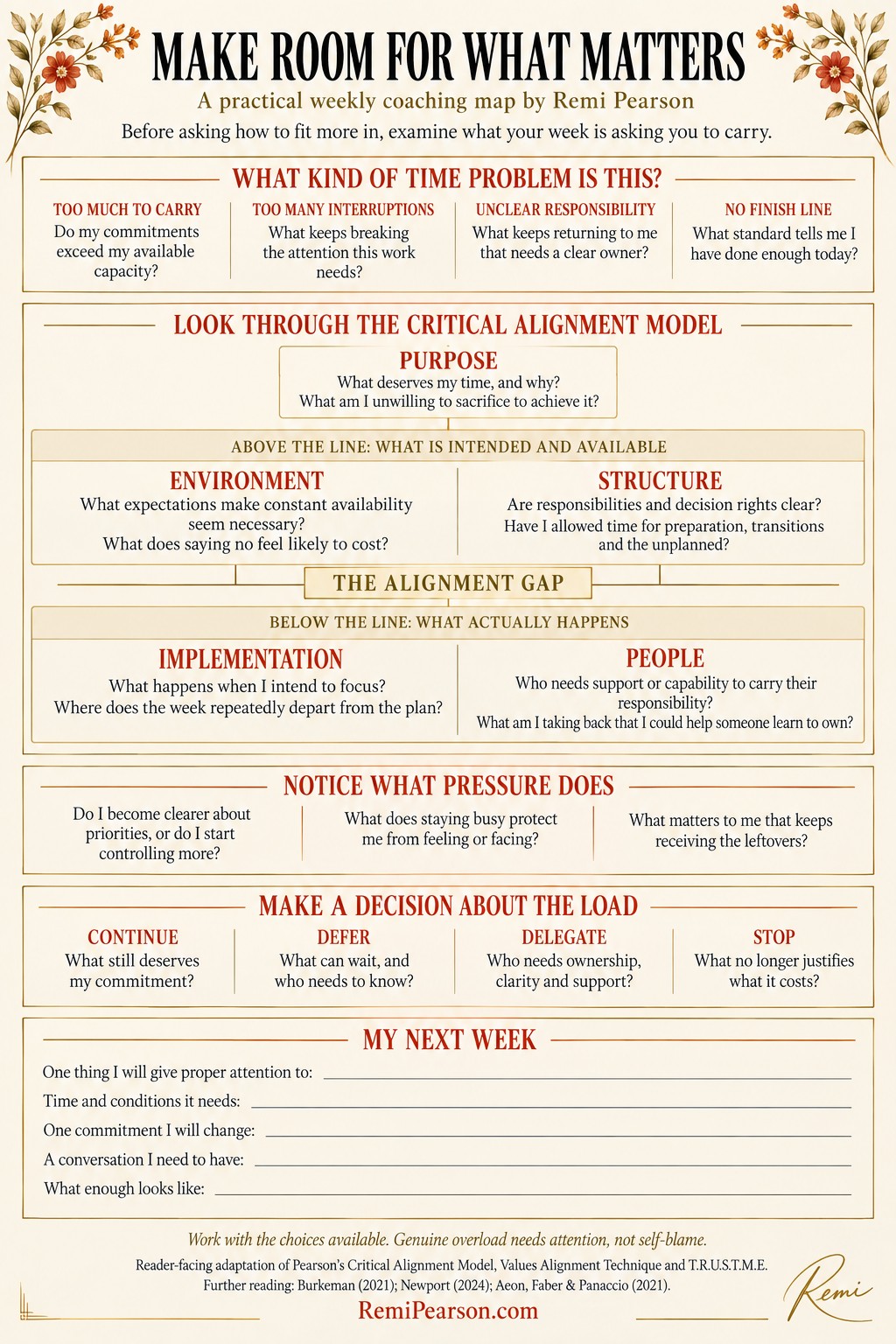

Why Do I Never Have Enough Time, Even When I’m Productive?
How to tell an overloaded life from a planning problem, and make more deliberate choices about what your time is for.
At 9.40 on a Tuesday night, Catherine opened her laptop to finish the proposal she had intended to write that morning. She had worked all day. There had been meetings, messages, a client problem and several decisions her team wanted her to make. She had also booked her mother’s appointment, organised a birthday present and answered a friend who needed to talk. Looking back, she could account for almost every hour. What she could not explain was why the things she most wanted to give her attention to kept arriving at the end of it.
This fictional example captures a familiar frustration: you can be busy, capable and remarkably efficient, yet still feel perpetually behind. Exploring why you never have enough time can help you distinguish an overloaded life from a planning problem, understand what keeps claiming your attention, and make more deliberate choices about what your time is for.
What are we really asking when we say we need more time?
“I don’t have enough time” can describe several different problems. Your commitments may genuinely exceed your capacity. You may have enough hours on paper but little uninterrupted attention. Or you may spend your days responding to demands while the things you care about remain difficult to begin.
These distinctions matter because they call for different responses.
| What is happening? | What may need attention? |
|---|---|
| Your commitments exceed your available hours. | Workload, expectations and what can change. |
| Your attention is repeatedly interrupted. | Availability, communication practices and protected time. |
| You keep taking responsibility for other people’s work. | Ownership, capability and clear agreements. |
| Important work is repeatedly postponed. | Its place in the week, and what makes beginning difficult. |
| Nothing you complete feels sufficient. | The standard you are using to decide you have done enough. |
A more detailed schedule may help with some of this. It cannot settle every question in the table.
Why our relationship with time matters
Time is where our intentions encounter the conditions of our lives. We can sincerely value friendship, creativity or thoughtful leadership while finding that these receive whatever attention remains after everything else.
Oliver Burkeman’s bestselling Four Thousand Weeks examines the limits of our time and what those limits mean for how we live. His work invites us to reconsider the expectation that we will eventually become efficient enough to accommodate everything (Burkeman, 2021).
Planning still has value. A meta-analysis of 158 studies found that time management was associated with performance and well-being, with a somewhat stronger relationship to well-being than performance (Aeon, Faber and Panaccio, 2021).
That gives us a broader question than “How much did I get done?”
“Did the way I used my time support a life I want to participate in?”
What does constantly feeling behind cost us?
When every day feels like an attempt to catch up, it can become difficult to assess your commitments calmly. Another request arrives, you respond, and the week continues before you have considered whether anything needs to change.
You may notice:
- A life organised around urgency: what arrives most loudly receives attention first.
- Less depth: important work is squeezed between interruptions.
- Relationship debt: time with people you care about is repeatedly postponed.
- Resentment: you keep being available while feeling that your own priorities barely count.
- Rest with conditions attached: you wait to relax until the work is finished.
- A shrinking sense of choice: the week feels decided before you have entered it.
There are real constraints here. Caring responsibilities, financial pressure, illness and demanding workplaces can leave very little flexibility. Any useful inquiry needs to respect those conditions while examining where some choice remains.
For the larger question of what deserves that choice, read How Do I Find Meaning in Life When Everything Feels Pointless?.
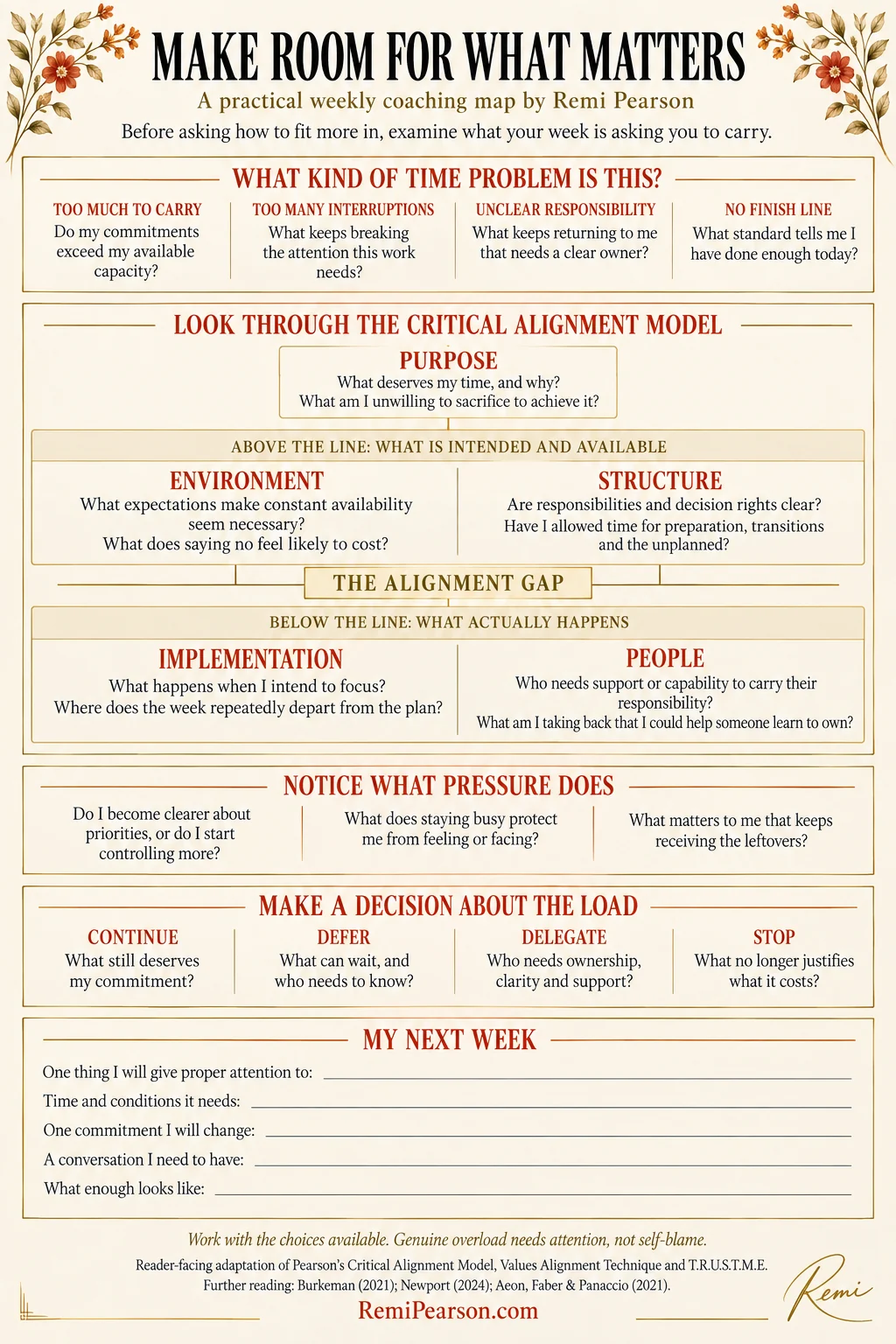
1. Make the full workload visible
Before judging your time management, find out what your life is asking you to carry. For several ordinary days, record where your time goes without attempting to improve it.
Include more than formal work:
- Preparation and follow-up.
- Travel and transitions.
- Household administration.
- Caring responsibilities.
- Unplanned requests and interruptions.
- The time needed to recover after something demanding.
Then compare your commitments with your available capacity. If the numbers do not fit, that is useful information.
If we were exploring this in coaching, I would ask: “What have you left out when estimating what your week requires?”
Catherine might discover that she has been planning around an imaginary version of her day in which nobody asks her anything and life produces no administration. Her actual Tuesday deserves a place in the plan.
2. Use the Critical Alignment Model to examine the conditions
My Critical Alignment Model examines Purpose, Environment, Structure, Implementation and People. It provides a way to investigate the conditions supporting an outcome before deciding that the person should simply try harder (Pearson, n.d.a).
Applied to time, that inquiry might look like this:
| CAM lens | A question for your week |
|---|---|
| Purpose | What needs this time, and why does it matter? |
| Environment | What expectations make constant availability seem necessary? |
| Structure | Are roles, resources and decision rights clear? |
| Implementation | What actually happens when I intend to focus? |
| People | Who needs support or capability to carry their responsibility? |
For Catherine, a recurring interruption may reveal that her team does not know which decisions they can make independently. Reserving an hour for her proposal will help only if that uncertainty receives attention too.
Read How Do I Find the Root Cause of Problems in My Business? for the fuller application. You can also explore Find the Gap in Your Own Life.
3. Ask what being busy gives you
Busyness can be imposed on us. It can also provide something we have become reluctant to question.
Being needed may reassure you that you matter. Responding immediately may protect you from someone’s disappointment. A crowded day may keep you away from work that exposes you to judgement.
These are possibilities to explore, rather than conclusions to impose.
In my Values Alignment Technique, I examine the relationship between what someone says they want and what their familiar choices may be protecting (Pearson, n.d.c).
Ask yourself:
- What would I have to feel if I stopped being immediately available?
- What difficult conversation am I avoiding by continuing to do this?
- Is preparation helping me begin, or helping me postpone beginning?
- What might change in how others see me if I stopped carrying so much?
The programme When Your Values and Your Life Stop Matching offers a related place to explore that discrepancy.
4. Notice what pressure does to your thinking
You may agree with thoughtful working practices and still abandon them when something goes wrong. Suddenly, you are checking every detail, taking back delegated work or treating speed as the only acceptable response.
My T.R.U.S.T.M.E. Model explores how thinking can shift under pressure. It asks what is organising a person or system in the moment, rather than assigning a permanent personality label (Pearson, n.d.b).
For this article, the practical question is:
“When I feel behind, do I become clearer about what matters, or do I start controlling more?”
Catherine may find that pressure makes her take back decisions, which creates further pressure. Recognising that loop gives her something specific to work on.
Read Why Do Leaders Revert to Old Habits Under Pressure? for more on this pattern.
5. Reduce the work competing for your attention
In Slow Productivity, Cal Newport proposes a more sustainable approach to accomplishment through doing fewer things, working at a natural pace and attending to quality (Newport, 2024).
A useful application is to distinguish everything you would eventually like to do from the work you are actively carrying now.
Review your commitments and decide:
Continue → Defer → Delegate → Stop
For each active project, ask:
- Does it need to be active this week?
- What does completing it actually require?
- Which other commitment will move to make room?
- Who needs to know about that decision?
This requires communication, especially when deadlines affect other people. It also requires admitting that a new priority cannot always be absorbed through greater personal effort.
For business owners whose work repeatedly returns to them, explore From Practice to Enterprise.
6. Give important work a workable place
Choose something that matters and give it a specific place in your week. Consider the conditions it needs, including energy, information and a realistic period of attention.
You might:
- Reserve time for one defined piece of work.
- Agree when routine questions will be discussed.
- Establish a separate route for genuinely urgent issues.
- Define what a satisfactory result looks like before beginning.
- Leave some room for the unplanned.
If you lead a team, explain these arrangements and remain available in the ways the work requires. Protected focus needs an agreement people can understand.
Coaching question … “What would make this time usable, rather than merely reserved?”
The Critical Alignment Model for Leaders is relevant if unclear responsibilities or repeated interruptions are part of the problem.
7. Decide what “enough” looks like today
An unfinished list can follow you into every free hour unless you have some way to decide that today’s work is complete.
Try naming the essential commitments for the day, making them realistic, and deciding how you will close the day even if other work remains. This might include recording the next step, communicating a changed deadline or setting aside something that does not need attention yet.
You may still feel uncomfortable stopping. That feeling deserves inquiry too.
Read How to Set Boundaries Without Feeling Guilty if availability and guilt are tightly linked, or How to Stop Overthinking and Trust Yourself if you keep reopening decisions after the work is done.
Catherine’s proposal still needed writing. But she could begin changing the conditions that kept pushing it into the night: clearer decisions for her team, fewer simultaneous commitments and an honest conversation about what would wait. She could also decide that dinner with a friend deserved a place in the week before every outstanding task had been resolved.
Further resources
- How Do I Find the Root Cause of Problems in My Business?Article
- Why Do Leaders Revert to Old Habits Under Pressure?Article
- How to Set Boundaries Without Feeling GuiltyArticle
- How Do I Solve the Right Problem Instead of Staying Busy Fixing the Wrong One?Article
- How Do I Find Meaning in Life When Everything Feels Pointless?Article
- How to Stop Overthinking and Trust YourselfArticle
- Find the Gap in Your Own LifeAUD $29 · Foundation level
- When Your Values and Your Life Stop MatchingAUD $29 · Intermediate level
- From Practice to EnterpriseAUD $79 · Intermediate level
- Critical Alignment Model for LeadersAUD $79 · Advanced level
References
- Aeon, B., Faber, A. and Panaccio, A. (2021) Does time management work? A meta-analysis. PLOS ONE, 16(1), e0245066. doi: 10.1371/journal.pone.0245066.
- Burkeman, O. (2021) Four Thousand Weeks. London: The Bodley Head.
- Newport, C. (2024) Slow Productivity: The Lost Art of Accomplishment Without Burnout. New York: Portfolio.
- Pearson, R. (n.d.a) The Critical Alignment Model. Available at: https://www.remipearson.com/ideas-models/critical-alignment-model (Accessed: 5 October 2026).
- Pearson, R. (n.d.b) The T.R.U.S.T.M.E. Model. Available at: https://www.remipearson.com/ideas-models/trustme-model (Accessed: 5 October 2026).
- Pearson, R. (n.d.c) Values Alignment Technique. Available at: https://www.remipearson.com/ideas-models/values-alignment-technique (Accessed: 5 October 2026).
 Talk to Remi