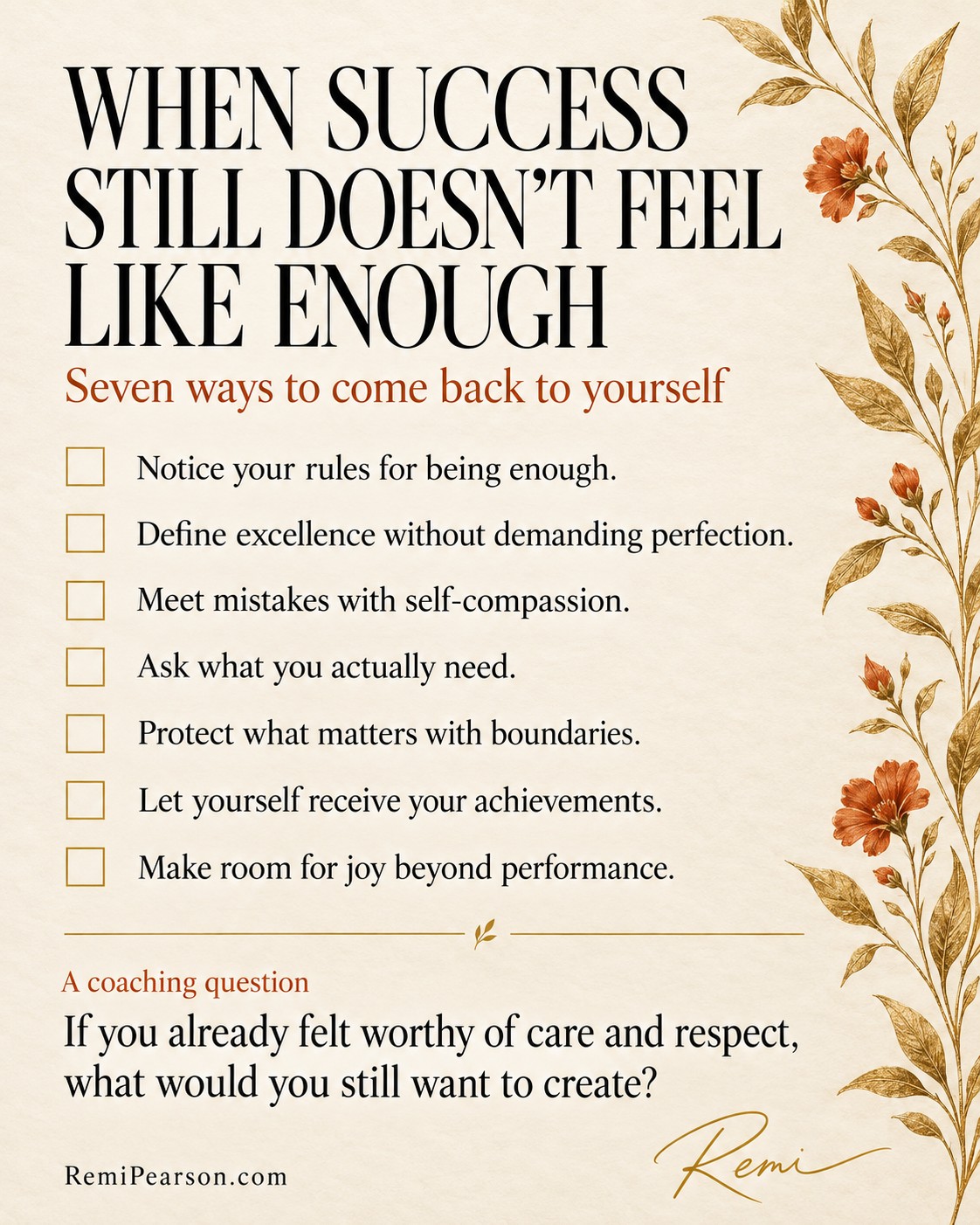

Why Don’t I Feel Good Enough, No Matter What I Achieve?
Why achievement can leave the feeling of being insufficient untouched, and seven ways to come back to yourself.
Imagine Claire, the founder of a successful business, sitting in her car after an awards dinner. She has just been recognised for something she spent years building. Her team cheered, her friends sent messages, and for a few minutes she felt proud. Now she is checking an email about a project running behind schedule. Another finalist’s business is growing faster than hers. She wonders whether the award means very much anyway. Before she reaches home, an evening that could have become a lovely memory has turned into a private review of everything she still hasn’t done.
If you recognise that experience, this article is for you. We’ll explore why achievement can leave the feeling of being insufficient untouched, what happens when your worth becomes tied to performance, and how to develop a steadier relationship with yourself while continuing to pursue work you care about. There are also questions I would want to explore with you in coaching, because understanding this pattern is only useful if something begins to change in how you live.
What Does “Not Feeling Good Enough” Mean?
Feeling that you are not good enough is different from recognising that a skill needs developing. You can know that your presentation needs work without concluding that something is wrong with you.
The difficulty begins when a specific outcome becomes a judgment about your value as a person.
“This needs improving” → a practical problem you can work on.
“I’m inadequate” → a judgment with no clear finishing point.
Researchers describe contingent self-worth as worth that depends on meeting particular conditions. Those conditions might involve achievement, approval or how we compare with other people. Crocker and Park argue that pursuing validation in areas where our worth is invested can carry substantial costs, especially when those areas feel threatened (Crocker and Park, 2004).
For a high achiever, work can become one of those conditions. A good result brings relief. A disappointing result feels personal. Neither leaves much room for being an ordinary human having a variable day.
Why Success Doesn’t Always Make You Feel Enough
A goal can give you direction, satisfaction and opportunities you genuinely want. But consider what else you are asking it to provide.
Perhaps you have quietly attached a promise to it:
- When I reach that revenue, I’ll be able to relax.
- When I earn their respect, I’ll stop questioning myself.
- When the business runs smoothly, I’ll feel capable.
- When I achieve something exceptional, I’ll finally feel that I matter.
The result may arrive while the promise remains unfulfilled. You then set another condition.
Brené Brown’s The Gifts of Imperfection explores worthiness alongside authenticity and self-compassion, including the difficulty of perfectionism and living under other people’s expectations (Brown, 2010). Her work invites us to examine the conditions we place on being acceptable to ourselves.
If we were exploring this in coaching, I would ask:
What are you expecting your next achievement to change about the way you feel towards yourself?
Then I would want to know whether previous achievements have delivered that change, and for how long.
Why This Matters for High Achievers
Being capable does not make us immune to self-doubt. We may be exceptionally good at delivering results while having very little experience of resting without guilt or making a mistake without attacking ourselves.
From the outside, the arrangement can look impressive. We are dependable, productive and willing to take responsibility. From the inside, there may be a constant calculation about whether we have done enough to deserve our place.
That deserves attention because the business, career or contribution we are building is also the life we are spending. It matters whether we can experience any pleasure in it.
What Does It Cost to Keep Proving Yourself?
Crocker and Park describe how goals centred on validating our worth can interfere with learning, autonomy and self-regulation (Crocker and Park, 2004).
In everyday life, you might notice:
- Difficulty receiving recognition: praise is quickly explained away or followed by a reminder of what remains unfinished.
- Rest that feels conditional: you stop only when exhaustion leaves you little choice.
- Overcommitment: saying yes helps preserve your identity as capable or indispensable.
- Defensiveness around feedback: a useful observation feels like evidence against you.
- Goals that keep moving: you reach the standard, then immediately raise it.
- Less room for enjoyment: pleasure competes with the feeling that you should be doing something useful.
Have you considered how much of your effort goes towards the work itself, and how much goes towards maintaining a particular impression of yourself?
That distinction can be uncomfortable. It can also explain why success has become so tiring.
1. Discover Your Private Rules for Being Enough
Begin by completing this sentence honestly:
“I am acceptable to myself when …”
Write several answers. Avoid the answers you think a psychologically sophisticated person should give. Notice the rules operating on an ordinary Tuesday.
Perhaps you are acceptable when everyone is pleased with you, when nothing is behind schedule or when you are achieving more than you did last year.
Then ask:
- Where did I learn this rule?
- What happens emotionally when I cannot meet it?
- Would I apply it to someone I love?
- Does it leave room for illness, uncertainty or a disappointing day?
- What has following it cost me?
You do not need to settle every question immediately. The first step is noticing the arrangement you have been living under.
2. Distinguish Excellence From the Need to Be Beyond Criticism
High standards can help us produce work we are proud of. Problems arise when we expect excellent performance to protect us from embarrassment or disapproval.
Brown connects perfectionism with efforts to avoid judgment and shame, and places self-compassion among the practices that help us respond differently (Brown, 2010).
Try asking:
What would high-quality work look like here if I accepted that someone could still dislike it?
Define the actual standard before you begin. What must the work accomplish? Which checks matter? When is it ready?
This helps keep the task connected to its purpose, rather than allowing anxiety to keep adding requirements.
For more on taking considered action while discomfort is present, read How to Overcome Fear of Failure and Find the Courage to Live Fully.
3. Practise a Constructive Response to Yourself
Kristin Neff and Roos Vonk found that self-compassion was associated with more stable feelings of self-worth and less dependence on particular outcomes than global self-esteem. It also showed stronger negative associations with social comparison and self-rumination (Neff and Vonk, 2009). These findings support examining how we respond to ourselves, rather than relying entirely on favourable evaluations.
When something goes wrong, try this sequence:
Describe the event → acknowledge its impact → choose what needs attention.
“The project missed its deadline. I feel disappointed, and the client needs a clear explanation. I’ll review what contributed and agree on a realistic recovery plan.”
You have acknowledged the problem without turning the whole of yourself into it.
A coaching question I would ask is:
Can you take responsibility for this outcome without using it as permission to treat yourself badly?
4. Notice What You Need Beneath the Drive to Achieve
Within my Self-Esteem Triad, I explore the relationship between emotions, emotional needs and boundaries. At the centre is the lived experience of being worthy, lovable and enough. It is a model for examining how we relate to ourselves, rather than another score we must improve (Pearson, n.d.).
Use it to consider what is happening beneath your next goal:
- Emotions: What am I feeling, and can I acknowledge it?
- Needs: What am I hoping this achievement will provide?
- Boundaries: What am I giving up to keep pursuing it?
Perhaps you need recognition. Perhaps you need rest, or the chance to enjoy what you have already created. Naming the need allows you to consider a direct response.
A useful coaching question: What are you asking your work to provide that it has repeatedly failed to give you?
5. Protect Something That Matters to You
If feeling valuable depends on being useful, boundaries can feel surprisingly threatening. Declining a request may bring guilt even when your schedule is already unreasonable.
Choose one commitment to examine. What does it require? What will you have to sacrifice? Are you agreeing because it fits your priorities, or because somebody’s disappointment feels intolerable?
Read How to Set Boundaries Without Feeling Guilty for more on communicating a boundary and following through.
For now, consider:
What would you protect this week if your needs counted before you had reached exhaustion?
Your answer needs to become something observable. A free evening, a realistic deadline or an honest conversation gives you an opportunity to practise.
6. Stop Reopening the Case Against Yourself
An accomplishment can disappear surprisingly quickly under repeated analysis. Was it really impressive? Did you deserve the recognition? Would someone else have done it better?
Notice whether those questions produce useful information or simply make receiving the experience more difficult.
You can record what you did, what helped and what you learned. You can also allow yourself to enjoy it before deciding what comes next.
If that private review is familiar, read How to Stop Overthinking and Trust Yourself.
Ask yourself: What would happen if I allowed this achievement to be real without immediately qualifying it?
7. Include Something You Don’t Have to Excel At
Consider whether there is anything in your week that you enjoy without needing to become impressive at it.
You might draw badly, cook something unfamiliar or spend an afternoon somewhere beautiful without turning it into content. The activity is yours to choose. The question is whether you can participate without making it another assessment.
If strong emotion appears when you slow down, it deserves attention. My article on Emotion Integration Technique explores the gap between understanding ourselves intellectually and being able to engage with our emotional experience.
Build a Life You Can Actually Receive
Claire does not need to stop caring about her business. She may still want to grow it. But perhaps, after the next awards dinner, she can leave the email until morning and let the evening belong to her.
A steadier relationship with ourselves gives achievement somewhere to land. We can enjoy what we have done, acknowledge what still needs work and have a life beyond the next measure of success.
If you would like to explore the foundations more closely, Self-Esteem from the Inside Out introduces the work of the Self-Esteem Triad. You can visit the product page to register your interest.
And before choosing your next goal, consider this:
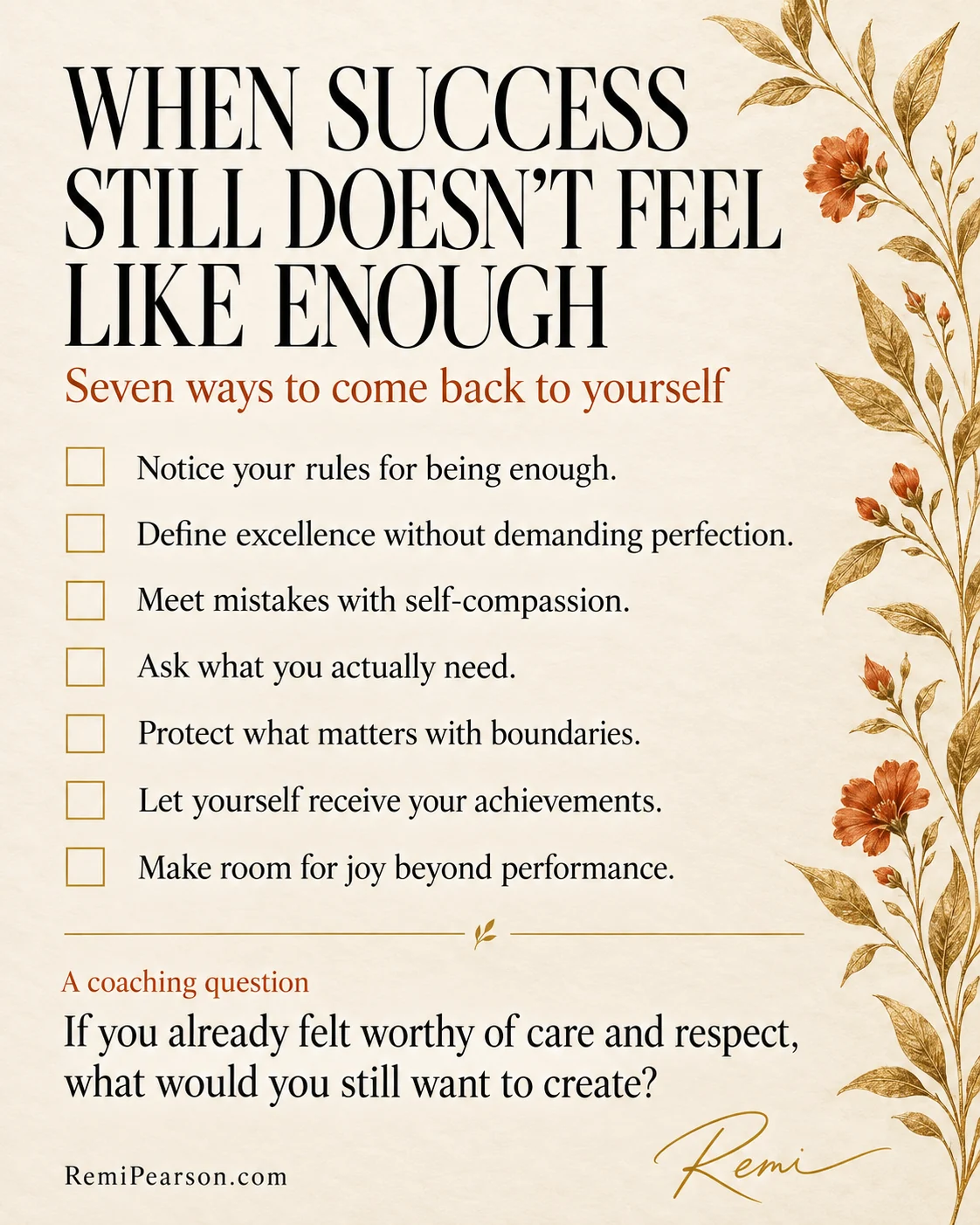
If you already felt worthy of care and respect, what would you still want to create?
There may be a great deal. It is worth discovering what remains when the goal no longer has to prove your right to matter.
Further resources
- How to Set Boundaries Without Feeling GuiltyArticle
- Why Do I Keep Repeating the Same Patterns Even When I Understand Myself?Article
- How to Overcome Fear of Failure and Find the Courage to Live FullyArticle
- How to Stop Overthinking and Trust YourselfArticle
- Self-Esteem from the Inside OutFree · Introduction level
- Emotion Integration Technique FoundationsAUD $49 · Advanced level
References
- Brown, B. (2010). The gifts of imperfection: Let go of who you think you’re supposed to be and embrace who you are. Center City, MN: Hazelden.
- Crocker, J. and Park, L.E. (2004). The costly pursuit of self-esteem. Psychological Bulletin, 130(3), pp. 392–414. doi: 10.1037/0033-2909.130.3.392.
- Neff, K.D. and Vonk, R. (2009). Self-compassion versus global self-esteem: Two different ways of relating to oneself. Journal of Personality, 77(1), pp. 23–50. doi: 10.1111/j.1467-6494.2008.00537.x.
- Pearson, R. (n.d.). How do you build self-esteem that lasts? The Self-Esteem Triad. Available at: https://www.remipearson.com/ideas-models/self-esteem-triad (Accessed: 5 October 2026).
 Talk to Remi