


Finding Our Way Back With Remi Pearson
The argument is over. So why do you still feel miles apart?
Learn how to return to a difficult conversation, understand each other’s hurt and make agreements that help you reconnect.
A short introduction, three practical videos and a workbook … $29 AUD.
Perhaps you’ve apologised. Perhaps you’re talking again, making dinner, getting on with the day. From the outside, everything looks fine. But something between you still feels unsettled, and you don’t know how to bring it up without being accused of starting another argument.
Finding Our Way Back helps you understand what that unfinished feeling may be asking for, and how to approach the conversation with care.
Self-paced learning. Watch individually or together.
“I don’t want another argument. I want us to understand what happened.”
There can be so much care in that sentence. You want to feel close again, and you want to know that what hurt you matters. Perhaps you also know you contributed to the distance, but every attempt to explain yourself seems to make things worse.
Most of us have familiar ways of getting through these moments. We defend our intentions, go quiet, try to smooth things over or wait until enough time has passed that it feels awkward to mention it. Sometimes the warmth returns. Sometimes the same hurt comes back in the next disagreement.

You may recognise yourself here:
- You say, “That’s not what I meant,” before you’ve understood how it felt for them.
- You apologise because you want the tension to end, but neither of you knows what will change.
- You need space, while your partner is left wondering whether you’ll ever return to the conversation.
- You keep explaining your hurt because you don’t feel it has been understood.
- You resume everyday life while quietly becoming less open with each other.
- You want to reach out, but you’re afraid of being dismissed again.
- You care deeply about the relationship and still struggle to find your way through a difficult moment.
There are skills you can learn for these conversations. You can begin with something small enough to practise the next time you miss each other.
What does it cost when we keep leaving things unresolved?
An unfinished disagreement can follow us into ordinary moments. A question sounds like criticism. A quiet evening feels like rejection. We start responding to what we expect will happen, sometimes before the other person has finished speaking.
Over time:
We become more guarded.
There are things we stop sharing because being misunderstood feels too costly.
Small moments carry old hurt.
Today’s disagreement arrives with the weight of previous conversations.
We lose confidence in apologies.
Reassuring words become harder to trust when the behaviour stays the same.
We spend more energy managing tension.
We monitor moods, avoid subjects or rehearse conversations in our heads.
We can feel lonely together.
The relationship continues, but feeling understood becomes less familiar.
Returning to a difficult moment gives you an opportunity to learn something about each other and respond differently. Both people need room to be heard, and both need to be willing to consider their impact.
Imagine knowing how to begin
You don’t need a perfect speech. It may begin with, “I’ve been thinking about yesterday. I don’t think I really heard you.”
From there, you can learn how to stay with the conversation long enough to understand what happened, acknowledge your contribution and discuss what would help.
In Finding Our Way Back, you’ll learn how to:
- Recognise when a conversation is slipping into defensiveness or withdrawal.
- Raise a concern without turning it into a judgement of someone’s character.
- Offer a small attempt to reconnect before tension escalates further.
- Ask for a pause with a clear commitment to return.
- Listen to someone’s hurt without immediately arguing with their interpretation.
- Acknowledge your impact while remaining honest about your own experience.
- Offer an apology that names what you are taking responsibility for.
- Make a realistic agreement about what you’ll do differently.
- Follow up, so the conversation has a chance to change everyday behaviour.
- Recognise the limits of what you can repair on your own.
The aim is to help you become more capable of caring for the relationship when something between you needs attention.
Inside Finding Our Way Back
A short introduction
Why things can still feel unfinished
You’ve stopped arguing, but have you understood each other? This introduction explores what can remain after the tension settles and why returning to a conversation may matter.
What we cover
- The difference between calming down and addressing what happened.
- Why everyday differences need room for discussion.
- What repair asks of each person.
- How to use the program individually or together.
Why this matters
Without a shared understanding of repair, one person may think everything is resolved while the other is still waiting to be heard.
What this gives you
A clearer sense of what you’re trying to do when you return to a difficult moment.

“I’m getting defensive, and I’m losing track of what you’re trying to tell me. Can we slow this down?”
Video one
When the conversation starts going wrong
How do we interrupt the damage while keeping the issue open for discussion?
Sometimes you can feel the conversation turning. Your voice changes, you start building your defence, or you want to leave immediately. This video helps you recognise that moment and consider your next move.
What we cover
- Bringing up a specific concern with less blame.
- Recognising your own contribution to escalation.
- Making and receiving small attempts to reconnect.
- Taking a pause with an agreed return.
Why this matters
When a conversation becomes increasingly hurtful, the original concern can disappear beneath everything said in response to it.
What this gives you
Practical ways to slow the interaction and preserve an opportunity to talk about what matters.

“I can understand why you felt dismissed when I walked away. I was overwhelmed, and I still need to take responsibility for how I left.”
Video two
Can I understand your hurt without defending myself?
Can your experience matter to me when it is uncomfortable to hear?
It is difficult to listen when you feel accused or misunderstood. This video explores how to remain interested in your partner’s experience while retaining your own perspective.
What we cover
- Separating your intention from the impact of your behaviour.
- Listening before explaining.
- Acknowledging feelings without pretending to agree with every interpretation.
- Taking responsibility without immediately adding a counteraccusation.
- Making room for both experiences without assuming equal blame.
Why this matters
A person can hear your explanation and still feel that their hurt has barely been acknowledged. Understanding requires enough curiosity to discover something you may have missed.
What this gives you
A way to approach the conversation with more openness and clearer responsibility.

“Next time I need a break, I’ll tell you rather than walking out. We’ll agree on when to return, and I’ll take responsibility for restarting the conversation.”
Video three
What will be different after this conversation?
How do we turn understanding into something we can rely on?
A thoughtful conversation creates an opening. What happens afterwards helps determine whether that opening becomes a change in how you relate.
What we cover
- Making a specific apology.
- Asking what would help now.
- Agreeing on a realistic change in behaviour.
- Returning to the agreement and checking how it is working.
- Allowing closeness to return without demanding immediate forgiveness.
- Recognising repeated apologies that are not followed by change.
Why this matters
It is easier to trust an agreement when you can see it being honoured. Follow-through gives your partner something beyond your intentions to rely on.
What this gives you
A practical way to carry the conversation into everyday life, with space to revisit what still needs attention.
Your workbook … bring the learning into a real conversation
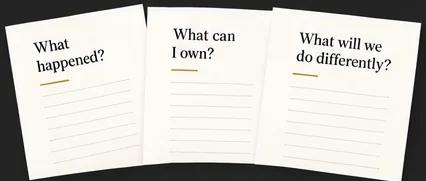
The workbook helps you reflect on a manageable disagreement and prepare for a more thoughtful response. You can use it privately first, then share what feels useful.
It includes space to explore:
- What you tend to do when tension rises.
- What happened and what you understood it to mean.
- What you now understand about the other person’s experience.
- What you can honestly take responsibility for.
- How you will ask for space and return.
- What you want to agree on and revisit.
You’ll also have original example phrases to help you begin when the words are hard to find.

A note from Remi
If you hurt, I want to understand
One of the things I care about most in relationships is whether we are willing to let another person’s experience matter to us, especially when hearing it is uncomfortable. It’s easy to feel caring when things are going well. When someone tells us we’ve hurt them, we discover what we’re able to stay present for, and where we still have work to do.
I want us to be able to say, “Help me understand. What did that feel like for you? What have I missed?” There is room in that conversation for our own experience too. We can be overwhelmed, have limits and need time, while still taking responsibility for how we treat someone.
That is the spirit of Finding Our Way Back. We keep learning how to relate to each other. We revisit things. We notice when an agreement isn’t working and speak about it again. Over time, those moments can give us a more honest understanding of the relationship we are creating together.
A small program with a clear purpose
Finding Our Way Back … $29 AUD
Your program includes:
- A short introductory video.
- Three core teaching videos.
- A practical workbook with reflection prompts and example language.
- Self-paced learning you can work through individually or together.
The program draws on John and Julie Gottman’s work on conflict and repair, with complementary perspectives on compassionate presence from Heather Plett and trust from David Richo.
This is Remi’s independent educational program.
Continue with the support that fits what you’re noticing





Frequently asked questions
Do we both need to do the program?
You can begin on your own. The videos and workbook can help you understand your responses, prepare for a conversation and become clearer about what you want to take responsibility for. Shared repair requires the other person’s participation too.
What if my partner won’t talk about what happened?
You can make an invitation and explain why the conversation matters to you. You cannot make someone participate, listen or take responsibility. The program helps you consider your contribution without making you responsible for repairing the entire relationship.
What if we remember the disagreement differently?
You can explore how each person experienced it without first agreeing on every detail. That doesn’t require you to accept an inaccurate account or dismiss a specific behaviour. The aim is to understand each other more clearly while remaining honest.
Does taking responsibility mean accepting all the blame?
No. You are looking honestly at your own behaviour and its impact. Both people deserve to be heard, and responsibility does not have to be equally divided.
What if I need space before I can talk?
A pause can be useful. The program explores how to communicate that need, agree on a return and take responsibility for following through.
Is saying sorry enough?
Sometimes a straightforward apology is all a small misunderstanding needs. Other situations need more conversation, a specific change or time to rebuild trust. You’ll explore how to move beyond a general apology when something remains unresolved.
Will this stop us from arguing?
That isn’t the promise. You will still have differences. This program introduces ways to approach difficult conversations and respond when hurt has occurred.
What if the relationship involves intimidation or abuse?
This program is designed for everyday conflict where both people can participate safely. It is not a process for managing coercion, threats or abuse, and does not ask you to take shared responsibility for someone else’s harmful behaviour. Those situations call for individual, specialist support.
Is this couples therapy?
No. It is a short educational program with videos and a workbook. It does not include individual assessment or personalised therapeutic support.
What do I receive for $29 AUD?
A short introduction, three core videos and a practical workbook.
Do I need to buy another program first?
No. Finding Our Way Back stands on its own. The related resources are optional.
You don’t have to know exactly what to say to begin
Perhaps there is a conversation you have been avoiding because you’re afraid it will end the same way. Perhaps you’ve been waiting for the other person to understand something you haven’t found a way to explain.
You can start by learning how to approach that moment with more care, clearer responsibility and a practical sense of what comes next.
Finding Our Way Back
How to repair after conflict and reconnect with care.
Introduction + three videos + workbook … $29 AUD.
Coming soon
 Talk to Remi