


Obstacles to Love With Remi Pearson
You want to feel close. So why do you keep ending up hurt, guarded or alone?
Understand what gets between you and the love you want … and discover a way forward.
Perhaps you give more than you want to, then feel resentful. Perhaps you pull away when someone gets close, or find yourself asking for reassurance that never quite settles the fear. You may love someone deeply and still feel exhausted by what happens between you.
Obstacles to Love helps you recognise seven patterns that can make connection difficult, understand how they show up in your life and begin responding with greater awareness and care.
Seven focused videos + a practical workbook • $49 AUD
Self-paced learning with Remi Pearson. Begin individually or explore together.

“I don’t want to keep having a different version of the same relationship.”
You may have learned a great deal about yourself already. You can explain your childhood, identify some of your triggers and recognise when you’re becoming defensive. Yet in the moments that matter, you still agree when you want to say no, retreat when you want comfort or keep trying to earn care from someone who rarely offers it.
Understanding a pattern can be the beginning of change. It helps to see what you’re doing, what you’re trying to protect and what happens to the relationship as a result. From there, you can consider a different response.
You might recognise yourself in some of these experiences:
- You work hard to maintain connection, even when you’re becoming exhausted.
- You want closeness, then feel uncomfortable when someone needs you.
- You know your partner’s preferences better than your own.
- You find it easier to be useful than to let someone care for you.
- You keep hoping someone will become the partner you need.
- You become so overwhelmed during conflict that their experience disappears from view.
- You’ve forgiven the same behaviour several times, but nothing seems to change.
- You care deeply, yet the relationship has become mostly logistics and unfinished conversations.
You don’t need to identify with every pattern. One recurring obstacle can be enough to shape a great deal of your experience.
What happens when we keep repeating these patterns?
Sometimes the cost is obvious: another argument, another relationship ending, another evening spent wondering where you stand. Sometimes it is quieter. You become more careful about what you say. You stop asking for something you need. You tell yourself that this is simply what relationships are like.
When patterns remain unexamined:
You can lose touch with your own needs.
Keeping the relationship becomes more familiar than asking whether it works for you.
You may keep mistaking familiarity for compatibility.
A recognisable dynamic can draw you in even when it repeatedly hurts.
Protection can become distance.
The responses that help you avoid exposure can also make it difficult for someone trustworthy to know you.
Unresolved hurt can shape new conversations.
You begin responding to what you expect will happen.
Care can become difficult to feel.
Good intentions remain, while attention, affection and responsiveness become less available.
You can take responsibility for too much, or too little.
You blame yourself for the whole relationship or overlook the impact of your own behaviour.
Looking honestly at these patterns gives you more information to work with. You can become clearer about what belongs to you, what needs a shared conversation and what the other person would need to be willing to change.
Begin to see more clearly … and choose more consciously
Obstacles to Love brings together accessible ideas from attachment theory, David Richo’s work on mindful loving, Daniel Siegel’s work on presence and connection, and a gentle introduction to the Internal Family Systems model.
You’ll explore how these ideas relate to ordinary moments: waiting for a reply, receiving affection, saying what you need, hearing that you’ve hurt someone or deciding whether to keep investing in a relationship.
Through the program, you’ll learn to:
- Recognise when fear is influencing how you reach for or retreat from connection.
- Notice where you silence yourself to preserve a relationship.
- Understand conflicting responses within you with more curiosity.
- Distinguish what someone is offering from what you hope they will offer.
- Ask for support while respecting the other person’s needs and limits.
- Consider your impact without taking responsibility for everything.
- Identify hurt that still needs attention.
- Express care in ways the other person can experience.
- Choose one practical place to begin.
You’ll leave with a clearer picture of your patterns and a first practice for each obstacle.
Seven obstacles. A pathway forward for each.

Video one … When fear starts making the decisions
“I want to feel close, but I keep doing things that make closeness harder.”
A delayed reply can become an urgent need for reassurance. A request for more time together can leave you feeling crowded. You may alternate between wanting someone nearer and needing them further away.
This video introduces attachment-related patterns and helps you consider both your expectations and what is actually happening in the relationship.
What we explore
- How fear can shape the way you pursue or avoid connection.
- What you do when you feel uncertain about someone.
- How your response affects the interaction between you.
- Why another person’s current behaviour matters too.
What it can cost you
You can spend more energy trying to secure connection or escape discomfort than discovering whether the relationship is caring and reliable.
What you’ll take away
A simple reflection process to separate the event, the fear and your next move, so you can consider a clearer request.
Your first practice:
What happened? What did I fear? What did I do? What could I ask for?

Video two … Losing yourself to keep the relationship
“I can tell you what they need. I’m less sure what I need.”
You say you don’t mind. You accommodate another change of plan. You hold back a preference because it feels easier than disappointing someone. Over time, there may be less of you available to be known.
What we explore
- The difference between chosen compromise and repeatedly silencing yourself.
- How fear of disconnection can influence your decisions.
- Making room for two people’s preferences and limits.
- Remaining connected while allowing differences.
What it can cost you
Resentment can build around agreements you never wanted to make. Your partner may also have little opportunity to understand what matters to you.
What you’ll take away
A way to identify one small truth you’ve been withholding and practise expressing it with care.
Your first practice:
What have I been saying is fine when it isn’t fine for me?

Video three … Being so protected that care struggles to reach you
“I want someone to know me, but I don’t want them to see how much I need them.”
Perhaps you’re capable, helpful and easy to rely on. Receiving care is more complicated. You may dismiss reassurance, make a joke when something becomes tender or keep your more vulnerable feelings out of view.
This video introduces parts work as a way to understand conflicting inner responses.
What we explore
- The part of you that wants connection and the part that fears it.
- What protective responses may be trying to prevent.
- How to approach those responses with curiosity.
- Taking a small step towards openness with someone who has shown themselves trustworthy.
What it can cost you
You can remain admired for what you offer while feeling unseen in what you need. People may care about you without knowing how to reach you.
What you’ll take away
Language for noticing inner conflict without immediately judging yourself or forcing yourself to be vulnerable.
Your first practice:
“A part of me wants … and another part is worried that …”
- Get All Seven Videos and the Workbook • $49 AUD

Video four … Relating to the person you hope they will become
“If they would just change this, we could finally be happy.”
You can see their potential. You understand why they struggle. You’ve explained what would help, perhaps many times. Meanwhile, the relationship you’re experiencing remains different from the relationship you keep imagining.
What we explore
- The difference between supporting someone and managing their growth.
- What you observe, what you hope for and what you need.
- Allowing another person to be themselves while making your own choices.
- Considering compatibility without having to make either person wrong.
What it can cost you
You can invest months or years in a hoped-for future while repeatedly setting aside the information available now.
What you’ll take away
A clearer way to consider the relationship as it is, make an honest request and identify a decision that belongs to you.
Your first practice:
What am I observing? What am I hoping for? What do I need to decide?

Video five … Losing sight of each other when feelings get intense
“Once I’m upset, all I can think about is making this feeling stop.”
You may need reassurance immediately. Your partner may want to leave the conversation. Both of you can become so occupied with your distress that caring for each other becomes difficult.
This video explores co-regulation and shared emotional responsibility.
What we explore
- How distress can affect your capacity to listen.
- Asking for support in a specific, realistic way.
- Offering comfort without becoming responsible for every feeling.
- Communicating limits while remaining considerate.
- Taking space with an agreed return.
What it can cost you
One person’s attempt to feel better can leave the other feeling overwhelmed or abandoned. The interaction can become increasingly difficult for both.
What you’ll take away
A starting point for discussing what helps each of you when emotions rise, including what you can reasonably offer.
Your first practice:
“When this happens, something that would help me is … What would help you?”

Video six … Letting hurt accumulate without repair
“We’ve moved on, apparently. But I’m still carrying it.”
You’re talking again, but something remains unsettled. Perhaps the apology was vague, the impact was dismissed or the behaviour happened again. Perhaps you’re the person who wants everything to feel normal before you’ve understood what needs attention.
What we explore
- Recognising when hurt remains unresolved.
- Listening to impact without immediately defending intention.
- Taking responsibility for a specific behaviour.
- Considering what needs to change after an apology.
What it can cost you
You can become increasingly guarded, or find that old hurt returns in new disagreements. Apologies may become harder to trust.
What you’ll take away
A thoughtful opening for a repair conversation and a clearer understanding of your own contribution.
Your first practice:
“I’ve been thinking about what happened. I can see that I … and I want to understand how that affected you.”

Video seven … Assuming love is understood while everyday connection fades
“Of course I love you. I just haven’t been showing you in ways you can feel.”
Life becomes busy. Conversations become practical. You know what needs doing, but perhaps less about what your partner has been feeling. Appreciation stays in your head, and affection becomes something you intend to offer when there is more time.
What we explore
- The attention you bring to everyday interactions.
- Assumptions that can replace curiosity.
- Expressing appreciation and affection in welcome ways.
- Discovering what feels connecting to each of you now.
What it can cost you
You can care deeply and still leave each other feeling unnoticed. The relationship may function while closeness becomes less familiar.
What you’ll take away
A simple conversation to help you discover where connection is already present and what you both miss.
Your first practice:
“When do you feel close to me? Is there something you miss between us?”
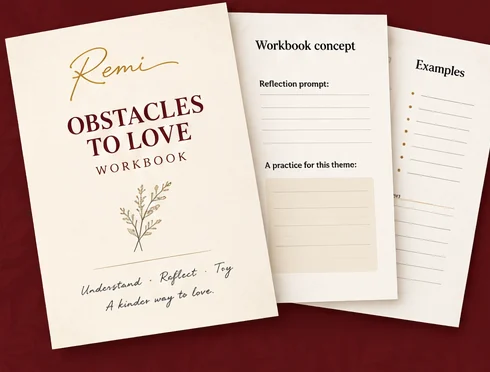
Your workbook … find your own place to begin
The workbook helps you bring each video into your experience, with examples, reflection prompts and a small practice for every theme.
You’ll have space to consider:
- Which patterns you recognise and when they tend to appear.
- What you may be trying to protect.
- How your behaviour affects you and the other person.
- What the relationship is actually offering.
- What you can practise yourself and what needs mutual participation.
- Which next step feels useful and manageable.
A question runs throughout:
Is this happening within me, between us or in the behaviour I am receiving?
That question matters. You deserve an honest understanding of your contribution, alongside a clear view of the relationship itself.
You’ll finish by choosing one pattern to work with and one practical step to take.

A note from Remi
I’m interested in what happens when people genuinely want love and still find themselves doing things that make it difficult to give or receive. We can be thoughtful in so many areas of life, yet become frightened, guarded or strangely unfamiliar to ourselves when a relationship matters.
There is something useful in being able to notice, “This is what happens to me here.” It gives us a place to become curious. What am I afraid of? What am I hoping this person will provide? What am I contributing, and what am I tolerating?
I also want us to keep looking at the relationship we are actually in. Understanding yourself should help you see more clearly, including when another person is unavailable or unwilling to participate. You can have compassion for their history and still take your own experience seriously.
I created this program to help you begin those conversations with yourself, and where appropriate, with someone you care about. There is room to learn without turning every difficulty into proof that something is wrong with you.
Obstacles to Love • $49 AUD
Understand what gets between you and the closeness you want … and discover a way forward.
Your program includes:
- Seven focused teaching videos.
- A practical workbook.
- Everyday examples to help you recognise the patterns.
- A first practice for each obstacle.
- A guide to choosing relevant further learning.
Self-paced. Explore individually or together.
Where would you like to go next?

Attachment or Love? … Free
Three introductory videos exploring attachment patterns, shared emotional safety and caring for each other when something hurts.
Explore Attachment or Love?
The Five Paths to a Healthy Relationship … $29 AUD
Explore what you each bring, how you respond to each other and the relationship you want to build.
Explore The Five Paths to a Healthy Relationship
Finding Our Way Back … $29 AUD
Explore how to revisit a disagreement, understand the hurt and make agreements you can follow through on.
Explore Finding Our Way Back
Holding Space Without Rescuing or Disappearing … $29 AUD
Explore how to listen and support someone while respecting their autonomy and your own limits.
Explore Holding Space Without Rescuing or Disappearing
Self-Regulation When It Matters … $29 AUD
Learn more about your responses to pressure and explore ways to support yourself when you become overwhelmed, defensive or withdrawn.
Explore Self-Regulation When It Matters
Becoming Conscious … $29 AUD
A simple introduction to presence, bodily awareness and noticing thoughts as they arise.
Explore Becoming Conscious
Getting to Know All of You … Planned program … $149 AUD
An introduction to parts work through the Internal Family Systems model, with further exploration of protective responses and inner conflict.
This program is in development.
Register interest in Getting to Know All of You
Frequently asked questions
- Is this for people who are single or in a relationship?
- Both. You can reflect on a current relationship or patterns you have noticed across previous relationships. The emphasis is on recognising your experience and finding a useful place to begin.
- Do I need to know my attachment style?
- No. The program introduces relevant patterns in everyday language. You don’t need a label before you can explore what happens when connection feels uncertain.
- Will this tell me whether I should stay or leave?
- No. It gives you questions and distinctions to help you consider your experience more clearly. Your needs, compatibility and the other person’s behaviour all matter in that decision.
- Does this mean the problems are my fault?
- No. Some difficulties involve your own responses, some emerge between you and some concern behaviour you are receiving. Understanding your contribution does not make you responsible for another person’s choices.
- What if my partner won’t do the program?
- You can learn and reflect individually. Some changes are yours to practise, while mutual connection and repair require the other person’s participation.
- Is this an IFS course?
- It includes a gentle introduction to parts as one way of understanding conflicting inner responses. It does not teach a full IFS process or provide practitioner training.
- Will seven videos resolve my relationship patterns?
- The program offers an introduction, practical reflection and first steps. Changing longstanding patterns can take continued practice and, sometimes, personalised support.
- Is this therapy?
- No. It is an independent educational program with self-paced videos and a workbook. It does not include individual assessment or therapy.
- What if my relationship involves intimidation or abuse?
- This program does not ask you to reinterpret harmful behaviour as your own obstacle to love. Where there is coercion, intimidation or abuse, safety and individual specialist support take priority over shared relationship exercises.
- What do I receive for $49 AUD?
- Seven focused videos, a practical workbook and a first practice for each of the seven themes.
- Do I need to buy the other programs?
- No. The program includes its own explanations, reflection prompts and practices. Further learning is optional.

Choose one place to begin
You may already recognise a pattern you want to understand: the things you don’t say, the care you find difficult to receive or the moment fear starts deciding how you respond.
You can begin there. Give yourself room to understand what happens, consider its impact and practise something different.
Obstacles to Love
Understand what gets between you and the closeness you want … and discover a way forward.
Seven videos + workbook • $49 AUD
Coming soon
 Talk to Remi