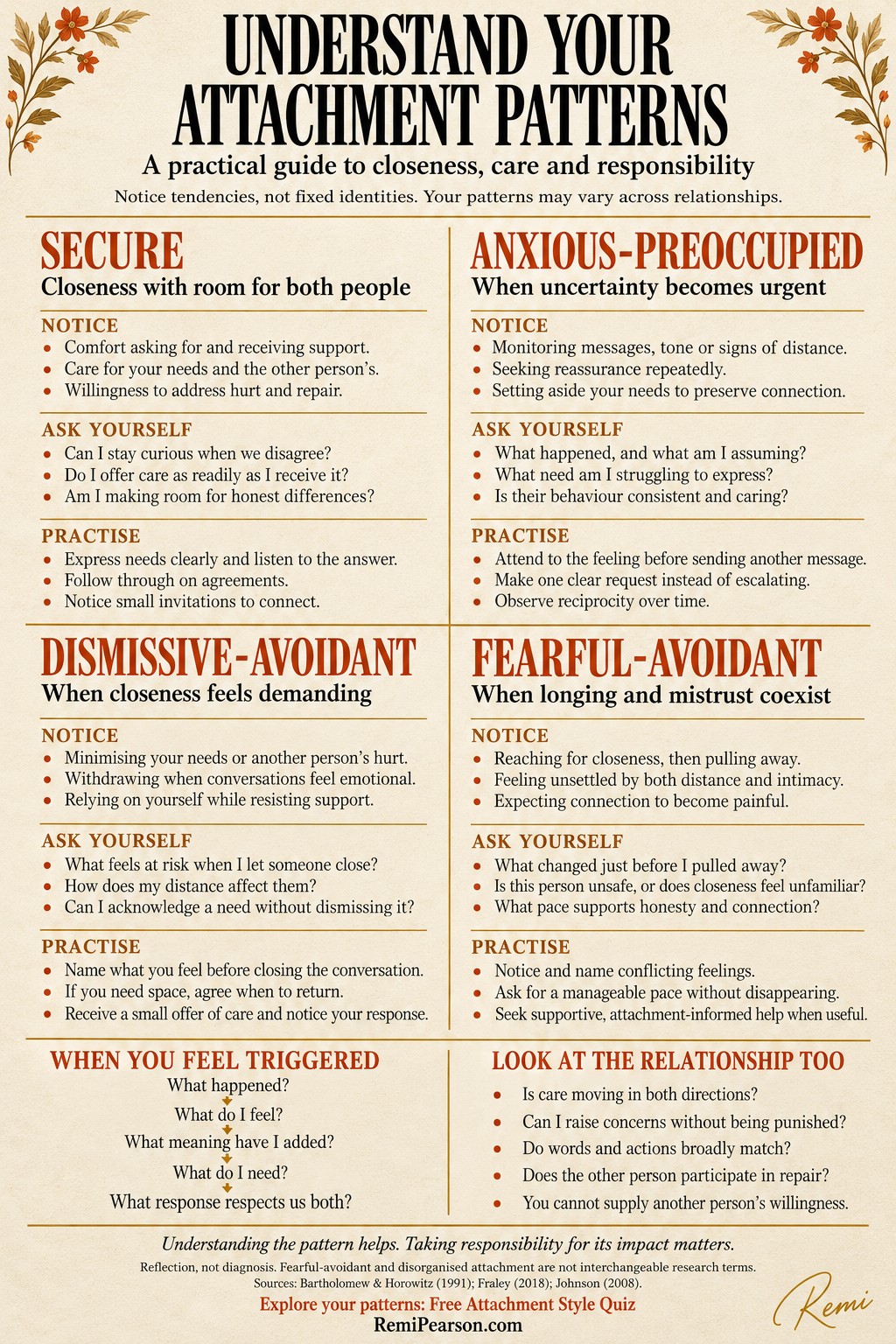

What Is My Attachment Style? Understanding How You Connect in Relationships
What happens inside you, and between you, when connection matters, and how to begin changing a pattern that costs you the relationship you want.
Rachel was the person everyone relied on. She ran a successful business, remembered birthdays and could usually work out what someone needed before they asked. Yet when a man she was dating took longer than usual to reply, her attention narrowed around her phone. She could see herself doing it and felt faintly ridiculous … surely, after everything she had achieved, a delayed message should not have this much power. Her friend Anna had a different experience. She loved the beginning of a relationship, but as someone became more available and interested, she started noticing their faults and wondering whether she would be happier alone.
These fictional examples show two ways closeness can become complicated. Understanding your attachment style can help you recognise what happens when someone matters to you, what you do when connection feels uncertain, and where those responses might be costing you the relationship you want. It can also help you ask a question that is easily overlooked: is this an old fear being activated, or is something happening here that deserves my attention?
What is attachment theory?
Attachment theory examines the bonds we form with people we turn to for comfort and support, and how we respond when their availability feels uncertain. Originally developed by John Bowlby to understand children’s relationships with caregivers, it was later extended to adult romantic relationships (Fraley, 2018).
An attachment style describes tendencies in how you experience closeness, dependence and the possibility of rejection. Those tendencies may become particularly noticeable when you care deeply about someone, need support or feel disconnected.
You might move towards the person with increasing urgency. You might minimise your needs and withdraw. You might want closeness while also finding it difficult to trust.
The useful question is:
“What happens inside me, and between us, when connection matters?”
Why understanding your attachment style matters
Without this understanding, it is easy to mistake a familiar response for an accurate reading of the situation. Feeling anxious can become “they are going to leave”. Feeling uncomfortable with closeness can become “this person must be wrong for me”.
Sometimes your concern is well founded. Sometimes your interpretation needs checking. Learning to distinguish the two gives you more room to respond thoughtfully.
In her bestselling book Hold Me Tight, Sue Johnson explores how recognising patterns of disconnection and becoming more emotionally responsive can help couples strengthen their bond (Johnson, 2008).
Attachment awareness can help you:
- Recognise a recurring pattern before you disappear into it.
- Express a need without turning it into an accusation.
- Notice another person’s needs alongside your own.
- Assess whether a relationship offers genuine reciprocity.
- Understand why certain moments carry more emotional weight than you expected.
What can these patterns cost us?
Consider what happens when your protective response repeatedly takes over.
You may pursue reassurance so urgently that the other person has little room to respond freely. You may withdraw so completely that they are left alone with a problem affecting both of you. You may become extraordinarily accommodating, then resentful that nobody knows what you need.
Some questions worth sitting with:
- How much attention am I spending monitoring this relationship?
- Do I make myself easier to love by becoming harder to know?
- When someone needs me, do I remain interested in their experience?
- Am I choosing relationships I enjoy, or relationships whose uncertainty feels familiar?
In Why Do I Lose Myself in Relationships?, I explore the cost of preserving connection by repeatedly setting your own experience aside (Pearson, n.d.b).
What are the four attachment styles?
A widely used adult attachment model describes secure, preoccupied, dismissing and fearful patterns (Bartholomew and Horowitz, 1991). You will often see slightly different names in popular writing.
| Attachment pattern | A tendency you may recognise | A question to explore |
|---|---|---|
| Secure | Relative comfort with closeness and mutual reliance. | Can I receive care and remain attentive to you? |
| Anxious-preoccupied | Concern about rejection or whether another person truly wants you. | What happens when I cannot immediately confirm our connection? |
| Dismissive-avoidant | Emphasis on self-reliance and discomfort depending on others. | What do I do when someone wants more closeness? |
| Fearful-avoidant | Wanting connection while also expecting it to be unsafe or disappointing. | What makes me reach towards you, then pull away? |
These descriptions are starting points. Researchers commonly measure adult attachment along two dimensions: attachment anxiety, concerning another person’s availability, and attachment avoidance, concerning intimacy and dependence. People vary in degree rather than fitting neatly into fixed boxes (Fraley, 2018).
You may also encounter “disorganised attachment” used interchangeably with fearful-avoidant attachment online. The terms come from different research traditions and should not automatically be treated as identical.
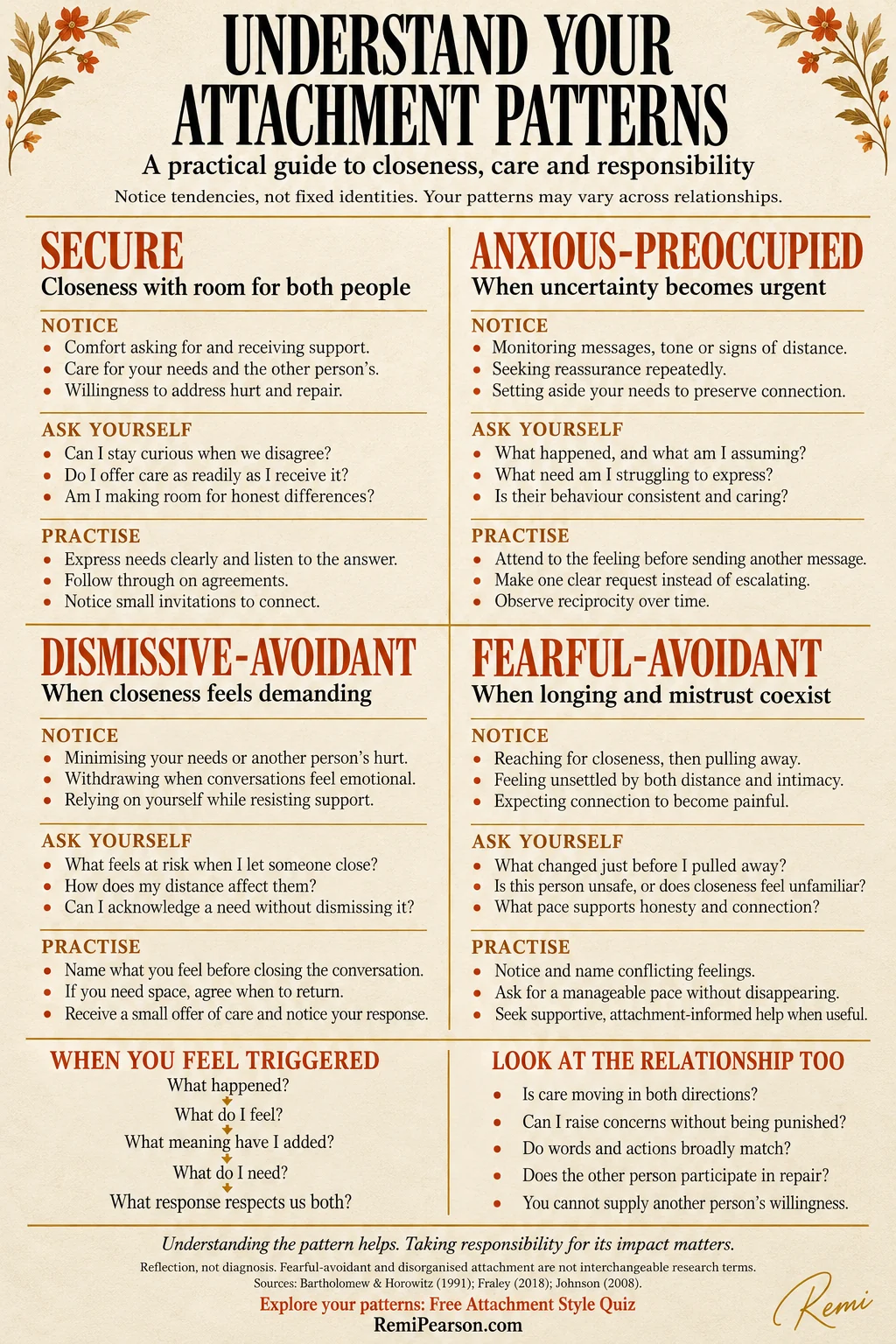
For a starting point for reflection, take my free Attachment Style Quiz. Treat the result as something to explore alongside your lived experience.
How do I recognise my own attachment pattern?
Look at what happens in specific moments. A label tells you much less than an honest account of what you feel and do.
Choose a recent interaction and work through this sequence:
What happened → What I felt → What I assumed → What I did → What happened next
For Rachel, it might look like this:
“He did not reply that evening. I felt anxious and unimportant. I assumed he was losing interest. I sent another message, then checked repeatedly. By bedtime, I was exhausted and cross with him, although I still did not know why he had been unavailable.”
For Anna:
“He suggested a weekend away. I felt pressure. I assumed this meant I would lose my freedom. I became distant and started looking for reasons to end things.”
If we were exploring this in coaching, I would ask:
“At which point did you stop being curious and become certain about what the situation meant?”
In Why Do Relationships Trigger Me So Much?, I explore noticing that point of departure, while keeping responsibility for present-day behaviour clear (Pearson, n.d.c).
How can I begin changing an attachment pattern?
1. Attend to the feeling before acting from it
Try identifying what is happening beneath the urge to chase, withdraw or please.
You might feel frightened, disappointed, exposed or angry. Give that experience some attention without immediately requiring someone else to remove it.
Ask yourself:
- What feels threatened here?
- What am I trying to prevent?
- What support would help me stay present to this feeling?
My Self-Esteem Triad brings together emotions, emotional needs and boundaries, with worthiness at the centre. It offers a way to consider your emotional experience and needs while recognising where your responsibility ends and another person’s begins (Pearson, n.d.a).
For related work, explore Emotion Integration Technique.
2. Make the need clear enough to respond to
A person cannot reliably respond to a need you have disguised as criticism.
Compare:
“You never bother with me.”
With:
“I’d like more time together. Could we plan an evening this week?”
Or:
“You’re suffocating me.”
With:
“I want to keep seeing you, and I also need time to myself. Can we talk about a pace that works for us both?”
Clear language gives you a better opportunity to understand each other. Using the sentence, however, does not demonstrate that the underlying fear has healed. Pay attention to whether you can remain emotionally available, hear the answer and follow through.
3. Consider your impact as well as your intention
You may be trying to protect yourself and still leave another person feeling pressured, dismissed or alone.
That deserves attention.
“When I become focused on getting myself through this moment, what happens to my awareness of you?”
This question applies whether you tend to pursue or withdraw. Understanding the origin of a response can support compassion; you still need to take responsibility for its effect.
Read Why Saying Sorry Isn’t Enough: How to Repair a Relationship and How to Reconnect After Conflict: Harmony, Disharmony and Repair for practical ways to approach that responsibility.
4. Assess the relationship you are actually in
Someone repeatedly cancelling plans, dismissing your concerns or withholding affection may leave you unsettled for understandable reasons.
Ask:
- Are their actions reasonably consistent?
- Can I raise a concern without being ridiculed or punished?
- Do they show interest in my experience?
- When something goes wrong, do they participate in repair?
- Is care moving in both directions?
Your growth cannot supply another person’s willingness.
The programme Attachment or Love is a relevant place to explore these questions further.
5. Notice ordinary opportunities for connection
Relationships also take shape in the small moments when someone reaches for you. An invitation to talk, a shared joke or a request for comfort gives you an opportunity to notice how you respond.
Read What Are Emotional Bids? How Small Moments Build Connection and ask:
“When someone I care about reaches towards me, do I notice? What do I do with that moment?”
Can your attachment style change?
Early experiences can influence later relationships, but they do not provide a complete prediction of your adult attachment pattern. Attachment can differ across relationships, and experiences over time may alter your expectations (Fraley, 2018).
Change may involve emotional work, supportive relationships and, where useful, working with an attachment-informed therapist. It also involves looking honestly at what you keep doing when you feel threatened.
For Rachel, a meaningful beginning might be expressing what she wants, checking her assumptions and observing whether the man she is dating responds with care. For Anna, it might be exploring her discomfort before deciding that closeness itself is the problem.
Neither has to abandon herself to become more available to someone else. There is room to learn whether she can be known, receive care and offer it in return.
Explore Love Without Losing Yourself for the broader relationship collection.
Further resources
- Why Do Relationships Trigger Me So Much?Article
- Why Do I Lose Myself in Relationships?Article
- What Are Emotional Bids? How Small Moments Build ConnectionArticle
- How to Reconnect After Conflict: Harmony, Disharmony and RepairArticle
- Why Saying Sorry Isn’t Enough: How to Repair a RelationshipArticle coming soon
- Attachment or Love?Free · Introduction level
- Love Without Losing YourselfBundle investment AUD $97
References
- Bartholomew, K. and Horowitz, L.M. (1991) Attachment styles among young adults: A test of a four-category model. Journal of Personality and Social Psychology, 61(2), pp. 226–244. doi: 10.1037/0022-3514.61.2.226.
- Fraley, R.C. (2018) A brief overview of adult attachment theory and research. Available at: https://labs.psychology.illinois.edu/~rcfraley/attachment.htm (Accessed: 5 October 2026).
- Johnson, S. (2008) Hold Me Tight: Seven Conversations for a Lifetime of Love. New York: Little, Brown and Company.
- Pearson, R. (n.d.a) How Do You Build Self-Esteem That Lasts? The Self-Esteem Triad. Available at: https://www.remipearson.com/ideas-models/self-esteem-triad (Accessed: 5 October 2026).
- Pearson, R. (n.d.b) Why Do I Lose Myself in Relationships? Available at: https://www.remipearson.com/articles/the-moment-you-leave-yourself (Accessed: 5 October 2026).
- Pearson, R. (n.d.c) Why Do Relationships Trigger Me So Much? Available at: https://www.remipearson.com/articles/why-relationships-trigger-me (Accessed: 5 October 2026).
 Talk to Remi