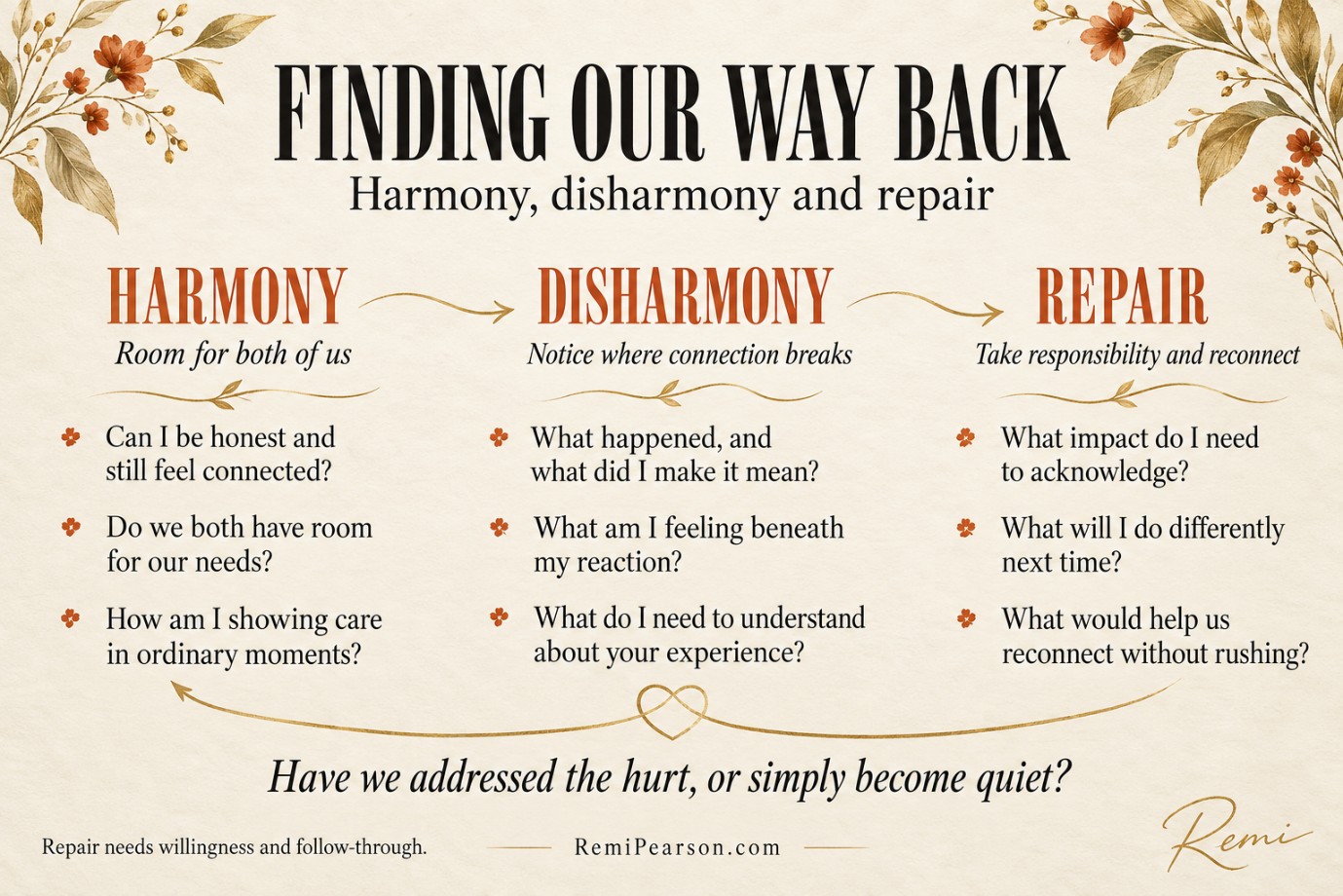

How to Reconnect After Conflict: Harmony, Disharmony and Repair
How relationships move through harmony, disharmony and repair, and how to find your way back with honesty, responsibility and care.
Emma could lead a difficult meeting, make decisions under pressure and hold her own in almost any professional conversation. Yet when her partner, Ben, went quiet after an argument, she felt herself unravel. She would follow him from room to room, explaining what she meant, asking another question, trying to get them back to somewhere that felt safe. Ben experienced her urgency as pressure and withdrew further. By morning, they were usually polite again. Someone made coffee. Someone asked about the day. But Emma often wondered whether they had repaired anything, or simply become better at carrying the hurt quietly.
Perhaps you recognise something of yourself in this fictional example. You might reach for connection immediately, need space before you can speak, or find yourself pretending everything is fine because you cannot face another argument. This article explores how relationships move through harmony, disharmony and repair, and how to reconnect after conflict with greater honesty, responsibility and care.
What are harmony, disharmony and repair?
Relationships change from moment to moment. We feel close, misunderstand each other, encounter a difference, become disconnected and, hopefully, find our way back.
Relationship therapist and bestselling author Terry Real describes this movement through harmony, disharmony and repair. The capacity to return to connection matters because even loving relationships experience disruption (Real, 2023).
Here is a practical way to understand the cycle:
| Where you are | What you might experience | A useful question |
|---|---|---|
| Harmony | Warmth, trust and room to be yourself, including when you disagree. | Can we both be honest here? |
| Disharmony | Hurt, defensiveness, distance or a sense that you have lost each other. | What happened between us? |
| Repair | Acknowledgement, responsibility and action that help restore connection. | What needs attention before we move forward? |
Connection → Disconnection → Repair → Renewed connection
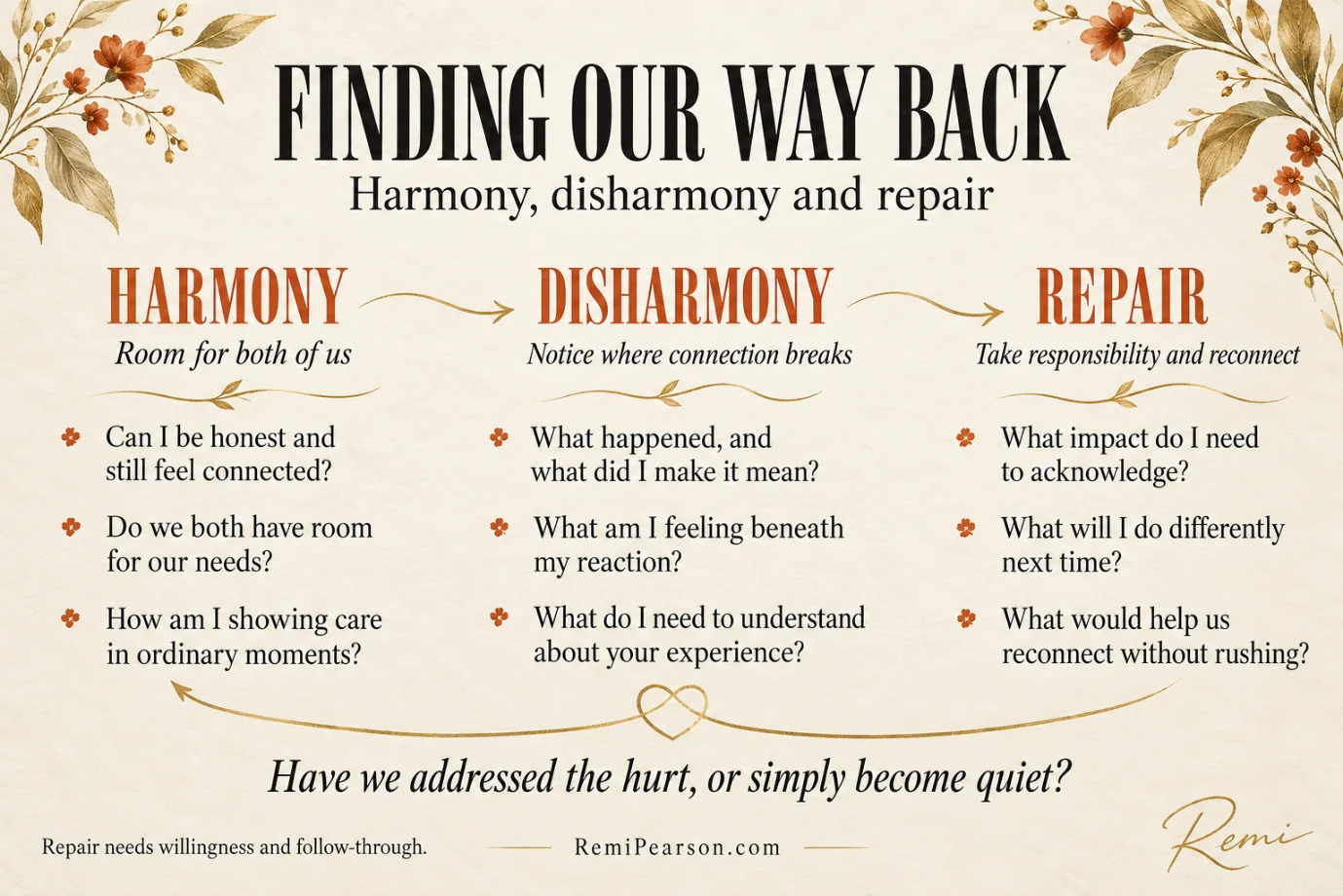
This is a useful map, rather than a promise that every rupture will resolve. Repair requires willingness, and sometimes the other person is unwilling to participate.
Why learning to reconnect after conflict matters
An argument can leave you wondering whether your relationship is secure. Learning to recognise the cycle gives you somewhere to begin: you can notice the disconnection and decide how to respond, rather than treating each difficult moment as a verdict on your entire relationship.
Research involving young adults and their partners found that better recovery after conflict was associated with more positive relationship emotions and greater satisfaction (Salvatore et al., 2011). Recovery in this study concerned how people moved out of a conflict interaction; it does not mean that calming down alone resolves the underlying issue.
Both capacities deserve attention:
- Can we settle enough to stop escalating?
- Can we return to the issue and address what happened?
What does unresolved conflict cost us?
When an issue keeps returning without meaningful attention, it can become harder to approach each other openly.
You might notice:
- Growing caution: you rehearse ordinary requests because you anticipate a difficult response.
- Accumulated resentment: today’s disappointment carries several earlier disappointments.
- Emotional distance: practical conversations continue, while tenderness becomes scarce.
- Self-abandonment: you minimise what matters to you to preserve the peace.
- Less trust in repair: another apology feels difficult to believe because little changes afterwards.
In my article Why Do I Lose Myself in Relationships?, I explore what happens when maintaining connection requires you to keep editing yourself out of it (Pearson, n.d.b).
A useful coaching question is:
“Are we becoming more connected, or am I becoming less expressed?”
1. Recognise the pattern you enter together
Couples can become so focused on the subject of an argument that they miss what happens around it.
Emma and Ben were discussing weekend plans. Their interaction also involved urgency, withdrawal and increasingly painful interpretations of each other.
Sue Johnson’s Hold Me Tight helps couples recognise recurring patterns of disconnection and explore the emotional needs beneath them (Johnson, 2008).
Try separating three things:
| What happened | What I understood it to mean | What I did next |
|---|---|---|
| “You stopped responding.” | “I don’t matter to you.” | “I asked repeatedly and became sharper.” |
| “You kept asking questions.” | “I cannot get this right.” | “I shut down and left.” |
Your interpretation deserves care. It also needs checking.
You could say:
“When you went quiet, I understood it as you no longer wanting to hear me. Is that what was happening for you?”
In Why Do Relationships Trigger Me So Much?, I explore how to notice the moment you begin reacting from a protective pattern, while still taking present-day behaviour seriously (Pearson, n.d.c).
Coaching question: “What do I do when connection feels uncertain, and how does that affect what happens next?”
Understanding a pattern does not make responsibility equal. Each person remains responsible for their own behaviour.
2. Take space with a clear intention to return
Sometimes you need a pause before you can have a useful conversation. The way you communicate that pause matters.
Consider:
“I’m becoming overwhelmed and I want to handle this carefully. I need half an hour. Can we come back to it at seven?”
A workable pause includes:
- An explanation of what you need.
- A realistic time to reconnect.
- Following through, or communicating if you need to renegotiate.
Use the time to settle yourself. Walk, breathe, write down what you are feeling or identify the point you most want understood. Rehearsing a prosecution speech is unlikely to help you return with curiosity.
The programme Holding Space Without Rescuing or Disappearing offers a related opportunity to explore staying present while respecting your own limits.
Coaching question: “What would help me return able to listen?”
3. Find the hurt beneath the argument
Once you are ready to talk, begin with one specific moment.
You might ask:
- What hurt most?
- What did you need me to understand?
- What were you afraid was happening between us?
- What did I miss?
Listen long enough to understand the answer. There will be room to explain your experience too.
For Emma, the painful moment was feeling left alone with a conversation that mattered. For Ben, it was feeling that he could not pause without making things worse. Hearing this gave them something more useful to work with than accusations about who was “too demanding” or “too distant”.
4. Own your behaviour and its impact
Good intentions do not remove the need to examine what you actually did.
“I was trying to explain” may be true. So might “I interrupted you repeatedly.”
An acknowledgement could sound like:
“I kept pushing after you said you needed space. I can see how that made it harder to stay in the conversation. Next time, I’ll ask when we can return to it.”
Or:
“I left without saying whether I would come back. I understand why that felt unsettling. I’ll communicate my need for space more clearly.”
The Gottman Institute’s guidance on processing a fight includes understanding each person’s experience and taking responsibility for your contribution (Wilde, 2026).
For a deeper exploration, read Why Saying Sorry Isn’t Enough: How to Repair a Relationship.
Coaching question: “What can I acknowledge without attaching an excuse?”
5. Make an agreement you can actually keep
“We’ll communicate better” leaves plenty of room for misunderstanding.
A useful agreement describes what you will do:
“If either of us needs a pause, we will say so and agree when to return.”
Other possibilities include:
- Raising a concern privately rather than through a joke in company.
- Asking whether the other person wants listening or problem-solving.
- Making time to discuss an unresolved issue instead of relying on bedtime.
- Checking in after a difficult conversation.
Choose one change and practise it. Let repeated action give the agreement credibility.
Conflict, Repair and Harmony is the relevant programme to explore here; you can register your interest through its product page.
6. Allow connection to return at an honest pace
After a difficult conversation, one person may want a hug immediately. The other may still need time.
You can offer closeness without requiring it:
“I’d like to sit with you for a while. Would that feel good, or would you prefer some space?”
An invitation, a shared task or a moment of warmth can become a way back towards each other. Notice these small openings, while keeping any unfinished issue in view. Read What Are Emotional Bids? How Small Moments Build Connection for more on recognising them.
Coaching question: “Can I offer connection without asking you to prove that everything is fine?”
Healthy harmony leaves room for both people
In the Self-Esteem Triad, I connect self-esteem with boundaries, emotional experience and a stable sense of worth. These capacities help you stay connected to yourself while engaging with someone else (Pearson, n.d.a).
Before calling a conflict repaired, consider:
- Have I expressed what mattered?
- Have I listened to what mattered to you?
- Is responsibility clear?
- Have we agreed on a meaningful next step?
- Is that agreement becoming visible in our behaviour?
Where there is intimidation, coercion or repeated harm, safety and appropriate support take priority. A relationship cycle should never be used to explain away mistreatment.
For Emma and Ben, progress began with a small agreement: space would come with a return time, and returning would include listening. Over time, they could approach difficult conversations with more confidence because they had a way to remain accountable to each other.
That is something worth building: a relationship where honesty has somewhere to land, hurt receives attention, and both people have room to remain themselves.
For a broader exploration, visit Love Without Losing Yourself.
Further resources
- What Are Emotional Bids? How Small Moments Build ConnectionArticle
- Why Do Relationships Trigger Me So Much?Article
- Why Do I Lose Myself in Relationships?Article
- Why Saying Sorry Isn’t Enough: How to Repair a RelationshipArticle coming soon
- Conflict, Repair and HarmonyAUD $29 · Advanced level
- Holding Space Without Rescuing or DisappearingAUD $29 · Intermediate level
- Love Without Losing YourselfBundle investment AUD $97
References
- Johnson, S. (2008) Hold Me Tight: Seven Conversations for a Lifetime of Love. New York: Little, Brown and Company.
- Pearson, R. (n.d.a) How Do You Build Self-Esteem That Lasts? The Self-Esteem Triad. Available at: https://www.remipearson.com/ideas-models/self-esteem-triad (Accessed: 5 October 2026).
- Pearson, R. (n.d.b) Why Do I Lose Myself in Relationships? Available at: https://www.remipearson.com/articles/the-moment-you-leave-yourself (Accessed: 5 October 2026).
- Pearson, R. (n.d.c) Why Do Relationships Trigger Me So Much? Available at: https://www.remipearson.com/articles/why-relationships-trigger-me (Accessed: 5 October 2026).
- Real, T. (2023) When to End a Relationship: How to Know When It’s Time to Go. Available at: https://terryreal.com/articles/when-to-end-a-relationship/ (Accessed: 5 October 2026).
- Salvatore, J.E., Kuo, S.I.-C., Steele, R.D., Simpson, J.A. and Collins, W.A. (2011) Recovering from conflict in romantic relationships: A developmental perspective. Psychological Science, 22(3), pp. 376–383. doi: 10.1177/0956797610397055.
- Wilde, E. (2026) Manage Conflict: The Aftermath of a Fight. The Gottman Institute. Available at: https://www.gottman.com/blog/manage-conflict-the-aftermath-of-a-fight/ (Accessed: 5 October 2026).
 Talk to Remi