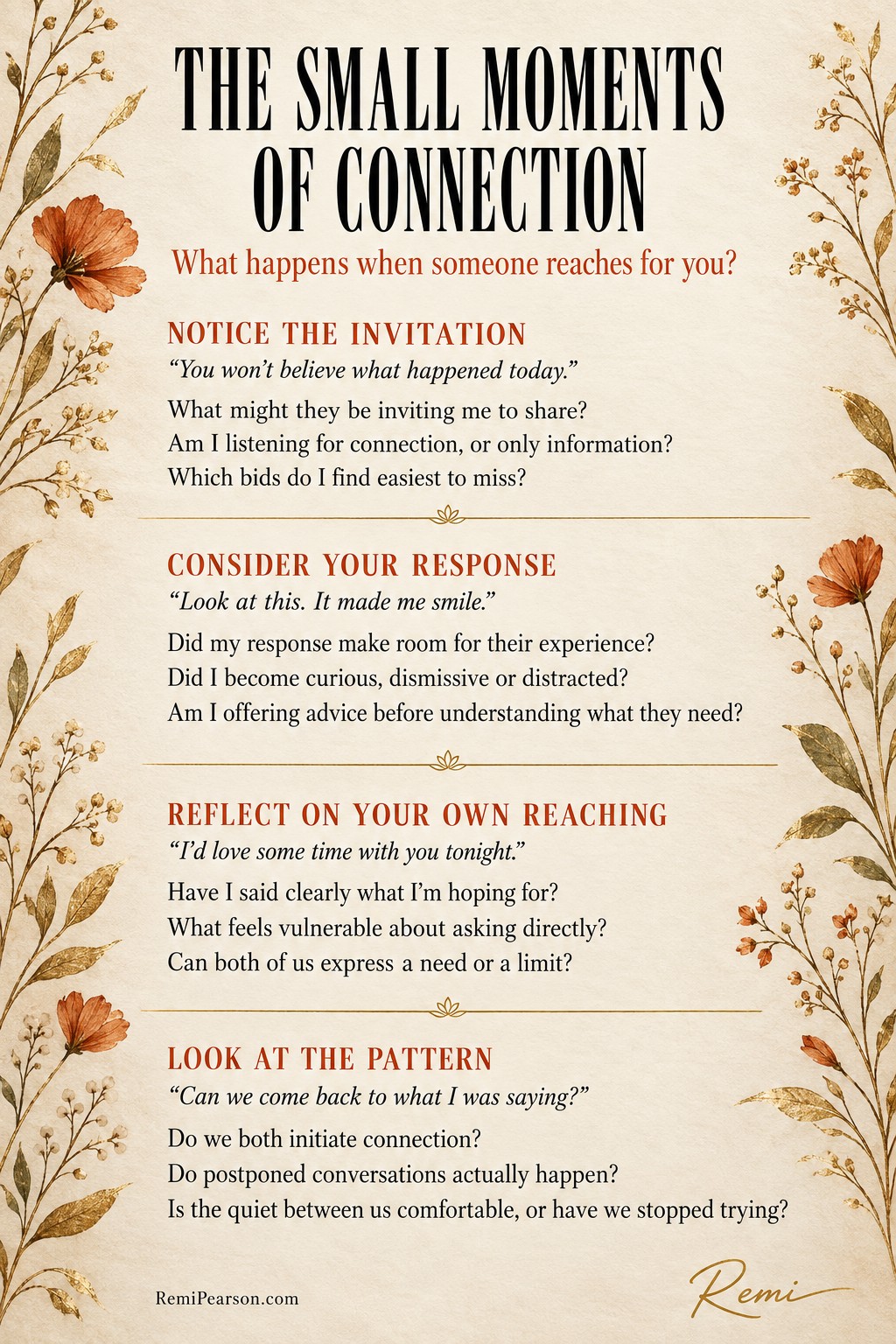

What Are Emotional Bids? How Small Moments Build Connection
How to recognise the small invitations through which we seek connection, and respond without becoming endlessly available.
Imagine Kate coming home after a difficult day. She puts her bag down and tells her partner, James, “You won’t believe what happened in the meeting.” He is looking at his phone. “Hang on,” he says, finishing a message. A few minutes later, he asks what they’re doing for dinner. Kate says nothing about the meeting. Later, when he notices she is quiet, she tells him she’s tired. He assumes she needs space. She wonders why he never seems interested in what happens to her.
Neither has quite understood the moment they missed. Kate was reaching for him, and James didn’t return to the conversation. This article explores emotional bids, the small invitations through which we seek connection, and how to recognise and respond to them. We’ll look at what repeated missed bids can cost a relationship, how to communicate more clearly and how to remain responsive without becoming endlessly available.
What Is an Emotional Bid?
An emotional bid is an attempt to connect with another person. It may seek attention, affection, shared enjoyment or support. Sometimes it is direct: “Can we talk? I’ve had a difficult day.” Sometimes it is a passing comment, a gesture or an invitation to look at something together.
John Gottman and Joan DeClaire make bids a central idea in The Relationship Cure, exploring how we initiate connection and respond when someone reaches towards us (Gottman and DeClaire, 2002).
A bid might sound or look like:
- “Look at this photo.”
- “I’m nervous about tomorrow.”
- A hand reaching for yours.
- “Do you remember that little café we found?”
- “Would you like to come for a walk?”
- Someone sharing something they are proud of.
The subject can be ordinary while the invitation matters. A person showing you a photograph may simply want to share a moment of enjoyment.
A useful coaching question: What might this person be inviting me to share with them?
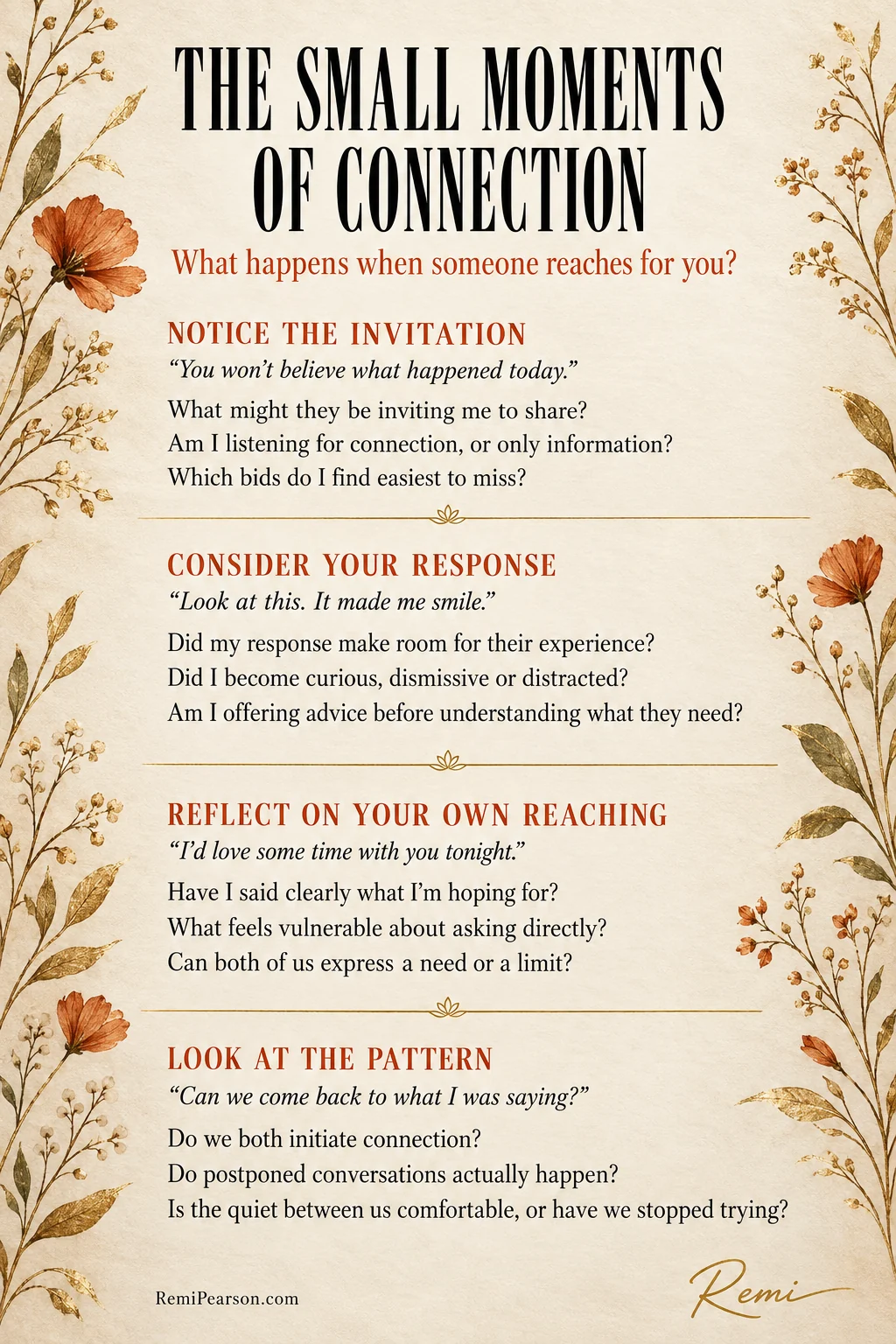
Why Do Emotional Bids Matter?
Connection needs opportunities to become an experience. We may know someone loves us while still longing to feel their interest in the details of our lives.
Research by Laurenceau, Barrett and Pietromonaco examined intimacy in everyday interactions and supported the role of both disclosure and perceived partner responsiveness. Feeling that the other person responds to us matters alongside what we reveal (Laurenceau, Barrett and Pietromonaco, 1998).
Sue Johnson’s Hold Me Tight similarly explores emotional connection through an attachment lens, helping couples recognise difficult patterns and reshape important moments between them (Johnson, 2008).
We do not have to make every exchange profound. Often, the opportunity is much simpler … look up, listen and allow something that matters to the other person to matter to you for a moment.
What Happens When Bids Keep Getting Missed?
One missed comment does not tell us everything about a relationship. People become distracted, tired or absorbed in something else. The pattern deserves more attention than an isolated incident.
Repeatedly reaching without receiving a response can leave someone:
- Less willing to share: they begin keeping experiences to themselves.
- Lonely in company: practical contact continues while emotional contact diminishes.
- Uncertain about their importance: they question whether their interests or difficulties matter.
- More frustrated when asking: a gentle invitation may become a complaint.
- Less hopeful about connection: another attempt feels unlikely to lead anywhere.
In Why Do Relationships Trigger Me So Much?, I explore how another person’s availability can activate protective responses. I also emphasise assessing the present relationship, including the care and reciprocity it actually offers (Pearson, n.d.c).
Ask yourself: Have they become quieter because they feel settled, or because sharing no longer feels worthwhile?
The Three Ways We Respond to Emotional Bids
Gottman’s framework describes turning towards, turning away and turning against a bid. These distinguish a responsive exchange from one that misses or actively rejects the invitation (Gottman and DeClaire, 2002).
Using Kate’s comment as an example:
| Response | What it might sound like |
|---|---|
| Turning towards | “What happened? You sound upset.” |
| Turning away | Continuing with the phone, then changing the subject. |
| Turning against | “Can you stop bringing work drama home?” |
James could also respond with a limit:
“I want to hear. I need to finish this message first, then I’ll put my phone away.”
The response becomes meaningful when he returns. A warm promise followed by no engagement still leaves Kate waiting.
1. Notice the Invitations Already Happening
Start with ordinary observation. What does the person share? When do they approach you? Are there moments when they pause, perhaps hoping you will ask more?
You do not need to interpret every action as a hidden message. Curiosity can help you clarify what you have noticed.
Try:
- “You sound pleased. What happened?”
- “Would you like to tell me more?”
- “Was that difficult for you?”
- “Did you want some help, or someone to listen?”
A coaching question: Which kinds of bids do I notice easily, and which do I tend to overlook?
You might respond readily to practical requests while becoming less available around sadness. That is something useful to recognise.
2. Respond to the Person Before Solving the Problem
Kate may eventually want advice about the meeting. First, she may want James to understand why it affected her.
A quick solution can miss that invitation. “Just speak to your manager” might be sensible advice, yet arrive before Kate has finished explaining.
Try acknowledging what you hear, then checking what would help:
“That sounds frustrating. Do you want to talk it through, or think about what to do next?”
My Self-Esteem Triad connects emotions, emotional needs and boundaries. It offers a way to consider the experience being expressed while keeping responsibility clear (Pearson, n.d.a).
Have you considered whether your impulse to fix things is helping the person, or helping you escape the discomfort of listening?
Holding Space Without Rescuing or Disappearing explores this capacity.
3. Make Your Own Bids Easier to Understand
We can ask for more responsiveness while also making our invitations clearer. Hints are easy to miss, particularly when people are occupied.
Consider these changes:
“You’re always busy” → “I’d like some time with you tonight. Can we sit together after dinner?”
“Nobody cares what happens to me” → “Something difficult happened today, and I’d appreciate you listening.”
Going quiet → “I felt disappointed when we didn’t return to what I was saying.”
Directness gives the other person better information. Their response then helps you assess what is available.
A coaching question: What do I want them to understand that I haven’t actually said?
4. Keep Room for Boundaries and Reciprocity
Responding to bids does not require constant availability. You can care and still need concentration, rest or time alone.
Communicate what is possible:
“I can’t give this proper attention while I’m working. Can we talk when I finish at six?”
Then honour the agreement.
My article Why Do I Lose Myself in Relationships? explores the cost of preserving connection by repeatedly dismissing our own experience (Pearson, n.d.b). A responsive relationship needs room for both people, including their limits.
Ask yourself:
- Do we both initiate connection?
- Can we both express a limit?
- Do postponed conversations actually happen?
- Is one person carrying most of the effort?
If you want to explore the patterns involved, begin with the free Attachment Style Assessment or visit Attachment or Love?.
5. Return to a Bid You Missed
You can notice afterwards and reopen the opportunity.
James might say:
“You started telling me about the meeting, and I never came back to it. I’m sorry. Would you still like to tell me?”
Kate may want to talk, or she may no longer want to at that moment. He can respect either answer while changing how he responds next time.
For more on following an apology with action, read Why Saying Sorry Isn’t Enough: How to Repair a Relationship. You can also register your interest in Conflict, Repair and Harmony.
A Small Practice for This Week
Choose one ordinary opportunity to be more available. Put the phone aside during a conversation, return to something you postponed or ask about an experience the person mentioned earlier.
Afterwards, reflect:
- What did I notice?
- Did I check what they wanted rather than assume?
- Did my response create room for them?
- Was there room for me too?
The Five Paths to a Healthy Relationship offers a broader starting point for exploring relationship patterns. The Love Without Losing Yourself bundle brings the relationship programs together.
Kate’s evening could have unfolded differently with a small act of follow-through. James finishes the message, puts the phone down and asks about the meeting. She tells him. Nothing dramatic has happened, but an experience she might have carried alone has found a place between them.
Further resources
- How to Support Someone You Love Without Losing YourselfArticle
- Why Do Relationships Trigger Me So Much?Article
- Why Do I Lose Myself in Relationships?Article
- Why Saying Sorry Isn’t Enough: How to Repair a RelationshipArticle coming soon
- The Five Paths to a Healthy RelationshipAUD $29
- Holding Space Without Rescuing or DisappearingAUD $29 · Intermediate level
- Attachment or Love?Free · Introduction level
- Conflict, Repair and HarmonyAUD $29 · Advanced level
- Love Without Losing YourselfBundle investment AUD $97
References
- Gottman, J.M. and DeClaire, J. (2002). The relationship cure: A five-step guide to strengthening your marriage, family, and friendships. New York: Harmony Books.
- Johnson, S. (2008). Hold me tight: Seven conversations for a lifetime of love. New York: Little, Brown and Company.
- Laurenceau, J.-P., Barrett, L.F. and Pietromonaco, P.R. (1998). Intimacy as an interpersonal process: The importance of self-disclosure, partner disclosure, and perceived partner responsiveness in interpersonal exchanges. Journal of Personality and Social Psychology, 74(5), pp. 1238–1251. doi: 10.1037/0022-3514.74.5.1238.
- Pearson, R. (n.d.a). How do you build self-esteem that lasts? The Self-Esteem Triad. Available at: https://www.remipearson.com/ideas-models/self-esteem-triad (Accessed: 5 October 2026).
- Pearson, R. (n.d.b). Why do I lose myself in relationships? Available at: https://www.remipearson.com/articles/the-moment-you-leave-yourself (Accessed: 5 October 2026).
- Pearson, R. (n.d.c). Why do relationships trigger me so much? Available at: https://www.remipearson.com/articles/why-relationships-trigger-me (Accessed: 5 October 2026).
 Talk to Remi