
How to Set Boundaries Without Feeling Guilty
What guilt can tell you, the six kinds of boundary, and how to hold a limit while staying connected.
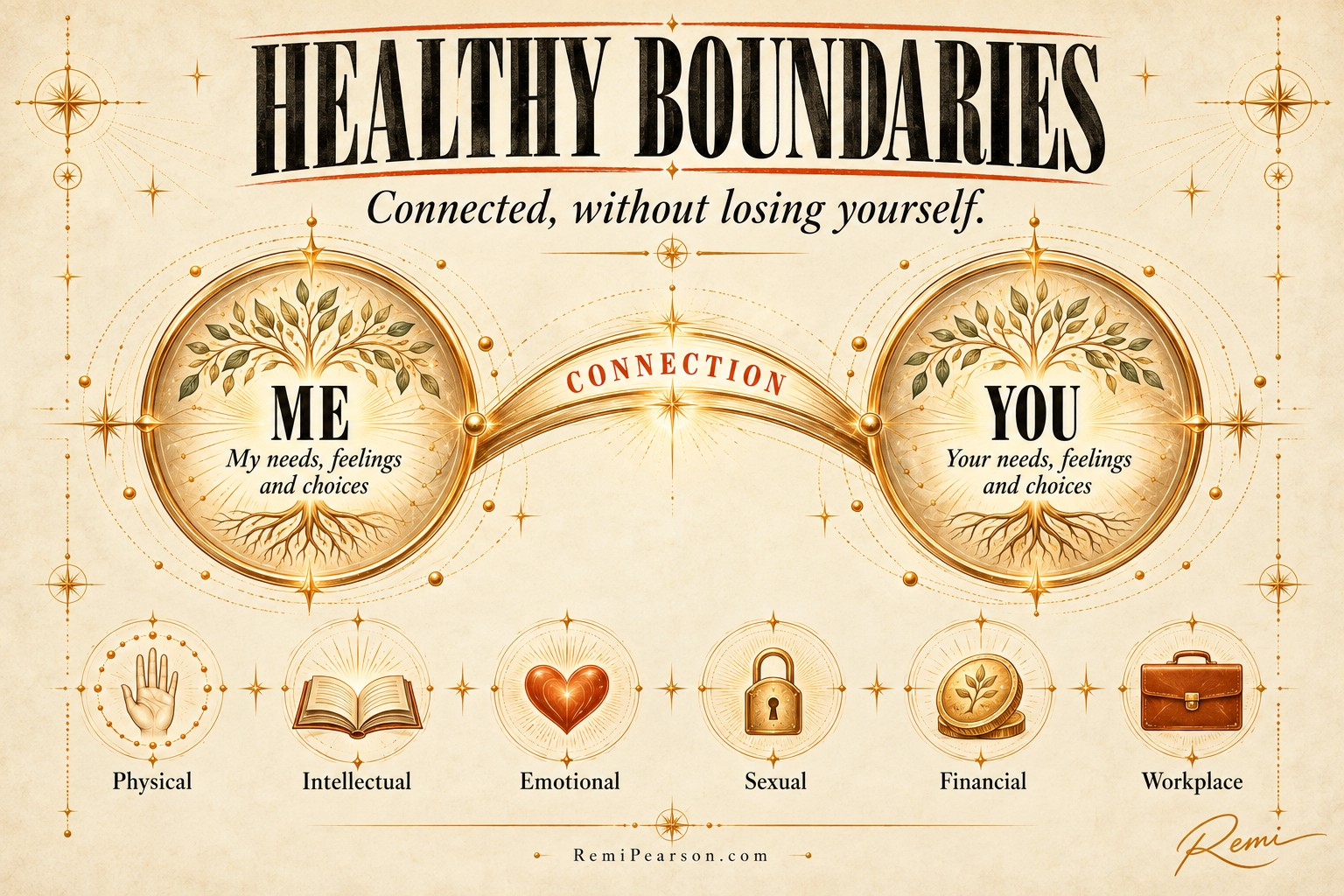
A boundary defines the limits of your participation in a relationship. It establishes a distinction between your needs, choices and responsibilities and another person’s, allowing you to remain connected without disappearing into what they want from you. You can care about someone and still have preferences, limits and a life that belongs to you.
Setting boundaries without feeling guilty begins with understanding what the guilt means. You may have acted unfairly and need to make a repair. You may also have expressed a perfectly reasonable limit and feel uncomfortable because someone is disappointed. Learning to distinguish those experiences matters, because another person’s disappointment cannot be the only measure of whether you have done something wrong.
What are the different types of boundaries?
Healthy boundaries concern more than saying no. They help us recognise what we consent to and where we need a limit:
- Physical boundaries: personal space, touch, privacy and access to your body or home.
- Intellectual boundaries: your right to hold opinions, question ideas and disagree without accepting ridicule.
- Emotional boundaries: expressing your feelings and caring about someone else’s without taking responsibility for managing their entire emotional experience.
- Sexual boundaries: choosing whether, when and how you participate in sexual contact, with consent that can be withdrawn.
- Financial boundaries: how your money is spent or shared, what you lend and which obligations you accept.
- Workplace boundaries: your availability, workload, responsibilities and acceptable treatment.
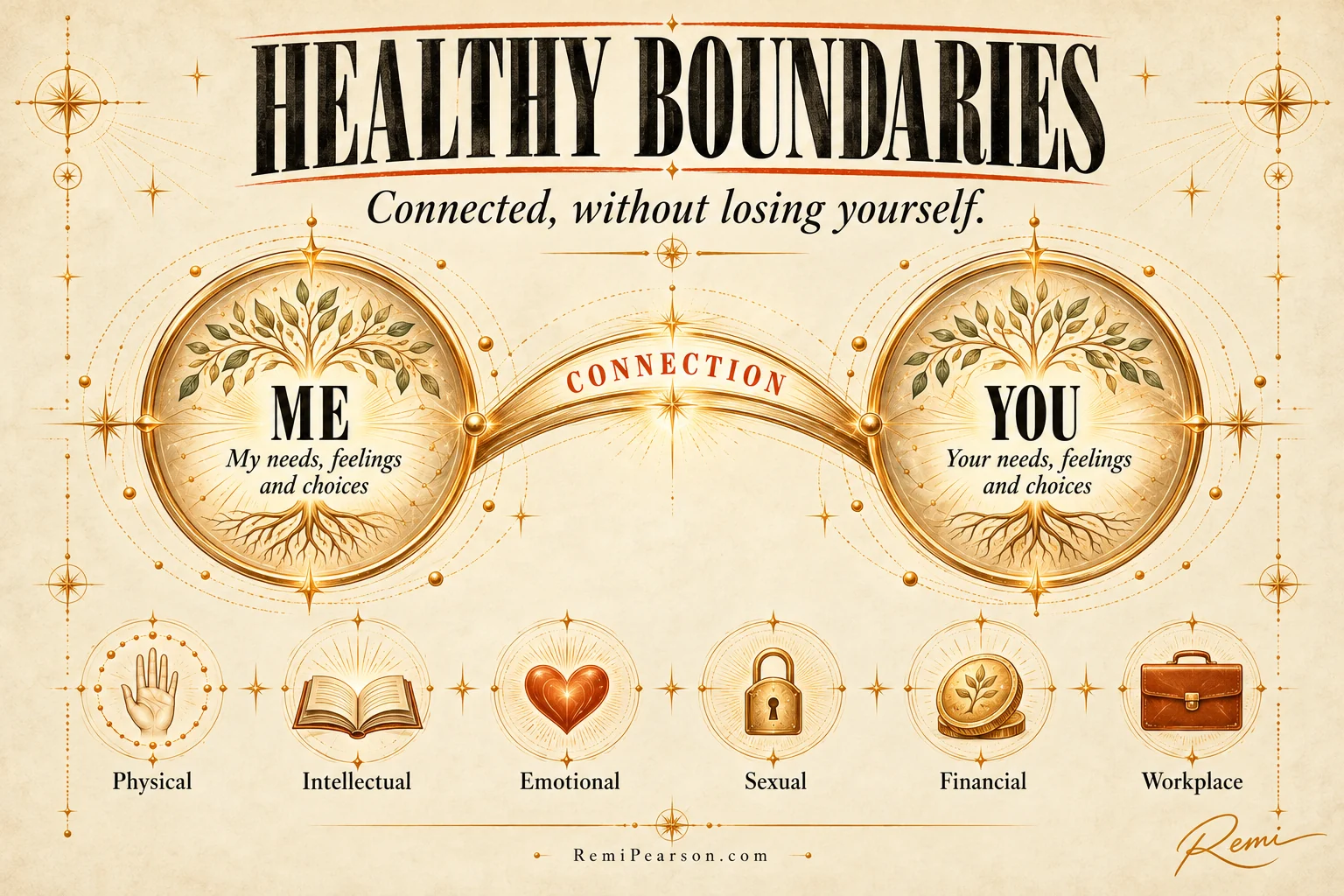
Nedra Glover Tawwab identifies physical, sexual, intellectual, emotional, material and time boundaries in Set Boundaries, Find Peace. Financial and workplace boundaries apply these principles to particular situations.
Why are healthy boundaries important?
Healthy boundaries make relationships clearer. Someone can understand you more accurately when you express what works for you, rather than agreeing and hoping they notice your reluctance. Your commitments can also reflect your actual capacity. Wanting to help does not necessarily mean you have the time or energy to provide everything being asked.
In my Self-Esteem Triad, boundaries sit alongside emotional needs and emotions. These capacities inform one another: you recognise what you need, notice what you feel and establish limits that allow you to take care of yourself while remaining connected. At the centre is the lived experience of being worthy, lovable and enough. Learn more about the Self-Esteem Triad.
What happens when you don’t have healthy boundaries?
The cost may appear gradually. You keep agreeing, then start dreading another request. You avoid someone’s calls because every conversation seems to create another obligation. Eventually, you feel resentful about arrangements the other person may believe you freely accepted.
Tawwab describes overwhelm, resentment and avoidance as common signs of boundary difficulties. Resentment gives you something to investigate: perhaps a commitment needs renegotiating, or a need has remained unspoken. It does not automatically establish who is at fault.
Another cost is confusion about responsibility. Henry Cloud describes how people can feel responsible for someone else’s disappointment and happiness. When keeping everyone comfortable becomes your ongoing assignment, recognising your own preferences can become difficult. Expressing them may feel almost disloyal.
What is the difference between a boundary and a request?
A request asks another person to change their behaviour. A boundary establishes a limit you will uphold through your own choices.
A boundary has a practical consequence when it is crossed. That consequence needs to be relevant and within your control; it might involve ending a conversation, declining additional work or restricting access. It does not need to be punitive. Melissa Urban’s The Book of Boundaries connects repeated disregard for a limit with action to uphold it.
| Request | Boundary with follow-through |
|---|---|
| “Please don’t shout at me.” | “If the shouting continues, I’ll end the conversation. We can try again later.” |
| “I’d prefer you checked before visiting.” | “I need visits arranged beforehand. If you arrive unannounced, I may not be available.” |
| “Please stop sending evening work requests.” | “I answer routine work messages during business hours. Evening messages will wait until the next working day.” |
Requests are useful. You can ask for cooperation and explain your limit together. The difficulty comes when you repeatedly ask someone to stop, they continue, and you have no plan for what you will do next.
Why do I feel guilty when I say no?
Cloud and Townsend describe how learning that saying no is unacceptable can produce habitual compliance. If being agreeable helped you maintain connection, changing that pattern may feel risky even when your decision is reasonable. They recommend examining where those guilt messages originated.
Tawwab also questions the expectation that a good decision should feel good immediately. Discomfort can accompany a necessary limit. You can remain curious about the feeling without treating it as proof that you should reverse your decision.
How do you set healthy boundaries when guilt appears?
Start with the situation in front of you. What can you genuinely offer? Have you already made a commitment? What would agreeing cost you? Give yourself enough time to answer before automatically accommodating the other person.
Then communicate clearly. A brief explanation can provide useful context, but repeatedly defending your right to have a limit can turn the conversation into a negotiation you never intended. Urban addresses this tendency to apologise, minimise and justify.
Practise the conversation with someone supportive. Cloud and Townsend recommend supportive relationships while learning boundaries, and a small randomised study involving 40 adults found that practising refusal improved that specific skill at three-month follow-up. The evidence is preliminary, but it supports rehearsing the behaviour you find difficult.
Follow through on the limit you have communicated, while remaining willing to listen. Healthy boundaries allow appropriate closeness and flexibility; they also require respecting another person’s no. You can reconsider when there is good reason without abandoning your position simply to relieve discomfort.
If you understand boundaries intellectually but lose access to them when someone becomes disappointed, the Self-Esteem Triad offers a way to explore what happens between recognising your needs and acting on them. Explore the Self-Esteem Triad and its guided introduction.
You can acknowledge another person’s feelings and take responsibility for your impact without making their immediate approval the condition for having a limit. That leaves room for a relationship in which both people can be present, including when they want different things.
Further resources
- How to Support Someone You Love Without Losing YourselfArticle
- Why Do I Lose Myself in Relationships?Article
- What Are Emotional Bids? How Small Moments Build ConnectionArticle
- Self-Esteem from the Inside OutFree · Introduction level
- Holding Space Without Rescuing or DisappearingAUD $29 · Intermediate level
- Love Without Losing YourselfBundle investment AUD $97
References
- Cloud, H. and Townsend, J. (2017) Boundaries: When to Say Yes, How to Say No to Take Control of Your Life. Updated and expanded edition. Zondervan.
- Pearson, R. (2026) ‘How do you build self-esteem that lasts? The Self-Esteem Triad’. Available at: https://www.remipearson.com/ideas-models/self-esteem-triad (Accessed: 5 October 2026).
- Probst, T., Geib, C., Güroff, E. and Mühlberger, A. (2017) ‘Training the social skill “being able to demand” vs. training the social skill “being able to say no”. A randomized controlled trial with healthy individuals’, Journal of Behavior Therapy and Experimental Psychiatry, 57, pp. 1–5. https://doi.org/10.1016/j.jbtep.2017.01.006.
- Tawwab, N.G. (2021) Set Boundaries, Find Peace: A Guide to Reclaiming Yourself. TarcherPerigee.
- Urban, M. (2022) The Book of Boundaries: Set the Limits That Will Set You Free. The Dial Press.
 Talk to Remi